Showing posts with label sustainable. Show all posts

Sunday, November 9, 2014

'Forest Man’ From Kerala, India

Almost 40 years ago, Abdul Kareem bought five acres of land in what was then a sparsely inhabited area in Kasargod district in Malabar, northern Kerala. As a travel agent his job involved travelling around five days a week. He thought he would use the land as a get-away to relax once in a while when he managed to get time off from his hectic work
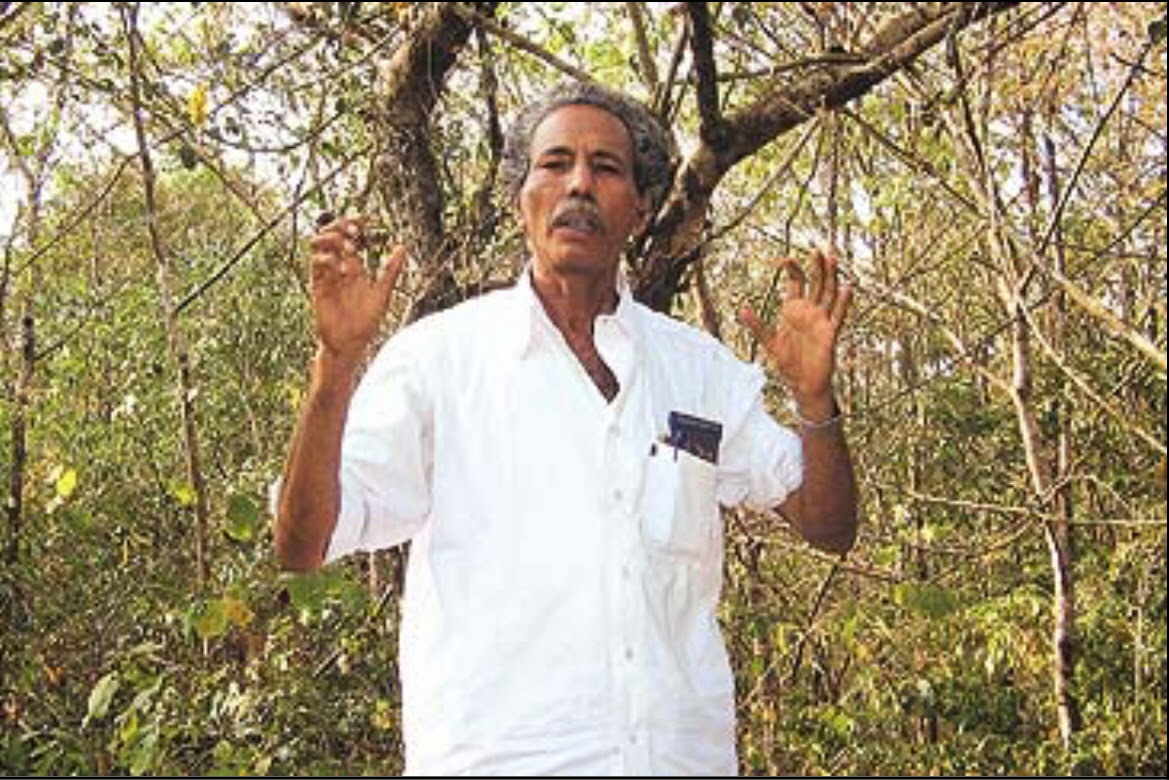
Shortly after, he bought some more land, and in just a few years, his 30-odd acres were transformed into a thick, vibrant forest, making Abdul Kareem one of the few people in India to have actually created a forest—and that too almost single-handedly!

Abdul Kareem hadn’t bought the land in order to conserve the environment or do something about global warming, but in a while, as his forest grew, he turned into a passionate Nature lover, with his efforts bringing him numerous awards and much appreciation. ‘Caring for Nature is one major mission of my life,’ this enthusiastic, cheerful 68 year-old man says.

Abdul Kareem was born in a village near the sea. ‘There was no forest there, but you could see hills and jungles far away in the distance. As a child, I would fantasize about forests—they seemed so enchanting! Even then I loved plants, and I planted many saplings around my home.’ he says.

When Abdul Kareem bought the land, much of it was bare. The thick layer of laterite rock that covered much of the area did not allow for much vegetation to survive. But that did not deter this intrepid man. When he planted a hundred saplings, hoping to green the land, and only one survived (the rest wilted away in the heat), he did not give up. ‘I didn’t lose hope. I was inspired by the one sapling that survived!’ he relates. The next year he planted 500 saplings, and they all flourished!

Abdul Kareem lovingly tended to the saplings for a year, and after that they took care of themselves, with no human interference—not even needing to be watered or fertilized by human hands. ‘I let the forest grow naturally,’ he says. In a few years, the land was bursting with greenery, a dense forest hosting almost 300 plant species. Birds attracted by the foliage did their bit to help the forest grow by dropping seeds that they had picked up elsewhere.

Trudging along a mud-path that snakes its way through the forest, for a moment you might think you are in the middle of a wild life sanctuary, so dense is it! Abdul Kareem identifies certain plants as we move ahead. ‘This is an orchid!’ he says with childlike enthusiasm, ‘and that’s a shampoo tree! You can make shampoo out of it! Can you imagine! And that, there, is a medicinal plant!’

The hills around the forest were probably once under thick forest cover and home to numerous wild animals. Now, almost all the land is under cultivation—mainly cash crops like rubber—and the wildlife has probably almost completely disappeared. Abdul Kareem’s forest, however, attracts several species: wild boars, jackals, and, of course, snakes, butterflies, various insects and numerous birds, including peacocks.

We walk up to a little pond, and Abdul Kareem insists that I sample the water. ‘Natural water!’ he says gleefully. When I hesitate, he insists, ‘It’s very, very clean!’ He explains how by allowing the land to regenerate and turn into a forest, the water table in the area, which had sunk very low, has risen considerably. The temperature in and around the forest, he adds, is substantially less than elsewhere in the area. ‘See how even a little forest can make a difference to global warming!’ he exclaims.

As we head to the simple little cottage in the middle of the forest where he and his wife live, I ask Abdul Kareem if he makes any money out of the forest. ‘None at all. Earning from it is not my intention,’ he replies. ‘I don’t sell anything that comes from the forest.’

This large-hearted man allows his neighbours to draw water from the wells and ponds in the forest free of cost. For people who might want to pluck a few leaves or fruits of the medicinal plants that the forest abounds in he doesn’t charge anything.

‘A man from a top hotel chain once approached me. He wanted to buy the land to convert it into a hotel or an ayurvedic resort. He would have offered a huge sum of money, and even said I could remain here, in a small portion of the land, but I declined,’ Abdul Kareem says. ‘Even if you offer to let me stay in the White House, I’d rather stay in my forest! Almost all my children live in the Gulf, and although I occasionally visit them, I can’t get to stay there more than just a few days. After that, I pine to rush back to the forest!’

Land prices in the area have soared in recent years, and the cost of Abdul Kareem’s 32 acres of forest land must run into several crores of rupees now. Yet, the man is happy not earning any money from the forest, living in his simple home and making a living as a small travel agent and managing a petrol pump.

Truly amazing, isn’t it?

After taking me around the forest, Abdul Kareem says, ‘Spend the night here if you like. There’s a room here where you can stay. You can learn even more.’

The offer does seem tempting. For a moment, I imagine sitting in the verandah as the sun goes down, listening to frogs croaking and crickets chirping, and maybe even spotting a jackal on the prowl and then waking up to the plaintive cry of a peacock. But the auto-rickshaw I came in is waiting, and so I give Abdul Kareem a parting hug.

‘Your forest is truly amazing, and so are you!’ I say. More


Monday, May 12, 2014

Architecture for the 21st Century with Michael Reynolds

What do beer cans, car tires and water bottles have in common?

Not much unless you're renegade architect Michael Reynolds, in which case they are tools of choice for producing thermal mass and energy-independent housing. For 30 years New Mexico-based Reynolds and his green disciples have devoted their time to advancing the art of "Earthship Biotecture" by building self-sufficient, off-the-grid communities where design and function converge in eco-harmony.

However, these experimental structures that defy state standards create conflict between Reynolds and the authorities, who are backed by big business. Frustrated by antiquated legislation, Reynolds lobbies for the right to create a sustainable living test site. While politicians hum and ha, Mother Nature strikes, leaving communities devastated by tsunamis and hurricanes. Reynolds and his crew seize the opportunity to lend their pioneering skills to those who need it most.


Shot over three years and in four countries, Garbage Warrior is a timely portrait of a determined visionary, a hero of the 21st century...


Friday, April 11, 2014

The Ohio State University presents Jeffrey Sachs


On April 4, 2014, Jeffrey Sachs spoke at Ohio State University on "The Age of Sustainable Development." Professor Sachs's lecture was both the Keynote Address for the COMPAS Program's Spring Conference and the inaugural Provost's Discovery Themes Lecture. Introductory comments are presented by Michael Neblo ofOSU's Political Science Department, Executive Dean and Vice Provost, David Manderscheid, and Executive Vice President and Provost, Joseph Steinmetz. After his lecture, Professor Sachs was joined on stage by Professors Elena Irwin and lan Sheldon, both of Ohio State's Agricultural, Environmental, and Development Economics Department for a discussion that was moderated by Michael Neblo.


Links:

OSU COMPAS Program: http://compas.osu.edu

OSU Discovery Themes Initiative: http://discovery.osu.edu

Thursday, December 27, 2012

Rhamis Kent Permaculturist, on Islam & Earth Repair

In our first podcast, Krystina sits down with Rhamis Kent, a Permaculture consultant who travels all over the Middle East and North Africa advising governments and organizations on how they can engage in ecosystem restoration in order to increase biodiversity and sustain plant, animal, and human life.

In this interview, they discuss his recent article entitled “Restoring the Amanah Through Earth Repair: Islam, Permaculture, and Ecosystem Restoration Work.” Download the podcast here.


Krystina Friedlander: I want to start by asking you about Ibn Khaldun, a Tunisian historiographer who lived in the 14th century. You wrote that he warned people about the “pleasures of civilization.” What might he say about what we’re seeing now in terms of environmental degradation and industrialization?

Rhamis Kent: Well, I think it’s a proof to what he’s pointing to in his work. The Muqaddimah is a book where he’s examining the causes for the rise and fall of civilizations. As far as what he means by the “pleasures of civilization,” I think the easier things become, the more convenient our day-to-day living becomes, the more distanced we are from really understanding what it is that we need in order to sustain our lives, the more distance we have between ourselves and the natural world. There’s this artificial separation, a misunderstanding of exactly where we are oriented within that order. It creates a type of lethargy where you become very disoriented, and you don’t realize the impact your actions are having on the things you actually need in order to survive. Ibn Khaldun, he called it very accurately, and we’re seeing the advanced stages of some of the types of decline that he’d spoken of in his work. More


Wednesday, September 12, 2012

Strengthening the Institutional Framework for Sustainable Development (IFSD)

Strengthening the Institutional Framework for Sustainable Development (IFSD)

UNITAR E-Learning Course

5 November – 14 December 2012


Dear Colleagues,


The United Nations Institute for Training and Research (UNITAR) is pleased to announce the delivery of the e-learning course, “Strengthening the Institutional Framework for Sustainable Development”, which will take place from 5 November – 14 December 2012. Participants will learn about the current institutional architecture concerned with sustainable development, emerging policy issues requiring an effective institutional response, and political challenges to advance reform as reflected in the negotiations leading up to, and during the Rio+20 Conference.


Please feel free to disseminate information about this course through your networks, and do not hesitate to contact us (envgov@unitar.org) should you need any further information.


Sincerely,


The UNITAR Environmental Governance Programme Team


Background

Since the 1972 Stockholm Conference on the Human Environment, the institutional framework to address environment and sustainable development challenges has witnessed a steady growth in the number of institutions and agreements, with more than 500 multilateral environmental agreements currently in existence. Yet the continuing deterioration in the natural resource base and ecosystems, global climate change and persistent poverty raise doubts about the capacity of the institutional framework to address these challenges. The 2012 UN Conference on Sustainable Development (Rio+20) reaffirmed the need to strengthen the institutional framework for sustainable development (IFDS) and initiated specific action to foster more effective and coherent institutional responses.


Target Groups

The course targets groups and individuals that are interested in obtaining a general understanding about the theme of international sustainable development governance and latest developments. They include:

• Civil servants in national Ministries, provincial departments and local authorities

• Diplomats from Permanent Missions and Ministries of Foreign Affairs

• Environmental managers in private sector and civil society organizations

• Faculty, researchers and students

• Interested citizens


Learning Objectives

Participants will learn about the strengths and weaknesses of the current institutional architecture concerned with sustainable development, key emerging policy issues requiring an effective institutional response, and the political challenges to advance reform as reflected in the negotiations leading up to, and during the Rio+20 Conference.


After completing the course, participants will be able to:

• Explain sustainable development challenges demanding effective international institutions

• Outline key milestones of developing and reforming international institutions concerned with sustainable development

• Chart and analyze the current international IFSD

• Recognize linkages between international, national and sub-national sustainable development governance

• Analyze key policy issues relevant for the Rio+20 negotiations and beyond

• Assess options to strengthen the institutional framework for sustainable development


Methodology

The course pedagogy is adapted to professionals in full-time work. Participants are provided with the opportunity to learn through various experiences: absorb (read); do (activity); interact (socialize); and reflect (relate to one’s own reality). The total number of learning hours is 40 over a 6 week period. During weeks 1-5 the reading of an e-book is complemented by a range of learning activities and experiences that include interactive exercises, discussion forums, and an applied case study. Week 6 is reserved for wrap-up and completing course assignments.


Course Fee and Registration

The course participation fee is 600 USD. A small number of full/partial fellowships are available for participants from developing countries working in the public sector, academia or non-profit organizations. Priority for fellowships will be given to applicants from Least Developed Countries (LDCs).


Register at: http://www.unitar.org/event/strengthening-institutional-framework-sustainable-development-ifsd


For details please contact the UNITAR Environmental Governance Programme at: envgov@unitar.org


Registration Deadline: 28 October 2012.


Friday, August 31, 2012

World Forest Area Still on the Decline

Forests provide many important goods, such as timber and paper. They also supply essential services—for example, they filter water, control water runoff, protect soil, regulate climate, cycle and store nutrients, and provide habitat for countless animal species and space for recreation.

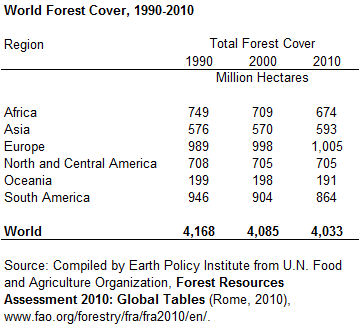
Forests cover 31 percent of the world’s land surface, just over 4 billion hectares. (One hectare = 2.47 acres.) This is down from the pre-industrial area of 5.9 billion hectares. According to data from the U.N. Food and Agriculture Organization, deforestation was at its highest rate in the 1990s, when each year the world lost on average 16 million hectares of forest—roughly the size of the state of Michigan. At the same time, forest area expanded in some places, either through planting or natural processes, bringing the global net loss of forest to 8.3 million hectares per year. In the first decade of this century, the rate of deforestation was slightly lower, but still, a disturbingly high 13 million hectares were destroyed annually. As forest expansion remained stable, the global net forest loss between 2000 and 2010 was 5.2 million hectares per year.

Global rates of deforestation do not capture the full damage done to the world’s forests. Forest degradation from selective logging, road construction, climate change, and other means compromises the health of remaining forests. Each year the world has less forested area, and the forests that remain are of lower quality. For example, replacing natural old-growth forests with a monoculture of an exotic species greatly reduces biodiversity.

The spread of planted forests has been accelerating, rising from an expansion of 3.7 million hectares annually in the 1990s to 4.9 million hectares annually the following decade. Planted forests now cover some 264 million hectares, comprising nearly 7 percent of total forest area. Plantations now have the potential to produce an estimated 1.2 billion cubic meters of industrial wood each year, about two thirds of current global wood production. Where forests have already been cleared, plantations can alleviate the pressure on standing forests.

Forests are primarily threatened by land clearing for agriculture and pasture and by harvesting wood for fuel or industrial uses. In Brazil—which has lost 55 million hectares since 1990, an area three fourths the size of Texas—land clearing for farms and ranches is the big driver. Home to the Amazon rainforest, Brazil contains 13 percent of the world’s forested area, second only to Russia’s 20 percent. Between 2000 and 2010, Brazil lost 2.6 million hectares of forest each year, more than any other country. Brazil is trying to reduce deforestation rates 80 percent from the 1996–2005 average by 2020 and has in fact seen a large drop in deforestation in recent years. But rising beef, corn, and soybean prices are likely to pressure the government to weaken its forest protection, further threatening the world’s largest rainforest. More


Wednesday, August 29, 2012

Message from Prince Charles to the IUCN World Conservation Congress

HRH the Prince of Wales addresses a session of the IUCN World Conservation Congress on the urgent need of bringing agriculture and conservation back together. "There is much to learn if we let nature be our guide", says Charles, Prince of Wales.

Thursday, August 23, 2012

Permaculture in Palestine - A green revolution

It was a brisk, rather harried morning when my husband, photographer Christopher List, and I set off on a trip to delve deeper into the relatively unheard of phenomenon of permaculture.

It felt like only yesterday when we’d announced to friends and family that were were going to Palestine, to study a 14-day intensive permaculture course. After discovering some of the principles of permaculture on a recent trip to SA, I knew we were in for a gruelling, yet worthwhile experience.

Relatively new to the Middle East, with permaculture projects in Saudi Arabia and in the Jordan River Valley, permaculture simply means working nature to produce a sustainable garden design, and can be used by farmers and gardeners alike.

In fact, permaculture principles can be applied to community gardens, rooftop gardens, small balconies or even just to help your pot plants flourish. Not only applicable to growing things, permaculture includes reusing and recycling as well as renewable energy. It even extends to sustainable housing. In a nutshell, permaculture entails a holistic, sustainable way of life. More


Sunday, July 22, 2012

Earthships: Sustainable and naturally temperature controlled homes

The arid New Mexico desert is home to a cluster of unusual buildings called 'Earthships' -- environmentally-sustainable, self-sufficient homes made using recycled and natural materials.

An earthship is a type of passive solar house made of natural and recycled materials. Designed and marketed by Earthship Biotecture of Taos, New Mexico, the homes are primarily constructed to work as autonomous buildings and are generally made of earth-filled tires, using thermal mass construction to naturally regulate indoor temperature. They also usually have their own special natural ventilation system. Earthships are generally off-the-grid homes, minimizing their reliance on public utilities and fossil fuels. Earthships are built to utilize the available local resources, especially energy from the sun. For example, windows on sun-facing walls admit lighting and heating, and the buildings are often horseshoe-shaped to maximize natural light and solar-gain during winter months. The thick, dense inner walls provide thermal mass that naturally regulates the interior temperature during both cold and hot outside temperatures.

Internal, non-load-bearing walls are often made of a honeycomb of recycled cans joined by concrete and are referred to as tin can walls. These walls are usually thickly plastered with stucco. http://en.wikipedia.org/wiki/Earthship

More information:

This type of construction would be perfect in any desert climate. For example in Pakistan where temperatures are hitting 49 degrees celcius. Editor

Saturday, July 21, 2012

Permaculture Keyline Water Systems

Permaculture seed wizard Don Tipping takes us on a 10 minute animated tour of the epic Seven Seeds Farm in the Siskiyou Mountains of Southern Oregon, USA. The farm was designed using Permaculture Principles and Keyline patterning. We follow the water system from top to bottom, and then the amazing downstream effects are revealed. This video was produced by Andrew Millison as part of the course content for his online Advanced Permaculture Design Practicum, Hort 485, taught through the Horticulture department at Oregon State University's Extended Campus: www.beaverstatepermaculture.com.

This Global Financial Fraud and Its Gatekeepers - by Naomi Wolf

The media's 'bad apple' thesis no longer works. We're seeing systemic corruption in banking – and systemic collusion.

Last fall, I argued that the violent reaction to Occupy and other protests around the world had to do with the 1%ers' fear of the rank and file exposing massive fraud if they ever managed get their hands on the books. At that time, I had no evidence of this motivation beyond the fact that financial system reform and increased transparency were at the top of many protesters' list of demands.

But this week presents a sick-making trove of new data that abundantly fills in this hypothesis and confirms this picture. The notion that the entire global financial system is riddled with systemic fraud – and that key players in the gatekeeper roles, both in finance and in government, including regulatory bodies, know it and choose to quietly sustain this reality – is one that would have only recently seemed like the frenzied hypothesis of tinhat-wearers, but this week's headlines make such a conclusion, sadly, inevitable.


The New York Times business section on 12 July shows multiple exposes of systemic fraud throughout banks: banks colluding with other banks in manipulation of interest rates, regulators aware of systemic fraud, and key government officials (at least one banker who became the most key government official) aware of it and colluding as well. Fraud in banks has been understood conventionally and, I would say, messaged as a glitch. As in London Mayor Boris Johnson's full-throated defense of Barclay's leadership last week, bank fraud is portrayed as a case, when it surfaces, of a few "bad apples" gone astray. More


Friday, July 6, 2012

Regeneration for real on the Ground and in Your Mind

Film of the Bristol Green Week Schumacher Lecture 2012: Regeneration for real on the Ground and in Your Mind (more info below). The other green week films can be found here: www.permanentculturenow.com More on Schumacher here: www.schumacher.org.uk More on Bristol green week: biggreenweek.com Regeneration for Real: on the Ground and in Your Mind. Speakers: Kevin McCloud (Channel 4's Grand Designs), Rob Hopkins (Transition Towns Co-founder) & Tim Smit (Founder of the Eden Project). Tonight's speakers personify regeneration -- bringing new life. Through Kevin's work we experience a continuous flow of innovation in design; Rob has brought us the model of the resilient community, and Tim has created one of the most inspiring projects in the country. More info on the speakers: Kevin McCloud Founder of Hab Housing, Author, Broadcaster and Designer. Kevin is best known for the BAFTA-nominated Grand Designs and the Stirling Prize. In 2009 he won a Prix Italia for his Grand Tour. He has made series about architecture, design and urban planning and is currently filming a series about a shed. In 2006 Kevin formed the development company Hab Housing. In partnership, the company is now building sustainable housing schemes across the West of England and last year completed their first scheme, The Triangle in Swindon, which was televised as a three-part series Kevin's Grand Design on Channel 4 in December. www.habhousing.co.uk Rob Hopkins Rob Hopkins is the co-founder of the Transition <b>...</b>

Wednesday, June 27, 2012

Two Views of Our Future

No previous civilization has survived the ongoing destruction of its natural supports. Nor will ours. Yet economists look at the future through a different lens.

Relying heavily on economic data to measure progress, they see the near 10-fold growth in the world economy since 1950 and the associated gains in living standards as the crowning achievement of our modern civilization. During this period, income per person worldwide climbed nearly fourfold, boosting living standards to previously unimaginable levels. A century ago, annual growth in the world economy was measured in the billions of dollars. Today, it is measured in the trillions. In the eyes of mainstream economists, our present economic system has not only an illustrious past but also a promising future.

Mainstream economists see the 2008–09 global economic recession and near-collapse of the international financial system as a bump in the road, albeit an unusually big one, before a return to growth as usual. Projections of economic growth, whether by the World Bank, Goldman Sachs, or Deutsche Bank, typically show the global economy expanding by roughly 3 percent a year. At this rate the 2010 economy would easily double in size by 2035. With these projections, economic growth in the decades ahead is more or less an extrapolation of the growth of recent decades.


But natural scientists see that as the world economy expanded some 20-fold over the last century, it has revealed a flaw—a flaw so serious that if it is not corrected it will spell the end of civilization as we know it. At some point, what had been excessive local demands on environmental systems when the economy was small became global in scope.

A study by a team of scientists led by Mathis Wackernagel aggregates the use of the earth’s natural assets, including carbon dioxide overload in the atmosphere, into a single indicator—the ecological footprint. The authors concluded that humanity’s collective demands first surpassed the earth’s regenerative capacity around 1980. By 2007, global demands on the earth’s natural systems exceeded sustainable yields by 50 percent. Stated otherwise, it would take 1.5 Earths to sustain our current consumption. If we use environmental indicators to evaluate our situation, then the global decline of the economy’s natural support systems—the environmental decline that will lead to economic decline and social collapse—is well under way. More


Sunday, May 6, 2012

Te Case For Interdependence

The physicist-turned international environmental activist Dr. Vandana Shiva gave the opening keynote address at the Living Future “unconference” on May 2 in Portland, Oregon. Shiva is the author of Earth Democracy and Water Wars, among other books, including Soil Not Oil: Environmental Justice in an Age of Climate Crisis (South End Press, 2008). This book posits that the triple threat of climate change, peak oil, the food and agrarian crisis, together, represent a “triple opportunity”—but only if we change our thinking and our systems.

The theme of this year’s event, put on by the International Living Future Institute, is Women Reshaping the World, and Shiva opened her remarks with a reference to the “feminine principle” of Shakti, the concept of feminine creative power in Hinduism, which can also be present in males, and which means “to be able” and refers to empowerment.

“The vocabulary is shifting,” she said. “And it should. Words signify imagination and we need a shift from dominance because it is failing us and the planet.” The mistake she sees is a system of artificial boundaries. These, she notes, are part of the unfortunate, destructive, and hubristic elevation of man over nature. “We need to give up the hubris of that notion and embrace interdependence. We may be in the anthropocene, but we can make this cooperative, creative anthropocene, rather than an age of dominance.”

She referenced her attempts to talk to naysayers at the highest level, scientists and thinkers who claim that traditional agricultural methods and economic systems will never be sufficient to feed the world’s population. When she queries them about the “externalities” and unintended consequences of their monoculture solutions, they say, about water or soil health or other matters: “that’s not my department,” or “that wasn’t part of my study.” But as Shiva points out, “If you want to build a living future, everything is your department.”

Her biggest complaint about the current approach, and the artificial boundaries that she sees as part of capitalism, is the persistent devaluation of the work of the planet and of women. In particular, she pointed to the economic valuation system that had created a false production boundary: “If producers consume what they produce—such as food in a family or community garden—they are, somehow, not producing anything. In other words, production takes place only when commodification begins, but not before. This results, perversely, in a system that produces less and less while pretending to produce more and more. We are in a situation where we are using increasingly more units of energy to produce fewer and fewer units of food.” More


Saturday, March 17, 2012

Effective World Government Will Be Needed to Stave Off Climate Catastrophe

Almost six years ago, I was the editor of a single-topic issue on energy forScientific American that included an article by Princeton University’s Robert Socolow that set out a well-reasoned plan for how to keep atmospheric carbon dioxide concentrations below a planet-livable threshold of 560 ppm. The issue came replete with technical solutions that ranged from a hydrogen economy to space-based solar.

If I had it to do over, I’d approach the issue planning differently, my fellow editors permitting. I would scale back on the nuclear fusion and clean coal, instead devoting at least half of the available space for feature articles on psychology, sociology, economics and political science. Since doing that issue, I’ve come to the conclusion that the technical details are the easy part. It’s the social engineering that’s the killer. Moon shots and Manhattan Projects are child’s play compared to needed changes in the way we behave.

A policy article authored by several dozen scientists appeared online March 15 inScience to acknowledge this point: “Human societies must now change course and steer away from critical tipping points in the Earth system that might lead to rapid and irreversible change. This requires fundamental reorientation and restructuring of national and international institutions toward more effective Earth system governance and planetary stewardship.”

The report summarized 10 years of research evaluating the capability of international institutions to deal with climate and other environmental issues, an assessment that found existing capabilities to effect change sorely lacking. The authors called for a “constitutional moment” at the upcoming 2012 U.N. Conference on Sustainable Development in Rio in June to reform world politics and government. Among the proposals: a call to replace the largely ineffective U.N. Commission on Sustainable Development with a council that reports to the U.N. General Assembly, at attempt to better handle emerging issues related to water, climate, energy and food security. The report advocates a similar revamping of other international environmental institutions. More


Monday, March 12, 2012

Collapse -Jared Diamond

www.ted.com Why do societies fail? With lessons from the Norse of Iron Age Greenland, deforested Easter Island and present-day Montana, Jared Diamond talks about the signs that collapse is near, and how -- if we see it in time -- we can prevent it.

Thursday, February 23, 2012

IntelliGlass: A new way to insulate windows with water

Large windows have become one of the most characteristic elements of 21st century architecture. Without a doubt, their ability to brighten interiors is much greater than just simple windows, but not more beneficial, as large windows are energy wasters.

In order to eliminate this problem, which necessitates the need of air conditioners, a group of engineers decided a few years ago to found IntelliGlass, a Spanish start-up that has developed an air conditioning system installed in the glazing of large buildings.

The origins of IntelliGlass go back to 2005, when the Neotec program at the Spanish Center for Industrial Technological Development provided the opportunity for a group of aeronautical engineers from the Complutense University of Madrid to start developing their project. The first goal was to simply obtain a patent. Two years later, they incorporated and in 2009 delivered their first product consisting of a new type of glazing with water sandwiched in the middle that, powered by a water pump, moves the liquid through a closed circuit. The water is able to absorb heat from the sun’s rays that would normally pass through a window — energy that can be dedicated to other functions, such as to heat a swimming pool. This system can save up to 70% on air conditioning costs.

So far, the only method to prevent overheating in buildings with large windows was to use sunscreens for windows, ie, adhesive films that reflect heat to some extent but not completely. IntelliGlass’ windows are designed as an HVAC system. In other words, it is possible to cool or heat the water circulating inside the panes for climatization during summer and winter while avoiding the use of air conditioning.

In the private sector, the company is focusing on the luxury home market, as the system can be quite expensive for small installations. As of now, only one private home in Valencia has seen the system installed. Other installations have taken place in classrooms at the University of Cuenca’ School of Journalism, in the School of Aeronautical Engineering at the University Complutense in a civic center in the Sierra de Madrid and in another building in Albacete. More


Friday, February 17, 2012

The Fight Of The Century

As economies contract, a global popular uprising confronts power elites over access to the essentials of human existence. What are the underlying dynamics of the conflict, and how is it likely to play out?

1. Prologue

As the world economy crashes against debt and resource limits, more and more countries are responding by attempting to salvage what are actually their most expendable features—corrupt, insolvent banks and bloated militaries—while leaving the majority of their people to languish in “austerity.” The result, predictably, is a global uprising. This current set of conditions and responses will lead, sooner or later, to social as well as economic upheaval—and a collapse of the support infrastructure on which billions depend for their very survival.

Nations could, in principle, forestall social collapse by providing the basics of existence (food, water, housing, medical care, family planning, education, employment for those able to work, and public safety) universally and in a way that could be sustained for some time, while paying for this by deliberately shrinking other features of society—starting with military and financial sectors—and by taxing the wealthy. The cost of covering the basics for everyone is within the means of most nations. Providing human necessities would not remove all fundamental problems now converging (climate change, resource depletion, and the need for fundamental economic reforms), but it would provide a platform of social stability and equity to give the world time to grapple with deeper, existential challenges.

Unfortunately, many governments are averse to this course of action. In fact, they will most likely continue to do what they are doing now—cannibalizing the resources of society at large in order to prop up megabanks and military establishments.

Even if they do provide universal safety nets, ongoing economic contraction may still likely result in conflict, though in this instance it would arise from groups opposed to the perceived failures of “big government.”

In either instance, it will increasingly be up to households and communities to provide the basics for themselves while reducing their dependence upon, and vulnerability to, centralized systems of financial and governmental power. This is a strategy that will require sustained effort and one that will in many cases be discouraged and even criminalized by national authorities.

The decentralization of food, finance, education, and other basic societal support systems has been advocated for decades by theorists on the far left and far right of the political spectrum. Some efforts toward decentralization (such as the local food movement) have resulted in the development of niche markets. However, here we are describing not just the incremental growth of social movements or marginal industries, but what may become the signal economic and social trend for the remainder of the 21st century—a trend that is currently ignored and resisted by governmental, economic, and media elites who can’t imagine an alternative beyond the dichotomies of free enterprise versus planned economy, or Keynesian stimulus versus austerity.

The decentralized provision of basic necessities is not likely to flow from a utopian vision of a perfect or even improved society (as have some social movements of the past). It will emerge instead from iterative human responses to a daunting and worsening set of environmental and economic problems, and it will in many instances be impeded and opposed by politicians, bankers, and industrialists. It is this contest between traditional power elites on one hand, and growing masses of disenfranchised poor and formerly middle-class people attempting to provide the necessities of life for themselves in the context of a shrinking economy, that is shaping up to be the fight of the century. More


Thursday, December 22, 2011

Compassion Is Our New Currency

Notes on 2011’s Preoccupied Hearts and Minds 

Usually at year’s end, we’re supposed to look back at events just passed -- and forward, in prediction mode, to the year to come. But just look around you! This moment is so extraordinary that it has hardly registered. People in thousands of communities across the United States and elsewhere are living in public, experimenting with direct democracy, calling things by their true names, and obliging the media and politicians to do the same.

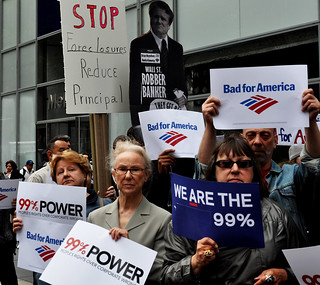
The breadth of this movement is one thing, its depth another. It has rejected not just the particulars of our economic system, but the whole set of moral and emotional assumptions on which it’s based. Take the pair shown in a photograph from Occupy Austin in Texas.  The amiable-looking elderlywoman is holding a sign whose computer-printed words say, “Money has stolen our vote.” The older man next to her with the baseball cap is holding a sign handwritten on cardboard that states, “We are our brothers’ keeper.”

The photo of the two of them offers just a peek into a single moment in the remarkable period we’re living through and the astonishing movement that’s drawn in… well, if not 99% of us, then a striking enough percentage: everyone from teen pop superstar Miley Cyrus with her Occupy-homage video to Alaska Yup’ik elder Esther Green ice-fishing and holding a sign that says “Yirqa Kuik” in big letters, with the translation -- “occupy the river” -- in little ones below.

The woman with the stolen-votes sign is referring to them. Her companion is talking about us, all of us, and our fundamental principles. His sign comes straight out of Genesis, a denial of what that competitive entrepreneur Cain said to God after foreclosing on his brother Abel’s life. He was not, he claimed, his brother’s keeper; we are not, he insisted, beholden to each other, but separate, isolated, each of us for ourselves.

Think of Cain as the first Social Darwinist and this Occupier in Austin as his opposite, claiming, no, our operating system should be love; we are all connected; we must take care of each other. And this movement, he’s saying, is about what the Argentinian uprising that began a decade ago, on December 19, 2001, called politica afectiva, the politics of affection.

If it’s a movement about love, it’s also about the money they so unjustly took, and continue to take, from us -- and about the fact that, right now, money and love are at war with each other. After all, in the American heartland, people are beginning to be imprisoned for debt, while the Occupy movement is arguing for debt forgiveness, renegotiation, and debt jubilees. More


Sunday, October 30, 2011

Israel and Hamas: In the Wake of the Prisoners Exchange

The prisoner swap in which Hamas released Israeli captive Gilad Shalit in exchange for 1,027 Palestinian prisoners in Israeli prisons suggests that Israel and Hamas recognize each other's unmitigated reality and prerogatives.

The deal was unquestionably motivated by mutually beneficial political calculations made on both sides, including a desire to overshadow President Abbas' efforts to seek UN recognition of a Palestinian state, to which Hamas and Israel object. Nevertheless, without an outright rejection of terror and recognition that Israel cannot be destroyed, Hamas' growth as a political force will remain limited and potentially mired in failure. Similarly, without Israel recognizing that lasting security is unlikely unless Hamas is included in the political process, efforts to advance a two-state solution will be fruitless.
The growing influences of Egypt and Turkey on Hamas, the Arab Spring and the promise of the Arab Peace Initiative all provide avenues to bridge the gaps between Israel and Hamas. To do so, the Quartet must rethink its three demands on Hamas, (renounce violence, accept Israel's existence and agree to past agreements) which will keep the two-sides mired in a dangerous status quo. Overcoming these obstacles will require new thinking to find a formula that enables each side to save face by altering their positions to move forward in a political process. More