We are facing issues of near-overwhelming complexity and unprecedented urgency. Can we think systematically and fashion policies accordingly? Can we move fast enough to avoid environmental decline and economic collapse? Can we change direction before we go over the edge? I will look at the economic future through and environmental lens to fashion a plan that will sustain civilization. The plan has four components: a massive cut in global carbon emissions of 80 percent by 2020; the stabilization of world population at no more than 8 billion by 2040; the eradication of poverty; and the restoration of forests, soils, aquifers, and fisheries. Lester Brown started his career as a farmer, growing tomatoes in southern New Jersey with his younger brother during high school and college. Shortly after earning a degree in agricultural science from Rutgers University in 1955, he spent six months living in rural India where he became intimately familiar with the food/population issue. Brown went on to earn masters degrees in agricultural economics from the University of Maryland and in public administration from Harvard University. In 1959 Brown joined the USDA's Foreign Agricultural Service as an international analyst, and in 1964 he became an adviser to Secretary of Agriculture Orville Freeman on foreign agricultural policy. In 1966, he was appointed Administrator of the department's International Agricultural Development Service. In early 1969, he left government to help establish
Showing posts with label limits to growth. Show all posts
Showing posts with label limits to growth. Show all posts
Sunday, July 15, 2012
Saturday, July 14, 2012
Global fight for natural resources 'has only just begun'
Academics and business figures gave a grim warning at the Resource 2012 conference, but defended the Rio+20 outcomes
The global battle for natural resources – from food and water to energyand precious metals – is only beginning, and will intensify to proportions that could mean enormous upheavals for every country, leading academics and business figures told a conference in Oxford on Thursday.
Sir David King, former chief scientific adviser to the UK government, who convened the two-day Resource 2012 conference, told the Guardian: "We are nowhere near realising the full impact of this yet. We have seen the first indications – rising food prices, pressure on water supplies, a land grab by some countries for mining rights and fertile agricultural land, and rising prices for energy and for key resources [such as] metals. But we need to do far more to deal with these problems before they become even more acute, and we are not doing enough yet."
Countries that are not prepared for this rapid change will soon – perhaps irrevocably – lose out, with serious damage to their economies and way of life, the conference was told.
Amartya Sen, a Nobel prize-winning economist, said that the free market would not necessarily provide the best solution to sharing out the world's resources. Governments would need to step in, he said, to ensure that people had access to the basics of life, and that the interests of businesses and the financial markets did not win out over more fundamental human needs.
Sen has played a key role as an academic in showing how the way resources are distributed can impact famine and surplus more than the actual amount of resources, that are available, particularly food.
David Nabarro, special representative for food security and nutrition at the United Nations Special, defended the outcomes of last month's Rio+20 conference – a global summit that was intended to address resource issues and other environmental problems, including pollution, climate change and the loss of biodiversity, all of which are likely to have knock-on effects that will exacerbate resource shortages. More
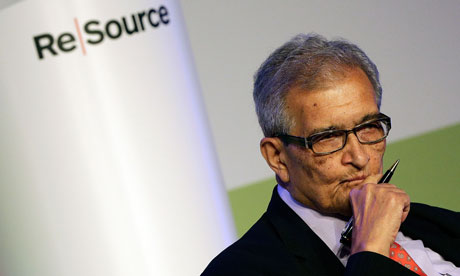 |
| Nobel prize-winning economist Amartya Sen |
The global battle for natural resources – from food and water to energyand precious metals – is only beginning, and will intensify to proportions that could mean enormous upheavals for every country, leading academics and business figures told a conference in Oxford on Thursday.
Sir David King, former chief scientific adviser to the UK government, who convened the two-day Resource 2012 conference, told the Guardian: "We are nowhere near realising the full impact of this yet. We have seen the first indications – rising food prices, pressure on water supplies, a land grab by some countries for mining rights and fertile agricultural land, and rising prices for energy and for key resources [such as] metals. But we need to do far more to deal with these problems before they become even more acute, and we are not doing enough yet."
Countries that are not prepared for this rapid change will soon – perhaps irrevocably – lose out, with serious damage to their economies and way of life, the conference was told.
Amartya Sen, a Nobel prize-winning economist, said that the free market would not necessarily provide the best solution to sharing out the world's resources. Governments would need to step in, he said, to ensure that people had access to the basics of life, and that the interests of businesses and the financial markets did not win out over more fundamental human needs.
Sen has played a key role as an academic in showing how the way resources are distributed can impact famine and surplus more than the actual amount of resources, that are available, particularly food.
David Nabarro, special representative for food security and nutrition at the United Nations Special, defended the outcomes of last month's Rio+20 conference – a global summit that was intended to address resource issues and other environmental problems, including pollution, climate change and the loss of biodiversity, all of which are likely to have knock-on effects that will exacerbate resource shortages. More

Wednesday, June 27, 2012
Two Views of Our Future
No previous civilization has survived the ongoing destruction of its natural supports. Nor will ours. Yet economists look at the future through a different lens.
Relying heavily on economic data to measure progress, they see the near 10-fold growth in the world economy since 1950 and the associated gains in living standards as the crowning achievement of our modern civilization. During this period, income per person worldwide climbed nearly fourfold, boosting living standards to previously unimaginable levels. A century ago, annual growth in the world economy was measured in the billions of dollars. Today, it is measured in the trillions. In the eyes of mainstream economists, our present economic system has not only an illustrious past but also a promising future.
Mainstream economists see the 2008–09 global economic recession and near-collapse of the international financial system as a bump in the road, albeit an unusually big one, before a return to growth as usual. Projections of economic growth, whether by the World Bank, Goldman Sachs, or Deutsche Bank, typically show the global economy expanding by roughly 3 percent a year. At this rate the 2010 economy would easily double in size by 2035. With these projections, economic growth in the decades ahead is more or less an extrapolation of the growth of recent decades.
 But natural scientists see that as the world economy expanded some 20-fold over the last century, it has revealed a flaw—a flaw so serious that if it is not corrected it will spell the end of civilization as we know it. At some point, what had been excessive local demands on environmental systems when the economy was small became global in scope.
A study by a team of scientists led by Mathis Wackernagel aggregates the use of the earth’s natural assets, including carbon dioxide overload in the atmosphere, into a single indicator—the ecological footprint. The authors concluded that humanity’s collective demands first surpassed the earth’s regenerative capacity around 1980. By 2007, global demands on the earth’s natural systems exceeded sustainable yields by 50 percent. Stated otherwise, it would take 1.5 Earths to sustain our current consumption. If we use environmental indicators to evaluate our situation, then the global decline of the economy’s natural support systems—the environmental decline that will lead to economic decline and social collapse—is well under way. More
Relying heavily on economic data to measure progress, they see the near 10-fold growth in the world economy since 1950 and the associated gains in living standards as the crowning achievement of our modern civilization. During this period, income per person worldwide climbed nearly fourfold, boosting living standards to previously unimaginable levels. A century ago, annual growth in the world economy was measured in the billions of dollars. Today, it is measured in the trillions. In the eyes of mainstream economists, our present economic system has not only an illustrious past but also a promising future.
Mainstream economists see the 2008–09 global economic recession and near-collapse of the international financial system as a bump in the road, albeit an unusually big one, before a return to growth as usual. Projections of economic growth, whether by the World Bank, Goldman Sachs, or Deutsche Bank, typically show the global economy expanding by roughly 3 percent a year. At this rate the 2010 economy would easily double in size by 2035. With these projections, economic growth in the decades ahead is more or less an extrapolation of the growth of recent decades.

A study by a team of scientists led by Mathis Wackernagel aggregates the use of the earth’s natural assets, including carbon dioxide overload in the atmosphere, into a single indicator—the ecological footprint. The authors concluded that humanity’s collective demands first surpassed the earth’s regenerative capacity around 1980. By 2007, global demands on the earth’s natural systems exceeded sustainable yields by 50 percent. Stated otherwise, it would take 1.5 Earths to sustain our current consumption. If we use environmental indicators to evaluate our situation, then the global decline of the economy’s natural support systems—the environmental decline that will lead to economic decline and social collapse—is well under way. More
Tuesday, June 5, 2012
An Introduction to Green Governance
Ecological Survival, Human Rights, and the Law of the Commons
 Commons scholar David Bollier and law school professor Burns H. Weston persuasively argue that protecting the commons depends upon “bold modifications of our legal structures and political culture.” This article, first published in the current issue of Kosmos Journal, is drawn from their forthcoming book Green Governance: Ecological Survival, Human Rights, and the Law of the Commons to be published by Cambridge University Press next year. Bollier and Weston are founders of the Commons Law Project, which envisions “a new architecture of law and public policy that can effectively address climate change and other urgent ecological problems while advancing human rights and social empowerment.” — Jay Walljasper
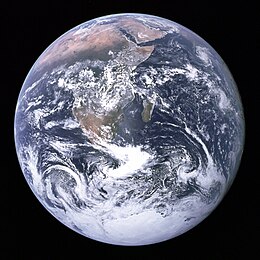
At least since Rachel Carson’s Silent Spring, we have known about humankind’s squandering of nonrenewable resources, its careless disregard of precious life species, and its overall contamination and degradation of delicate ecosystems. In recent decades, these defilements have assumed a systemic dimension. Lately we have come to realize the shocking extent to which our atmospheric emission of carbon dioxide and other greenhouse gases threatens Planet Earth.
If the human species is going to overcome the many interconnected ecological catastrophes now confronting us, this moment in history requires that we entertain some bold modifications of our legal structures and political culture. We must find the means to introduce new ideas for effective and just environmental protection—locally, nationally, regionally, globally and points in between. More

At least since Rachel Carson’s Silent Spring, we have known about humankind’s squandering of nonrenewable resources, its careless disregard of precious life species, and its overall contamination and degradation of delicate ecosystems. In recent decades, these defilements have assumed a systemic dimension. Lately we have come to realize the shocking extent to which our atmospheric emission of carbon dioxide and other greenhouse gases threatens Planet Earth.
If the human species is going to overcome the many interconnected ecological catastrophes now confronting us, this moment in history requires that we entertain some bold modifications of our legal structures and political culture. We must find the means to introduce new ideas for effective and just environmental protection—locally, nationally, regionally, globally and points in between. More
Thursday, May 31, 2012
Redefining Security for the 21st Century - Lester R. Brown
One of our legacies from the last century, which was dominated by two world wars and the cold war, is a sense of security that is defined almost exclusively in military terms. It so dominates Washington thinking that the U.S. foreign affairs budget of $701 billion in 2009 consisted of $661 billion for military purposes and $40 billion for foreign assistance and diplomatic programs.
 But the situation in which we find ourselves pushes us to redefine security in twenty-first century terms. The time when military forces were the prime threat to security has faded into the past. The threats now are climate volatility, spreading water shortages, continuing population growth, spreading hunger, and failing states. The challenge is to devise new fiscal priorities that match these new security threats.
Douglas Alexander, former U.K. Secretary of State for International Development, put it well in 2007: “In the 20th century a country’s might was too often measured in what they could destroy. In the 21st century strength should be measured by what we can build together.”
The good news is that in the United States the concept of redefining security is now permeating not only various independent think tanks but the Pentagon itself. A number of studies have looked at threats to U.S. interests posed by climate change, population growth, water shortages, and food shortages-—key trends that contribute to political instability and lead to social collapse.
Although security is starting to be redefined in a conceptual sense, we have not redefined it in fiscal terms. The United States still has a huge military budget, committed to developing and manufacturing technologically sophisticated and costly weapon systems. Since there is no other heavily armed superpower, the United States is essentially in an arms race with itself. What if the next war is fought in cyberspace or with terrorist insurgents? Vast investments in conventional weapons systems will be of limited use.
The far-flung U.S. military establishment, including hundreds of military bases scattered around the world, will not save civilization. It belongs to another era. We can most effectively achieve our security goals by helping to expand food production, by filling the family planning gap, by building wind farms and solar power plants, and by building schools and clinics. More
Humanity is today playing in the major leagues. We are in a sink or swim situation. If we can keep this our one and only home planet habitable by mitigating and adapting to the changing climate, switching to alternative sources of energy such as solar, wind, geothermal, wave, ocean thermal and nuclear, sequester CO2 and provide the population with adequate supplies of water and food and bring the population under control, humanity may survive . Cooperation between states globally is rhe only answer. Editor
Douglas Alexander, former U.K. Secretary of State for International Development, put it well in 2007: “In the 20th century a country’s might was too often measured in what they could destroy. In the 21st century strength should be measured by what we can build together.”
The good news is that in the United States the concept of redefining security is now permeating not only various independent think tanks but the Pentagon itself. A number of studies have looked at threats to U.S. interests posed by climate change, population growth, water shortages, and food shortages-—key trends that contribute to political instability and lead to social collapse.
Although security is starting to be redefined in a conceptual sense, we have not redefined it in fiscal terms. The United States still has a huge military budget, committed to developing and manufacturing technologically sophisticated and costly weapon systems. Since there is no other heavily armed superpower, the United States is essentially in an arms race with itself. What if the next war is fought in cyberspace or with terrorist insurgents? Vast investments in conventional weapons systems will be of limited use.
The far-flung U.S. military establishment, including hundreds of military bases scattered around the world, will not save civilization. It belongs to another era. We can most effectively achieve our security goals by helping to expand food production, by filling the family planning gap, by building wind farms and solar power plants, and by building schools and clinics. More
Humanity is today playing in the major leagues. We are in a sink or swim situation. If we can keep this our one and only home planet habitable by mitigating and adapting to the changing climate, switching to alternative sources of energy such as solar, wind, geothermal, wave, ocean thermal and nuclear, sequester CO2 and provide the population with adequate supplies of water and food and bring the population under control, humanity may survive . Cooperation between states globally is rhe only answer. Editor
Sunday, May 27, 2012
Limits We are Reaching – Oil, Debt, And Others
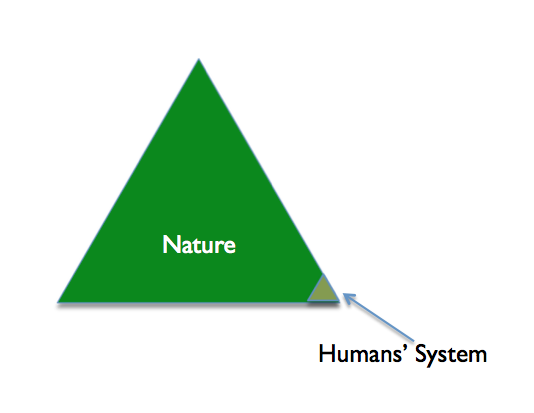
The world is clearly reaching many limits. This graphic below shows how I see man interacting with natural systems, back before man discovered fire and back before man became intelligent enough to kill off whole species.
 In these earliest days, human systems were a part of the natural system. Humans behaved like other animals, and fit easily into the natural order. There weren’t many humans–probably under 100,000 total in the whole world.
This is the way I see man’s systems interacting with the natural system now:
 In my illustration, human systems are sufficiently interrelated that they combine to form one single interrelated “humans’ system”. This system draws its power from the natural system. It also puts its waste products back into the natural system. Because of entropy, we know that everything we create eventually ends up as waste products. In order to keep the humans’ system going, we need to keep adding new energy to the system, partly to offset entropy and partly to support the growing world population.
What limits are the human and natural systems reaching now?
Oil Limits
According to EIA data, crude oil production in 2005 averaged 73.6 million barrels a day. It has grown very little since then. Crude oil production for 2011 averaged 74.0 million barrels a day. In the first two months of 2012, crude oil production was higher yet, averaging 75.6 million barrels a day. More
This is the way I see man’s systems interacting with the natural system now:
What limits are the human and natural systems reaching now?
Oil Limits
According to EIA data, crude oil production in 2005 averaged 73.6 million barrels a day. It has grown very little since then. Crude oil production for 2011 averaged 74.0 million barrels a day. In the first two months of 2012, crude oil production was higher yet, averaging 75.6 million barrels a day. More
Sunday, May 6, 2012
Te Case For Interdependence
The physicist-turned international environmental activist Dr. Vandana Shiva gave the opening keynote address at the Living Future “unconference” on May 2 in Portland, Oregon. Shiva is the author of Earth Democracy and Water Wars, among other books, including Soil Not Oil: Environmental Justice in an Age of Climate Crisis (South End Press, 2008). This book posits that the triple threat of climate change, peak oil, the food and agrarian crisis, together, represent a “triple opportunity”—but only if we change our thinking and our systems.

She referenced her attempts to talk to naysayers at the highest level, scientists and thinkers who claim that traditional agricultural methods and economic systems will never be sufficient to feed the world’s population. When she queries them about the “externalities” and unintended consequences of their monoculture solutions, they say, about water or soil health or other matters: “that’s not my department,” or “that wasn’t part of my study.” But as Shiva points out, “If you want to build a living future, everything is your department.”
Her biggest complaint about the current approach, and the artificial boundaries that she sees as part of capitalism, is the persistent devaluation of the work of the planet and of women. In particular, she pointed to the economic valuation system that had created a false production boundary: “If producers consume what they produce—such as food in a family or community garden—they are, somehow, not producing anything. In other words, production takes place only when commodification begins, but not before. This results, perversely, in a system that produces less and less while pretending to produce more and more. We are in a situation where we are using increasingly more units of energy to produce fewer and fewer units of food.” More
The theme of this year’s event, put on by the International Living Future Institute, is Women Reshaping the World, and Shiva opened her remarks with a reference to the “feminine principle” of Shakti, the concept of feminine creative power in Hinduism, which can also be present in males, and which means “to be able” and refers to empowerment.
“The vocabulary is shifting,” she said. “And it should. Words signify imagination and we need a shift from dominance because it is failing us and the planet.” The mistake she sees is a system of artificial boundaries. These, she notes, are part of the unfortunate, destructive, and hubristic elevation of man over nature. “We need to give up the hubris of that notion and embrace interdependence. We may be in the anthropocene, but we can make this cooperative, creative anthropocene, rather than an age of dominance.”She referenced her attempts to talk to naysayers at the highest level, scientists and thinkers who claim that traditional agricultural methods and economic systems will never be sufficient to feed the world’s population. When she queries them about the “externalities” and unintended consequences of their monoculture solutions, they say, about water or soil health or other matters: “that’s not my department,” or “that wasn’t part of my study.” But as Shiva points out, “If you want to build a living future, everything is your department.”
Her biggest complaint about the current approach, and the artificial boundaries that she sees as part of capitalism, is the persistent devaluation of the work of the planet and of women. In particular, she pointed to the economic valuation system that had created a false production boundary: “If producers consume what they produce—such as food in a family or community garden—they are, somehow, not producing anything. In other words, production takes place only when commodification begins, but not before. This results, perversely, in a system that produces less and less while pretending to produce more and more. We are in a situation where we are using increasingly more units of energy to produce fewer and fewer units of food.” More
Tuesday, April 24, 2012
Revisiting our limits (To Growth)
This year marks the 40th anniversary of the Club of Rome’s famous report The Limits to Growth, which developed a number of possible trajectories of human development from 1972 until 2100. Most of these scenarios projected ‘overshoot and collapse’: rapid industrial production, resource consumption and increasing pollution emissions overshoot biophysical planetary boundaries by around 2050, leading to a collapse in food production and population by end of the century.
 The frightening truth is that in 2012 many of its findings are still valid and we remain on the same potentially catastrophic pathway.
The report also developed stabilisation scenarios, and these remain potential future pathways. To avoid overshoot and collapse, according to the report, it is necessary to stabilise our economies, currently based on increasing material through-put; to slow and stabilise population growth; and to reduce pollution levels, all before mid-21st century. The two latter goals are relatively uncontroversial in most parts of the world, but even questioning the need for on-going economic growth is still highly politically sensitive.
Still, the debate about the limits of economic growth has arisen once more, especially in Europe. In France, the movement debating these issues goes by the name “La Decroissance” -- literally, “De-growth”, referring to the controlled downscaling of production. This political and counter-cultural movement, which stands for the egalitarian use of global resources, is barely known outside the Francophone world, but has nonetheless produced valuable texts such as La Décroissance: 10 questions pour comprendre et en débattre (“De-growth: 10 questions to understand the debate”). More
The report also developed stabilisation scenarios, and these remain potential future pathways. To avoid overshoot and collapse, according to the report, it is necessary to stabilise our economies, currently based on increasing material through-put; to slow and stabilise population growth; and to reduce pollution levels, all before mid-21st century. The two latter goals are relatively uncontroversial in most parts of the world, but even questioning the need for on-going economic growth is still highly politically sensitive.
Forty years have passed since the publication of The Limits to Growth. If the models are correct – and so far they look that way – business-as-usual is not an option: we do not have another 40 years to waste before taking action and changing course.
Still, the debate about the limits of economic growth has arisen once more, especially in Europe. In France, the movement debating these issues goes by the name “La Decroissance” -- literally, “De-growth”, referring to the controlled downscaling of production. This political and counter-cultural movement, which stands for the egalitarian use of global resources, is barely known outside the Francophone world, but has nonetheless produced valuable texts such as La Décroissance: 10 questions pour comprendre et en débattre (“De-growth: 10 questions to understand the debate”). More
Subscribe to:
Posts (Atom)