Showing posts with label earth summit. Show all posts

Sunday, August 26, 2012

The Dark Side of the “Green Economy”

Everywhere you look these days, things are turning green. In Chiapas, Mexico, indigenous farmers are being paid to protect the last vast stretch of rainforest in Mesoamerica. In the Brazilian Amazon, peasant families are given a monthly “green basket” of basic food staples to allow them to get by without cutting down trees.

In Kenya, small farmers who plant climate-hardy trees and protect green zones are promised payment for their part in the fight to reduce global warming. In Mozambique, one of the world’s poorest nations, fully 19 percent of the country’s surface is leased to a British capital firm that pays families to reforest.
These are a few of the keystone projects that make up what is being called “the green economy”: an emerging approach that promises to protect planetary ecology while boosting the economy and fighting poverty.

On its face this may sound like a good thing. Yet, during the recently concluded United Nations Rio+20 Earth Summit in Brazil, tens of thousands of people attending a nearby People’s Summit condemned such approaches to environmental management. Indeed, if social movements gathered in Rio last month had one common platform, it was “No to the green economy.”

Whose Economy? Whose Green?

Just a few years ago, the term “green economy” referred to economies that are locally based, climate friendly, and low-impact. But since the global economic meltdown began in 2007, the green economy has come to mean something more akin to the wholesale privatization of nature. This green economy is about putting a price on natural cycles through a controversial set of policies called “Payments for Ecosystem Services”—an approach to greening capitalism that some liken to a tiger claiming to turn vegetarian.

Rather than reducing pollution and consumption, protecting the territorial rights of land-based peoples, and promoting local initiatives that steward resources for future generations, the approach is doing the opposite: promoting monoculture tree plantations, trade in pollution credits, and the establishment of speculative markets in biodiversity and forests, all of which threaten to displace land-based communities.

A report by Ecosystem Marketplace, the leading purveyor of “Payments for Ecosystem Services,” lays out the green economy argument: “Ecosystems provide trillions of dollars in clean water, flood protection, fertile lands, clean air, pollination, disease control. ... So how do we secure this enormously valuable infrastructure and its services? The same way we would electricity, potable water, or natural gas. We pay for it.”

The United Nations Environment Program (UNEP), among the chief proponents of the green economy, says this approach will result in “improved well-being and social equity while significantly reducing environmental risks and ecological scarcities.” The World Bank, also promoting the green economy, says, “Natural capital accounting would add to our national GDPs the wealth stored in our natural resources: minerals before they are mined, forests before they are felled, water while it is still in the rivers.”

But, for social movements, land-based communities, and indigenous peoples, the question is, who really pays? For what are they paying? And, most poignantly, since when has nature, the source of all life, been reduced to a service-provider?

One concern is that this new green economy is a form of “disaster capitalism”—a global effort to put the “services” of nature into the same hands that caused the global financial meltdown. And that seems like a very, very bad idea.

Increasingly, the evidence on the ground bears this out.

The reforestation plan in Mozambique has peasant farmers planting industrial monocultures of African palm for biofuel production, not native forest. The Kenyan farmers of the Green Belt Movement, while initially receptive to a World Bank-backed scheme that would pay them to protect agricultural soils, became discouraged when they realized the payments would add up to less than 15 cents per acre per year, and that they would have to wait many years for payment. In Brazil, the “green basket” of food staples adds up to 100 Reales per family per month—but cooking gas alone can cost 50 Reales a month, leaving families without access to the forest hungry and dependent on paltry state support. More


Wednesday, June 27, 2012

Two Views of Our Future

No previous civilization has survived the ongoing destruction of its natural supports. Nor will ours. Yet economists look at the future through a different lens.

Relying heavily on economic data to measure progress, they see the near 10-fold growth in the world economy since 1950 and the associated gains in living standards as the crowning achievement of our modern civilization. During this period, income per person worldwide climbed nearly fourfold, boosting living standards to previously unimaginable levels. A century ago, annual growth in the world economy was measured in the billions of dollars. Today, it is measured in the trillions. In the eyes of mainstream economists, our present economic system has not only an illustrious past but also a promising future.

Mainstream economists see the 2008–09 global economic recession and near-collapse of the international financial system as a bump in the road, albeit an unusually big one, before a return to growth as usual. Projections of economic growth, whether by the World Bank, Goldman Sachs, or Deutsche Bank, typically show the global economy expanding by roughly 3 percent a year. At this rate the 2010 economy would easily double in size by 2035. With these projections, economic growth in the decades ahead is more or less an extrapolation of the growth of recent decades.


But natural scientists see that as the world economy expanded some 20-fold over the last century, it has revealed a flaw—a flaw so serious that if it is not corrected it will spell the end of civilization as we know it. At some point, what had been excessive local demands on environmental systems when the economy was small became global in scope.

A study by a team of scientists led by Mathis Wackernagel aggregates the use of the earth’s natural assets, including carbon dioxide overload in the atmosphere, into a single indicator—the ecological footprint. The authors concluded that humanity’s collective demands first surpassed the earth’s regenerative capacity around 1980. By 2007, global demands on the earth’s natural systems exceeded sustainable yields by 50 percent. Stated otherwise, it would take 1.5 Earths to sustain our current consumption. If we use environmental indicators to evaluate our situation, then the global decline of the economy’s natural support systems—the environmental decline that will lead to economic decline and social collapse—is well under way. More


Saturday, June 23, 2012

The Earth Cannot Be Saved by Hope and Billionaires

Rio 2012: it's a make-or-break summit. Just like they told us at Rio 1992

World leaders at Earth summits seem more interested in protecting the interests of plutocratic elites than our environment


Worn down by hope. That's the predicament of those who have sought to defend the earth's living systems. Every time governments meet to discuss the environmental crisis, we are told that this is the "make or break summit", on which the future of the world depends. The talks might have failed before, but this time the light of reason will descend upon the world.


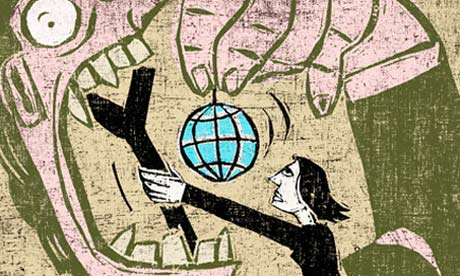
'To see Obama backtracking on the commitments made by Bush the elder 20 years ago is to see the extent to which a tiny group of plutocrats has asserted its grip on policy.' Illustration above by Daniel Pudles

We know it's rubbish, but we allow our hopes to be raised, only to witness 190 nations arguing through the night over the use of the subjunctive in paragraph 286. We know that at the end of this process the UN secretary general, whose job obliges him to talk nonsense in an impressive number of languages, will explain that the unresolved issues (namely all of them) will be settled at next year's summit. Yet still we hope for something better.

This week's earth summit in Rio de Janeiro is a ghost of the glad, confident meeting 20 years ago. By now, the leaders who gathered in the same city in 1992 told us, the world's environmental problems were to have been solved. But all they have generated is more meetings, which will continue until the delegates, surrounded by rising waters, have eaten the last rare dove, exquisitely presented with an olive leaf roulade. The biosphere that world leaders promised to protect is in a far worse state than it was 20 years ago. Is it not time to recognise that they have failed?

If world governments do not have the vision, the foresight and the compassion to do the right thing, then it is up to us, the People, to bring about change, and if change means a change of government, so be it. This is about a planetary emergency, about a decent life for our children, about our childrens survival. Editor

Friday, June 8, 2012

This is Ecocide - Youth Blast Rio Summit 2012

This video is being presented at Youth Blast at the Rio Earth Summit on behalf of the Eradicating Ecocide campaign. The aim is to inspire and intrigue young people to help make ecocide an international crime. Youth Blast is the official young peoples event for Rio+20 being held in June 2012.