Showing posts with label climate. Show all posts

Sunday, June 21, 2015

5 Radical Takeaways from the Pope’s Letter on Climate

Pope Francis recognizes that there’s no way to stop climate change without confronting the way the world does business. That’s huge.

Pope Francis just released an "encyclical," a letter meant to serve as a guide to understanding our personal relationship to some of the most complex issues of the day through religious doctrine. This particular encyclical is on climate change and is addressed not just to the globe’s 1.2 billion Catholics, but to everyone of any — or no — faith. In it, Pope Francis boldly challenges us all to take an honest look inside our hearts and question the foundations of a society that’s created wealth for some at the expense of others and "our common home"— the planet earth.

Here are five key quotes from the encyclical that will shake up the global climate debate.

1. Climate change and inequality are inextricably linked.

"We have to realize that a true ecological approach always becomes a social approach; it must integrate questions of justice in debates on the environment, so as to hear both the cry of the earth and the cry of the poor." It’s not hard to see how climate change hits people living in poverty first and worst, and inevitably widens the gulf between rich and poor. After extreme weather washes away their homes or drought kills their crops, those living in poverty have a harder time bouncing back than those with savings accounts and sturdier houses. But what’s really radical is how the Pope names inequality itself as an impediment to solving a looming planetary and human rights crisis. The encyclical calls out "masters of power and money" to stop masking the symptoms and address climate change in service of the common good.

Pope Francis boldly challenges us all to take an honest look inside our hearts and question the foundations of a society that’s created wealth for some at the expense of others and "our common home"— the planet earth.

2. The global economy must protect the Earth, our common home.

"The economy accepts every advance in technology with a view to profit, without concern for its potentially negative impact on human beings." Today’s global economy profits at the environment’s expense. And the pursuit of growth is fueling environmental degradation, natural disasters, and financial crises. Pope Francis envisions a people-and-planet-first economy more in harmony with the environment that would prevent imbalances of wealth and power and foster peace among nations.

3. Everyone must divest from fossil fuels and invest in the future.

"We know that technology based on the use of highly polluting fossil fuels… needs to be progressively replaced without delay." Pope Francis is crystal clear that the current development model based on the intensive use of coal, oil, and even natural gas has to go. In its place we need renewable energy options and new modes of production and consumption that combat global warming. This is precisely what a growing movement of students, faith communities, socially responsible investors and everyday citizens are calling on individuals and private and public institutions to do: Divest their money from fossil fuels and invest it in climate solutions like wind, solar, and energy efficiency.

4. It’s time for powerful nations to pay their fair share.

"A true ‘ecological debt’ exists, particularly between the global north and south. … In different ways, developing countries, where the most important reserves of the biosphere are found, continue to fuel the development of richer countries at the cost of their own present and future." Countries in the global North have benefitted from fossil fuel-driven industrialization, while developing countries bear the brunt of the related greenhouse gas emissions. So while everyone must act to avoid climate disruption, rich countries have a greater responsibility. For starters, they must make rapid, deep cuts in carbon emissions. And they have to keep their promise to finance the cost for poorer countries to build climate resilience and transition to renewable energy through the Green Climate Fund.

5. There’s no easy way out of this.

"Obstructionist attitudes, even on the part of believers, can range from denial of the problem to indifference, nonchalant resignation, or blind confidence in technical solutions." There’s only one way to meet the climate challenge: Extinguish the "dig, burn, dump economy." And markets and technology can’t be relied on to do the job. Gimmicks like trading carbon credits as a financial commodity or burning coal in "cleaner" power plants are distractions from the only real solution: Stop digging up and drilling — then burning — oil, gas, and coal.

Pope Francis is calling for solutions to climate change that is rooted in our "deepest convictions about love, justice, and peace." His letter to the world illuminates a radical, compassionate path that shows what it truly means to have faith in humanity. More


Thursday, January 1, 2015

Behind the veil of the Islamic State is a war for water

A little known fact of the war in Syria is that it started at the end of the worst drought in Syrian history, a biblical drought which forced over 1 million farmers into the cities.

Pulitzer Prize-winner Thomas L. Friedman interviewed Syrian refugees and farmers in Syria about the link between this drought and the start of the civil war. He comes to the conclusion that the drought certainly played some role and was probably a key tipping point for a bad situation to turn into a full scale war. In the documentary “Years of living dangerously” we see how wiki-leaked diplomatic cables and high level US officials such as Condoleezza Rice acknowledge this link.

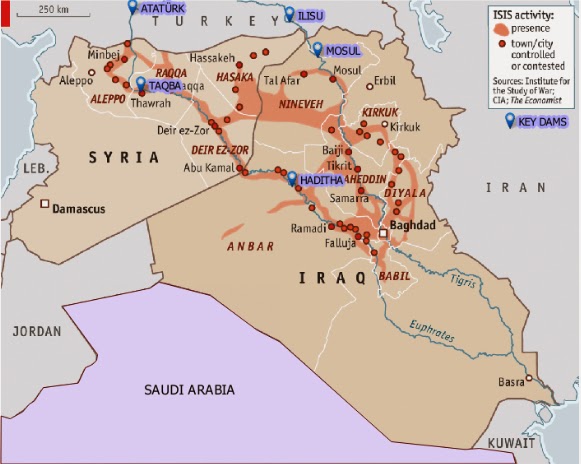
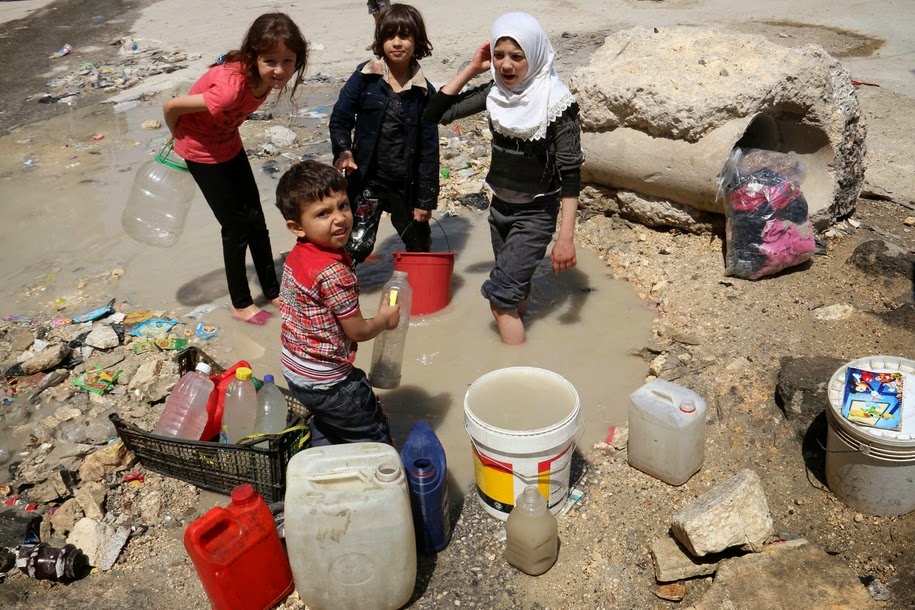
But there’s a lot more happening to explain why behind the veil of a quest for an Islamic State (IS), there’s also a war for water in Syria and Iraq. Making the plight of citizens worse is the continued targeting of water supply networks by both regime and opposition forces, which have attacked strategic lifelines, such as water channels, to gain control of territory and to punish and put pressure on their opponents.

Opening the flood gates …

The Islamic State’s quest for hydrological control began in Syria, when it captured the Tabqa Dam in 2013. Rebel-held areas had been systematically denied electricity by President Bashar al-Assad’s forces in their effort to turn the population against the insurgency. The Tabqa Dam was built more than 40 years ago with Russian help and aimed to make Syria self-sufficient in energy production. Behind the dam is Lake Assad, which provides millions of Syrians with drinking water and is a vital irrigation source for farms. After the capture of the dam, IS opened the flood-gates to get maximum electricity supply for the areas they control and win favour with the local population. As a result, the lake dropped six metres, to a record low in May, which worsened the plight of millions of already destitute Syrians as severe water cuts began to hit Aleppo province.

Conflict over the water flowing though the Euphrates and Tigris is of course nothing new and predates religious wars. They were the first rivers to be used for large scale irrigation, in the region once known as the Fertile Crescent. Somewhere between 1720 and 1684 BC, a grandson of Hammurabi dammed the Tigris to prevent the retreat of rebels led by Iluma-Ilum, who declared the independence of Babylon. The Euphrates was already used as a weapon somewhere around 2500 BC, in another fight for Babylon, when the king of Umma cut the banks of irrigation canals alongside the Euphrates dug by his neighbor, the king of Girsu.

The Euphrates and Tigris are the two major and longest rivers in the Middle East. They both originate in Turkey. The Euphrates flows through Syria and Iraq to reach the Persian Gulf while the Tigris flows through Kurdish territory, meeting up with the Euphrates in the Southern Mesopotamian Marshes of Iraq. There are currently at least 46 dams in the Tigris-Euphrates basin, with at least 8 more planned or under construction. These dams have become key pieces of geo-political control in the region.

… and shutting down the flows

While one act of war is opening the flood gates, another is closing them. In 1974, Iraq threatened to bomb the same Tabqa Dam in Syria, alleging that the dam had reduced the flow of Euphrates River water to Iraq. But between then and now, Turkey, through its position upstream, has taken over as the most powerful regional commander of water, by completing the giant Ataturk Dam. In 1990 Syria and Iraq protested that Turkey now has a weapon of war: by closing the gates they could leave them dry. They had good reason to protest. In mid-1990 Turkish president Turgut Özal threatened to restrict water flow to Syria to force it to withdraw support for Kurdish rebels operating in southern Turkey.

In April 2014, the Islamic State blamed the low water levels in Lake Assad to Turkey’s closure of the Ataturk Dam. Sources found by Al Jazeera said that these claims are disputed. But even if the allegations are only partly true: they were used by the Islamic State to issue threats to ‘liberate Istanbul’, if that was necessary. So while Turkey, IS and Assad fight over water, millions of ordinary Syrians and Iraqi’s see their water levels drop dramatically. Not just by a new drought, with rainfall down by 50-85 percent since October 2013, but mostly due to a power struggle.

Tensions over water control in the region are set to heat up further if Turkey completes the Ilisu Dam on the Tigris River near the border of Syria. The Ilisu Dam will generate 1,200 MW and is part of the vast and ambitious Southeastern Anatolia Project, known as GAP after its Turkish title (Guneydogu Anadolu Projesi): a network comprising 22 dams and 19 power plants. The Ilisu reservoir will flood 52 villages and 15 towns, including Hasankeyf, a Kurdish town of 5,500 people, which is the only town in Anatolia that has survived since the Middle Ages and is under archaeological protection. It will displace approximately 16,000 people in the troubled Kurdish region.

The World Bank (WB), the British construction company Balfour Beatty and the Italian company Impreglio have all withdrawn from the problematic project. So have international funds and export credit from Austria, Germany and Switzerland. However, the project is currently funded by Turkish banks. Iraq and also Syria will be the most heavily impacted if the dam and others go through, with the most extreme projections holding that, owing to a combination of climate change and upstream dam activity, the Tigris and Euphrates rivers won’t have sufficient flow to reach the sea by as early as 2040.

If you live in Syria or Iraq and the water irrigating your field stops coming you might join the ranks of any army promising to attack those who kept the water for themselves – no matter if they tell you the truth or not. As is often the case in conflicts or epidemics it is not the facts themselves that count most but what people believe to be the facts. Those who can convince it’s the enemies fault that there’s not enough water will have the key to where the hearts and minds of the people will go to – no matter what the facts are.

The US finally finds a Weapon of Mass Destruction in Iraq

The Tabqa Dam is not the only dam attacked by IS. They are also trying to take the Haditha Dam, the second-largest in Iraq, raising the possibility of catastrophic damage and flooding. On Sunday, the US was bombing IS positions close to the dam. The IS militants are also fighting for control of the Euphrates River Dam, about 120 miles northwest of Baghdad and government forces were fighting to halt their advance. Insurgents from IS seized the Falluja Dam in Iraq in February and closed the floodgates to cause upstream flooding and to cut downstream water supply. Some 40.000 people were displaced just to flood the area around the city of Falluja to force government troops to retreat and lift a siege, while cutting water supplies and hydroelectricity generation for other parts of the country. All that was peanuts compared to what IS did next.

On August 7 IS captured the 1GW Mosul Dam on the Tigris – sending shock waves through Bagdad, Kuwait and the US. Whoever controls the Mosul Dam, the largest in Iraq, controls most of the country’s water and power resources. Located on the Tigris River upstream of Mosul, the dam, 3.6 km long and with 320 MW of capacity daily, formerly known as the Saddam dam, was built beginning in 1980 at a cost of 1.5$ billion USD, to bolster the regime during the Iran-Iraq war by a German-Italian consortium that was led by Hochtief Aktiengesellschaft. Its construction submerged many archaeological sites in the region yet more troubling is that because the dam was constructed on a foundation of soluble gypsum, it requires continuous grouting of the dam’s foundation to promote stability. Due to the engineering problems it presents it has been described recently by US engineers as “the most dangerous dam in the world.” And that was before the “most dangerous terror group ever” captured it.

A senior U.S. administration official said that “The failure of the Mosul Dam could threaten the lives of large numbers of civilians, threaten U.S. personnel and facilities – including the U.S. Embassy in Baghdad – and prevent the Iraqi government from providing critical services to the Iraqi populace,” (Source: Reuters). A 2006 U.S. Army Corps of Engineers report obtained by the Washington Post said the dam, which blocks the Tigris and holds 12 billion cubic meters of water, could flood two cities killing over a half a million people if it were destroyed or collapsed. The tsunami going to Mosul, a city of 1.7 million people, can be 20m high if the dam breaks with a full reservoir.

But even without a catastrophic failure, the dam is already at the epicenter of the war. Soon after the Islamic State captured the Mosul Dam they cut supplies to some villages in the north of the country that have not joined their cause. Recapturing this instrument of war was a sufficient reason for US forced to deploy air power to support Kurdish forces to recapture the dam. Saving the Yazidis from their mountain captured most media attention, but a key reason for the US to bomb Iraqi soil for the first time since 2011 was the fact that IS took the Mosul Dam. After bombing IS positions for several days, freshly re-equipped Kurdish fighters recently regained control of the dam.

Mega Dams & Water Management Practices

The importance of hydro-infrastructure in these battles and how it can be wielded firstly underlines the need for a serious re-appraisal of water management practices. Big dams (with funding from Multilateral agencies such as the WB, national and regional development banks, private equity and pension funds as well as from the Clean Development Mechanism, etc.) cause large scale displacement of populations, are ecologically destructive, wash away any other source of livelihood, and often saddle countries with debt while performing well below planned outputs as regards electricity generation. Moreover, compounded by climate change, contemporary ecological crises are leading to ever more conflict over trans-boundary water rights, such as for example between Ethiopia and Egypt, which are also on the verge of war over the construction of the Grand Renaissance and Gibe 3 dams, which would become Africa’s tallest. The world’s Big Dam Fan Club should take note of what has just happened in Syria and Iraq and realise that once disaster hits, hatred will not go to any God but to those who constructed the weapon of mass destruction. Water, rather than oil, is shaping up to be the key strategic resource in the region. More


Sunday, December 7, 2014

Announcing “Disastersand Ecosystems: Resilience in a Changing Climate”

Announcing “Disastersand Ecosystems: Resilience in a Changing Climate”, a new Massive Open OnlineCourse (MOOC) to be launched on 12 January, 2015

What we all know is that disasters are increasing worldwide. Population growth,environmental degradation and climate change will likely exacerbate disasterimpacts in many regions of the world. What role do ecosystems play in reducingdisaster risks and adapting to climate change? This is the topic of an exciting new Massive Open Online Course thatwill go live in January 2015. It was developedjointly by the United Nations Environment Programme (UNEP), the Center for NaturalResources and Development (CNRD) and the Cologne University of Applied Sciences(CUAS), Germany. This is UNEP’s first MOOC, developed through its engagement with universities worldwide including the Global Universities Partnership on Environment for Sustainability (GUPES).

The MOOC covers a broad range of topics from disastermanagement, climate change, ecosystem management and community resilience. Howthese issues are linked and how well-managed ecosystems enhance resilience to naturaldisasters and climate change impacts are the core theme of the course.
The MOOC is designed at two levels: the leadership track, with the first 6 units providing generalintroduction to the fundamental concepts, which is suitable for people from allbackgrounds who wish to have a basic undertaking of the topic. The second level, or expert track comprises 15 units with more in depth learning on thevarious tools of ecosystem-based disaster risk reduction and climate changeadaptation.
The course is delivered by both scientists and practitioners.In addition there are guest lectures from global leaders and experts, such as Achim Steiner, the Executive Director of the United Nations Environment Programme, Julia Marton-Lefèvre, former Director General of the International Union for the Conservationof Nature (IUCN), Rajendra Pachauri of Teri University and Margareta Wahlströmof the UN International Strategy on Disaster Reduction (UNISDR).

Students will have the opportunity to enhance their knowledgethrough quizzes, real life and fictitious problem-solving exercises, additionalreading materials, videos and a discussion forum. An Expert-of-the-Week will be available torespond to questions and interact with students. Students will receive weeklynewsletters with up-to-date news on ecosystem-based disaster risk reduction andadaptation.
The course is invaluable for universities around the world,where faculty members can use it to update their curriculum and use thelectures and teaching materials for blended learning for their own courses. Atthe same time, the MOOC format also allows those currently outside theuniversity system to learn about the new developments in the area of disastersand climate change, without having to enroll in a university or pay for anonline course. Those who successfully complete the course will be provided witha course certificate.

Visit: www.themooc.net<http://www.themooc.net/>, or enroll directly at:
https://iversity.org/en/courses/disasters-and-ecosystems-resilience-in-a-changing-climate


Wednesday, September 3, 2014

5 Crucial Lessons for the Left From Naomi Klein’s New Book

In her previous books The Shock Doctrine: The Rise of Disaster Capitalism (2007) and NO LOGO: No Space, No Choice, No Jobs (2000), Canadian author and activist Naomi Klein took on topics like neoliberal “shock therapy,” consumerism, globalization and “disaster capitalism,” extensively documenting the forces behind the dramatic rise in economic inequality and environmental degradation over the past 50 years.

Naomi Klein

But in her new book, This Changes Everything: Capitalism vs. the Climate (due in stores September 16), Klein casts her gaze toward the future, arguing that the dangers of climate change demand radical action now to ward off catastrophe. She certainly isn’t alone in pointing out the urgency of the threat, but what sets Klein apart is her argument that it is capitalism—not carbon—that is at the root of climate change, inexorably driving us toward an environmental Armageddon in the pursuit of profit. This Changes Everything is well worth a read (or two) in full, but we’ve distilled some of its key points here.

1. Band-Aid solutions don’t work.

“Only mass social movements can save us now. Because we know where the current system, left unchecked, is headed.”

Much of the conversation surrounding climate change focuses on what Klein dismisses as “Band-Aid solutions”: profit-friendly fixes like whizz-bang technological innovations, cap-and-trade schemes and supposedly “clean” alternatives like natural gas. To Klein, such strategies are too little, too late. In her drawn-out critique of corporate involvement in climate change prevention, she demonstrates how profitable “solutions” put forward by many think-tanks (and their corporate backers) actually end up making the problem worse. For instance, Klein argues that carbon trading programs create perverse incentives, allowing manufacturers to produce more harmful greenhouse gases, just to be paid to reduce them. In the process, carbon trading schemes have helped corporations make billions—allowing them to directly profit off the degradation of the planet. Instead, Klein argues, we need to break free of market fundamentalism and implement long-term planning, strict regulation of business, more taxation, more government spending and reversals of privatization to return key infrastructure to public control.

2. We need to fix ourselves, not fix the world.

“The earth is not our prisoner, our patient, our machine, or, indeed, our monster. It is our entire world. And the solution to global warming is not to fix the world, it is to fix ourselves.”

Klein devotes a full chapter of the book to geoengineering: the field of research, championed by a niche group of scientists, funders and media figures, that aims to fight global warming by altering the earth itself—say, by covering deserts with reflective material to send sunlight back to space or even dimming the sun to decrease the amount of heat reaching the planet. However, politicians and much of the global public have raised environmental, health and ethical concerns regarding these proposed science experiments with the planet, and Klein warns of the unknown consequences of creating “a Frankenstein’s world,” with multiple countries launching projects simultaneously. Instead of restoring an environmental equilibrium, Klein argues these “techno-fixes” will only further upset the earth’s balance, each one creating a host of new problems, requiring an endless chain of further “fixes.” She writes, “The earth—our life support system—would itself be put on life support, hooked up to machines 24/7 to prevent it from going full-tilt monster on us.”

3. We can’t rely on “well-intentioned” corporate funding.

“A great many progressives have opted out of the climate change debate in part because they thought that the Big Green groups, flush with philanthropic dollars, had this issue covered. That, it turns out, was a grave mistake.”

Klein strongly critiques partnerships between corporations and major environmental groups, along with attempts by “green billionaires” such as Bill Gates and Virgin Group’s Richard Branson to use capitalism to fighting global warming. When capitalism itself is a principal cause of climate change, Klein argues, it doesn’t make sense to expect corporations and billionaires to put the planet before profit. For example, though the Gates Foundation funds many major environmental groups dedicated to combating climate change, as of December 2013, it had at least $1.2 billion invested in BP and ExxonMobil. In addition, when Big Greens become dependent on corporate funding, they start to push a corporate agenda. For instance, organizations such as the Nature Conservancy and the Environmental Defense Fund, which have taken millions of dollars from pro-fracking corporate funders, such as Shell, Chevron and JP Morgan, are pitching natural gas as a cleaner alternative to oil and coal.

4. We need divestment, and reinvestment.

“The main power of divestment is not that it financially harms Shell and Chevron in the short term but that it erodes the social license of fossil fuel companies and builds pressure on politicians to introduce across-the-board emission reductions.”

Critics of the carbon divestment movement often claim that divestment will have minimal impact on polluters’ bottom lines. But Klein argues that this line of reasoning misses the point, quoting Canadian divestment activist Cameron Fenton's argument that “No one is thinking we’re going to bankrupt fossil fuel companies. But what we can do is bankrupt their reputations and take away their political power.” More importantly, divestment opens the door for reinvestment. A few million dollars out of the hands of ExxonMobil or BP frees up money that can now be spent developing green infrastructure or empowering communities to localize their economies. And some colleges, charities, pension funds and municipalities have already got the message: Klein reports that 13 U.S. colleges and universities, 25 North American cities, around 40 religious institutions and several major foundations have all made commitments to divest their endowments from fossil fuel stocks and bonds.

5. Confronting climate change is an opportunity to address other social, economic and political issues.

“When climate change deniers claim that global warming is a plot to redistribute wealth, it's not (only) because they are paranoid. It's also because they are paying attention.”

In The Shock Doctrine, Klein explained how corporations have exploited crises around the world for profit. In This Changes Everything, she argues that the climate change crisis can serve as a wake-up call for widespread democratic action. For instance, when a 2007 tornado destroyed most of Greensburg, Kansas, the town rejected top-down approaches to recovery in favor of community-based rebuilding efforts that increased democratic participation and created new, environmentally-friendly public buildings. Today, Greensburg is one of the greenest towns in the United States. To Klein, this example illustrates how people can use climate change to come together to build a greener society. It also can, and indeed must, spur a radical transformation of our economy: less consumption, less international trade (part of relocalizing our economies) and less private investment, and a lot more government spending to create the infrastructure we need for a green economy. “Implicit in all of this,” Klein writes, “is a great deal more redistribution, so that more of us can live comfortably within the planet’s capacity.” More


Thursday, September 12, 2013

Angola: Head of State appoints Ecocide Convention Work Team

The Angolan head of State José Eduardo dos Santos Wednesday in Luanda ordered the setting up of a Work Team to study and draft proposals for incorporation in the country’s legal system of the Ecocide Convention, Angop learned from an official source.

Angolan head of State José Eduardo dos Santos

Ecocide is defined as the destruction or degradation of various ecosystems in a certain territory, through human action or others, putting at stake the full development of the resources by the population.

The United Nations has decided to discuss, approve and promote among the member states an International Convention against the Ecocide, aiming to protect the earth and its living species against the evil and hold legally accountable the institutions, organisms, organisations and their leaders found responsible for the phenomenon.

Internally, the Executive is required to set up national mechanisms of combat against the ecocide, promotion of the enforcement of the law and regulation of the cooperation with the international organisms and organisations involved in the protection of the environment, its technical assistance and exchange of information.

The just appointed Work Team is coordinated by the minister of Environment and includes representatives of the ministries of Energy and Water, Interior, Oil and National Defence.

According to the source, The Work Team is expected to conduct a deep study on the Ecocide Convention draft, by analysing the impact the phenomenon might have on the country’s legal system.

It is also the Work Team’s duty to create a legal framework for the country’s economic development, promote and facilitate international cooperation and provide technical assistance to prevent the ecocide, the source said.

The body is also tasked with arranging and promoting inter-sectoral programmes of information, publicity and social awareness, through environmental education campaigns and identifying and protecting the communities based in threatened areas. More


Angola: Head of State appoints Ecocide Convention Work Team

The Angolan head of State José Eduardo dos Santos Wednesday in Luanda ordered the setting up of a Work Team to study and draft proposals for incorporation in the country’s legal system of the Ecocide Convention, Angop learned from an official source.

Angolan head of State José Eduardo dos Santos

Ecocide is defined as the destruction or degradation of various ecosystems in a certain territory, through human action or others, putting at stake the full development of the resources by the population.

The United Nations has decided to discuss, approve and promote among the member states an International Convention against the Ecocide, aiming to protect the earth and its living species against the evil and hold legally accountable the institutions, organisms, organisations and their leaders found responsible for the phenomenon.

Internally, the Executive is required to set up national mechanisms of combat against the ecocide, promotion of the enforcement of the law and regulation of the cooperation with the international organisms and organisations involved in the protection of the environment, its technical assistance and exchange of information.

The just appointed Work Team is coordinated by the minister of Environment and includes representatives of the ministries of Energy and Water, Interior, Oil and National Defence.

According to the source, The Work Team is expected to conduct a deep study on the Ecocide Convention draft, by analysing the impact the phenomenon might have on the country’s legal system.

It is also the Work Team’s duty to create a legal framework for the country’s economic development, promote and facilitate international cooperation and provide technical assistance to prevent the ecocide, the source said.

The body is also tasked with arranging and promoting inter-sectoral programmes of information, publicity and social awareness, through environmental education campaigns and identifying and protecting the communities based in threatened areas. More


Monday, August 19, 2013

Where are the environmental movement’s leaders?

The history we grow up with shapes our sense of reality — it’s hard to shake. If you were young during the fight against Nazism, war seems a different, more virtuous animal than if you came of age during Vietnam.

I was born in 1960, and so the first great political character of my life was Martin Luther King, Jr. I had a shadowy, child’s sense of him when he was still alive, and then a mythic one as his legend grew; after all, he had a national holiday. As a result, I think, I imagined that he set the template for how great movements worked. They had a leader, capital L.

As time went on, I learned enough about the civil rights movement to know it was much more than Dr. King. There were other great figures, from Ella Baker and Medgar Evers to Bob Moses, Fannie Lou Hamer, and Malcolm X, and there were tens of thousands more whom history doesn’t remember but who deserve great credit. And yet one’s early sense is hard to dislodge: the civil rights movement had his face on it; Gandhi carried the fight against empire; Susan B. Anthony, the battle for suffrage.

Which is why it’s a little disconcerting to look around and realize that most of the movements of the moment — even highly successful ones like the fight for gay marriage or immigrant’s rights — don’t really have easily discernible leaders. I know that there are highly capable people who have worked overtime for decades to make these movements succeed, and that they are well known to those within the struggle, but there aren’t particular people that the public at large identifies as the face of the fight. The world has changed in this way, and for the better.

It’s true, too, in the battle where I’ve spent most of my life: the fight to slow climate change and hence give the planet some margin for survival. We actually had a charismatic leader in Al Gore, but he was almost the exception that proved the rule. For one thing, a politician makes a problematic leader for a grassroots movement because boldness is hard when you still envision higher office; for another, even as he won the Nobel Prize for his remarkable work in spreading climate science, the other side used every trick and every dollar at their disposal to bring him down. He remains a vital figure in the rest of the world (partly because there he is perceived less as a politician than as a prophet), but at home his power to shape the fight has been diminished.

That doesn’t mean, however, that the movement is diminished. In fact, it’s never been stronger. In the last few years, it has blocked the construction of dozens of coal-fired power plants, fought the oil industry to a draw on the Keystone pipeline, convinced a wide swath of American institutions to divest themselves of their fossil fuel stocks, and challenged practices like mountaintop-removal coal mining and fracking for natural gas. It may not be winning the way gay marriage has won, but the movement itself continues to grow quickly, and it’s starting to claim some victories.

That’s not despite its lack of clearly identifiable leaders, I think. It’s because of it.

A Movement for a New Planet

We live in a different world from that of the civil rights movement. Save perhaps for the spectacle of presidential elections, there’s no way for individual human beings to draw the same kind of focused and sustained attention they did back then. At the moment, you could make the three evening newscasts and the cover of Time (not Newsweek, alas) and still not connect with most people. Our focus is fragmented and segmented, which may be a boon or a problem, but mostly it’s just a fact. Our attention is dispersed.

When we started 350.org five years ago, we dimly recognized this new planetary architecture. Instead of trying to draw everyone to a central place — the Mall in Washington, D.C. — for a protest, we staged 24 hours of rallies around the planet: 5,200 demonstrations in 181 countries, what CNN called “the most widespread of day of political action in the planet’s history.” And we’ve gone on to do more of the same — about 20,000 demonstrations in every country but North Korea.

Part of me, though, continued to imagine that a real movement looked like the ones I’d grown up watching — or maybe some part of me wanted the glory of being a leader. In any event, I’ve spent the last few years in constant motion around the country and the Earth. I’d come to think of myself as a “leader,” and indeed my forthcoming book, Oil and Honey: The Education of an Unlikely Activist, reflects on that growing sense of identity.

What I do sense, however, is that it’s our job to rally a movement in the coming years big enough to stand up to all that money, to profits of a sort never before seen on this planet. Such a movement will need to stretch from California to Ecuador — to, in fact, every place with a thermometer; it will need to engage not just Chevron but every other fossil fuel company; it will need to prevent pipelines from being built and encourage windmills to be built in their place; it needs to remake the world in record time.

However, in recent months — and it’s the curse of an author that sometimes you change your mind after your book is in type — I’ve come to like the idea of capital L leaders less and less. It seems to me to miss the particular promise of this moment: that we could conceive of, and pursue, movements in new ways.

For environmentalists, we have a useful analogy close at hand. We’re struggling to replace a brittle, top-heavy energy system, where a few huge power plants provide our electricity, with a dispersed and lightweight grid, where 10 million solar arrays on 10 million rooftops are linked together. The engineers call this “distributed generation,” and it comes with a myriad of benefits. It’s not as prone to catastrophic failure, for one. And it can make use of dispersed energy, instead of relying on a few pools of concentrated fuel. The same principle, it seems to me, applies to movements.

In the last few weeks, for instance, 350.org helped support a nationwide series of rallies called Summerheat. We didn’t organize them ourselves. We knew great environmental justice groups all over the country, and we knew we could highlight their work, while making links between, say, standing up to a toxic Chevron refinery in Richmond, California, and standing up to the challenge of climate change.

From the shores of Lake Huron and Lake Michigan, where a tar-sands pipeline is proposed, to the Columbia River at Vancouver, Washington, where a big oil port is planned, from Utah’s Colorado Plateau, where the first U.S. tar-sands mine has been proposed, to the coal-fired power plant at Brayton Point on the Massachusetts coast and the fracking wells of rural Ohio — Summerheat demonstrated the local depth and global reach of this emerging fossil fuel resistance. I’ve had the pleasure of going to talk at all these places and more besides, but I wasn’t crucial to any of them. I was, at best, a pollinator, not a queen bee.

Or consider a slightly older fight. In 2012, the Boston Globe magazine put a picture of me on its cover under the headline: “The Man Who Crushed the Keystone Pipeline.” I’ve got an all-too-healthy ego, but even I knew that it was over the top. I’d played a role in the fight, writing the letter that asked people to come to Washington to resist the pipeline, but it was effective because I’d gotten a dozen friends to sign it with me. And I’d been one of 1,253 people who went to jail in what was the largest civil disobedience action in this country in years. It was their combined witness that got the ball rolling. And once it was rolling, the Keystone campaign became the exact model for the sort of loosely-linked well-distributed power system I’ve been describing.

The big environmental groups played key roles, supplying lots of data and information, while keeping track of straying members of Congress. Among them were the National Resources Defense Council, Friends of the Earth, the League of Conservation Voters, and the National Wildlife Federation, none spending time looking for credit, all pitching in. The Sierra Club played a crucial role in pulling together the biggest climate rally yet, last February’s convergence on the Mall in Washington.

Organizations and individuals on the ground were no less crucial: the indigenous groups in Alberta and elsewhere that started the fight against the pipeline which was to bring Canadian tar sands to the U.S. Gulf Coast graciously welcomed the rest of us, without complaining about how late we were. Then there were the ranchers and farmers of Nebraska, who roused a whole stadium of football fans at a Cornhuskers game to boo a pipeline commercial; the scientists who wrote letters, the religious leaders who conducted prayer vigils. And don’t forget the bloggers who helped make sense of it all for us. One upstart website even won a Pulitzer Prize for its coverage of the struggle.

Non-experts quickly educated themselves on the subject, becoming specialists in the corruption of the State Department process that was to okay the building of that pipeline or in the chemical composition of the bitumen that would flow through it. CREDO (half an activist organization, half a cell phone company), as well as Rainforest Action Network and The Other 98%, signed up 75,000 people pledged to civil disobedience if the pipeline were to get presidential approval.

And then there was the Hip Hop Caucus, whose head Lennox Yearwood has roused one big crowd after another, and the labor unions — nurses and transit workers, for instance — who have had the courage to stand up to the pipeline workers’ union which would benefit from the small number of jobs to be created if Keystone were built. Then there are groups of Kids Against KXL, and even a recent grandparents’ march from Camp David to the White House. Some of the most effective resistance has come from groups like Rising Tide and the Tarsands Blockade in Texas, which have organized epic tree-sitting protests to slow construction of the southern portion of the pipeline. More


Thursday, April 25, 2013

Pathways into the Future - Triggers of Change

The 2013 Earth Dialogues will attract leading figures of international politics, science, business and civil society in the search for solutions to resolve the most pressing and interconnected challenges of insecurity, poverty and environmental degradation.

The event is open to members of the public, who register with Green Cross following the guidelines found here.

The 7th edition of the Earth Dialogues will be held at the United Nations Office at Geneva, Switzerland, on 3 September, 2013. The day-long event, titled Pathways into the Future - Triggers of Change, comes at a time of deep crisis in multilateralism, hallmarked by a lack of consensus, and coordinated international action, to respond to rampant ecological breakdown, globalization and disparities between rich and poor.

The UN says clean energy funding too low to address climate change. http://buswk.co/12KfhH0 Clean energy is the future solution to our energy needs, and will be a key topic at the upcoming Earth Dialogues conference in Geneva on 3 September: http://bit.ly/15G7H2W

How can gains in human development be sustained, climate change controlled and sustainability ensured in the absence of a strong multilateral system that all decision-makers are party to?

The conference's objective will be to demonstrate how multilateralism can – and must – be recalibrated to meet these challenges. The event will provide a launching pad for initiatives to bolster effective multilateral action, and Geneva, the cradle for international modern consensus and cooperation, offers a perfect platform.

Five panels will be held during the Earth Dialogues conference on:

  • Lessons learned (from Rio 1992 to Rio+20)
  • Inclusive and Circular economy based Growth (In Search of a New Development Model)
  • Reinventing Multilateralism (Climate, Water/Energy/Food, Security) - two panels
  • Preparedness for the Future – Global and Local Resilience – Ability to Overcome and Reconsolidate Societal Functions after Major Shocks

The event will enable rich, valuable discourse and exchanges on critical issues and agendas facing the world today.

Discussions and decisions will go towards developing the “Geneva Appeal”, which will outline a road map of specific acitons and “tipping points” needed to launch the Future We Want movement, as outlined in the outcoome documentof the United Conference on Sustainable Development (Rio+20).

For more information: Please email earthdialogues@gci.ch or click here for registration details

Wednesday, April 17, 2013

Capitalism Is Great, But It Assigns No Value To Your Grandchildren, GRANTHAM

It started [in the mid-1990s] with a visit to the Amazon and to Borneo with the kids. And without thinking about it you start talking about the logs along the side of the river and the lack of mature forests in Borneo.

Jeremy Grantham

We were on family trips and happened to do a couple of tropical forests back to back. I'm sure that played a role, but we didn't treat it as an epiphany. I would argue that one of our children got there first. While we were environmentalists, but low key, one of my sons happened to get a job which saw him end up in a dry tropical forest in Paraguay for five years and then off into the forestry business. Shortly behind that, we [his investment company GMO] began to follow that interest in forestry. We started our own forestry operation 15 years ago [at GMO] because our interest in forestry and of our realisation that land is so important. Forests were mispriced and were an attractive investment. My interest in forestry at that point was entirely commercial and then it began to morph into a decent investment, plus, "look how important these forests are to maintain fresh water, carbon sequestration, etc"…

I picked up none of that [James Hansen's 1988 testimony before Congress on climate change and the 1992 Rio Earth Summit]. No. Absolutely not. I was following along afterwards [once the foundation launched in 1997] asking the big NGOs where was the leverage for the birds flying through Costa Rica and Panama. Let's put our money there. Where were the hotspots? The climate question wasn't there for me at that time. Now it is at least half of the focus for the foundation. And in the other half it brushes up against climate all the time. We are late arrivals to all this and I have nothing but admirations to those who beat me to the punch by a few decades.

On why his environmental interests moved beyond habitat conservation:

I was a moderate environmentalist 10-15 years ago. But then I started to get embroiled in resources and that [the rise in price of] oil was the first paradigm shift that we'd ever come across in an important asset class, and nothing is more important than oil. I realised that the price of oil had changed forever and is not going back to the old $15 a barrel. There had been a majorly important shift. That led us to asking the question, why only oil? Why not every finite resource? And so we ended up about four years ago saying, "watch out, we seem to be running out of things". Two years ago, we did a very detailed paper which took on a life of its own and helped to put these issues onto institutional agenda items, I think. That led me to the realisation, by looking at the data, that between population growth and China gobbling up the world that the world had changed – and dangerously so – and hidden under that that oil and food were the two most dangerous components and within that [the availability of] phosphorous was perhaps the most dangerous long-term issue of all. Digging into the phosphate problem, you realised that it can be handled, but only if the great majority of the world is fed via sustainable farming which means nurturing the soil and having it once again full of micro-organisms. If you kill them every year with herbicides and pesticides then you're dealing basically with sand. You've got to restore and renew the ability to grow by re-applying all the nutrients in very big, expensive doses every year. This is in contrast to well-nurtured soil. There's a 30-year patch in Pennsylvania at the Rodale Institute where they've never put on any phosphorous at all and they are getting productivity equal to regular farming up the road.

We arrived at all this just by looking at the numbers and the more I did the more I became concerned that we were already deep into a food crisis. Arab Spring countries were already getting throttled a bit by rising price of energy and food. They don't spend 8-10% of their budget on these, they spend 40%. So when that starts to double on you, you can see how quickly why people take to the streets. And that's where we are. The rich countries are really not that concerned and their casual behaviour is only serving to push up the price which is not that big a deal to them, certainly not the movers and shakers who make all the money. But it's a terrible deal for the poor half of the world and a disaster for the poorest 10% or so. That's the world we're in and it could lead to country after country being destabilised.
It has forced me to go back and read all the classics. On my iPad I think I have 40 or so books now. I recommend a book by a scholar who summarises all these works back to Gibbon's Decline and Fall of the Roman Empire. It's calledImmoderate Greatness: Why Civilisations Fail by William Ophuls. And then there's perhaps my favourite book of a more detailed type which is called Dirt: The Erosion of Civilisation [by David R Montgomery]. That's a really good read. Then there's Collapse by Jared Diamond, which seems to have done quite well and is reasonable. A lot of details are queried by the experts in the field, but I thought it was fine. Then there are books on peak oil and shortages of raw materials. Books on the whole package of long-term growth on a finite planet, going back to the Limits to Growth and a book by one of the co-authors that looks at the next 40 years. That's called 2052 [by Jorgen Randers]. And so on and so forth.

On the strengths and weaknesses of capitalism:

Capitalism does millions of things better than the alternatives. It balances supply and demand in an elegant way that central planning has never come close to. However, it is totally ill-equipped to deal with a small handful of issues. Unfortunately, today, they are the issues that are absolutely central to our long-term wellbeing and even survival. It doesn't think long-term very well because of high discount rate structure. If you're a typical corporation anything lying out 30 years literally doesn't matter. Or, as I like to say: QED, your grandchildren have no value. And they usually act as if that was true, even though I'm sure they are actually very kind to their grandchildren. More


Wednesday, February 27, 2013

Permaculture, Forever Sustainability

The guru of the permaculture movement came to Duke last week.

To hear him tell it, Toby Hemenway is an ordinary guy. To see him in person, you get the sense nothing could be further from the truth. The 300+ people that crowded into Love Auditorium underscored that with a standing ovation for his talk on "How Permaculture Can Save Humanity and the Earth but Not Civilization." The lecture was jam-packed with information ranging from human evolution to gardening -- and delivered by a far-from-ordinary guy.

Hemenway sketched in his background at dinner following the lecture. Starting out as a biologist working in genetics, he eventually found himself on a management track moving away from science. He wondered what he was doing with his life.

Then serendipity or inspiration or both hit. As he prepared to move to a rural setting, visions of tending a lush garden directed him to the library to learn how. There he stumbled upon the concept of permaculture and became hooked.

Today, fresh on the heels of publishing the second edition of Gaia's Garden, Hemenway is one of the world's leading proponents of permaculture -- a modern application of horticulture in which "edible landscaping meets wildlife gardening," as his book puts it, where the landscape "provides for people as well as the rest of nature."

Permaculture 101

So what's this movement all about? Here are some main points from his talk:

  • Regeneration: Hemenway rejects the notion of sustainable development, defined by the United Nations as "development that meets the needs of the present without compromising the ability of future generations to meet their own needs." His two problems with it:
    • The malleability of the definition of "need." One might say he needs a skim soy latte or a big car to tote around his children. But are those real needs?
    • Sustaining is simply too middle-of-the-road, blah; Hemenway prefers regeneration.
  • The oxymoron of sustainable agriculture: Agriculture, which Hemenway decribes as the "conversion of ecosystems to people," is destructive and unsustainable. It leads to overpopulation, replaces polycultures with monocultures, and inevitably converts arable land to wasteland, as evidenced by the fate of regions like Western Asia's Fertile Crescent, Greece, and America's Dust Bowl.
  • Green Revolution is food from oil: Energy from fossil fuels (which has allowed us, for one, to produce copious amounts of fertilizers) has kept agriculture alive, but that fuel supply will eventually run out.
  • Unhealthy by-products: Agriculture lowers life spans; leads to degenerative diseases, zoonosic epidemics, and cyclical famines.
  • Gardeners not farmers: Unlike agriculture, horticulture, a word from the Latin for garden, is regenerative. Hemenway cites Hopewell and Oaxaca as examples of horticultural societies that sustained themselves over millennia. (The Oaxaca eventually moved away from horticulture, becoming early developers of agricultural practices. See here and here.)
  • Horticulture`s advantages include the promotion of:
    • polyculture over monoculture,
    • succession instead of plowing and replanting,
    • ecosystem function,
    • a belief in "earth spirits instead of sky spirits" (replacing the notion of human "dominion over the earth"),
    • egalitarian as opposed to hierarchical societies,
    • time for leisure, human interaction, and cultural pursuits (resulting from less work).
  • Permaculture to the rescue: Defining permaculture as a post-industrial application of horticulture, Hemenway sees the movement as not about "going back" but "moving into." It's a design system based on observing and replicating nature. By intelligently tweaking wilderness -- much like a gardener tinkering with her garden -- one can catch and store energy in its myriad forms, making small changes for big effects. If properly applied and adapted to specific locations and conditions, it can provide an abundance of food.

Hemenway sees Gaia's Garden (and the principles of permaculture) as a manual or guide for living. Judging by the enthusiasm of the SRO audience who braved a North Carolina snowstorm to see Hemenway last Friday night, I'd say it's a guide that's provided both material and spiritual sustenance to many.

The Personal or Expansive Goal of Permaculture?

But is the guide primarily for a personal gardening experience or the survival of humanity? I suspect Hemenway and many other permaculturists believe it's the latter. I'm not so sure.

While Hemenway maintains that permaculture is about moving forward instead of going back, a world sustained by horticulture seems to me to be a lot like the Garden of Eden. Is such a way of life possible without biting into the metaphorical apple that makes us human?

During the Q&A following the talk, Hemenway was asked whether permaculture as a system of food production could provide an adequate food supply for all humanity.

Hemenway answered yes ... provided we shrink our population to about two billion. We haven't much choice in the matter, he argued, because two billion is the maximum number of people that earth can sustain. (A similar idea was advanced by Roderick Nash when he visited Duke last year.)