Showing posts with label watershed. Show all posts

Thursday, January 1, 2015

Behind the veil of the Islamic State is a war for water

A little known fact of the war in Syria is that it started at the end of the worst drought in Syrian history, a biblical drought which forced over 1 million farmers into the cities.

Pulitzer Prize-winner Thomas L. Friedman interviewed Syrian refugees and farmers in Syria about the link between this drought and the start of the civil war. He comes to the conclusion that the drought certainly played some role and was probably a key tipping point for a bad situation to turn into a full scale war. In the documentary “Years of living dangerously” we see how wiki-leaked diplomatic cables and high level US officials such as Condoleezza Rice acknowledge this link.
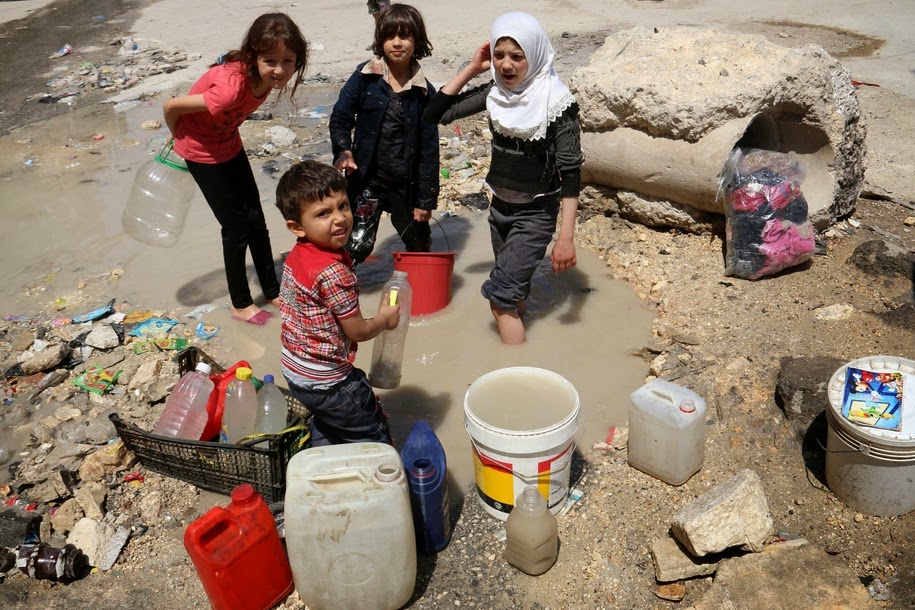
But there’s a lot more happening to explain why behind the veil of a quest for an Islamic State (IS), there’s also a war for water in Syria and Iraq. Making the plight of citizens worse is the continued targeting of water supply networks by both regime and opposition forces, which have attacked strategic lifelines, such as water channels, to gain control of territory and to punish and put pressure on their opponents.

Opening the flood gates …

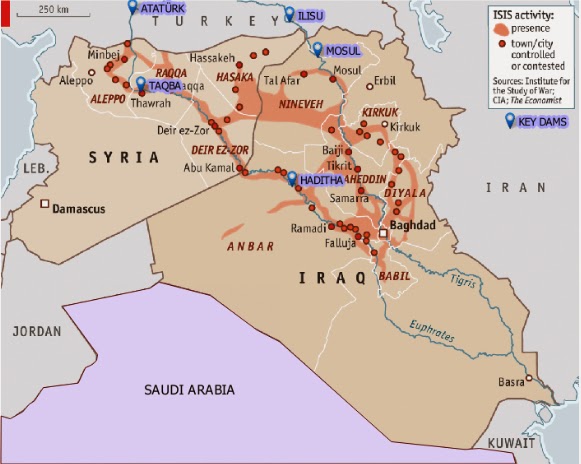
The Islamic State’s quest for hydrological control began in Syria, when it captured the Tabqa Dam in 2013. Rebel-held areas had been systematically denied electricity by President Bashar al-Assad’s forces in their effort to turn the population against the insurgency. The Tabqa Dam was built more than 40 years ago with Russian help and aimed to make Syria self-sufficient in energy production. Behind the dam is Lake Assad, which provides millions of Syrians with drinking water and is a vital irrigation source for farms. After the capture of the dam, IS opened the flood-gates to get maximum electricity supply for the areas they control and win favour with the local population. As a result, the lake dropped six metres, to a record low in May, which worsened the plight of millions of already destitute Syrians as severe water cuts began to hit Aleppo province.
Conflict over the water flowing though the Euphrates and Tigris is of course nothing new and predates religious wars. They were the first rivers to be used for large scale irrigation, in the region once known as the Fertile Crescent. Somewhere between 1720 and 1684 BC, a grandson of Hammurabi dammed the Tigris to prevent the retreat of rebels led by Iluma-Ilum, who declared the independence of Babylon. The Euphrates was already used as a weapon somewhere around 2500 BC, in another fight for Babylon, when the king of Umma cut the banks of irrigation canals alongside the Euphrates dug by his neighbor, the king of Girsu.

The Euphrates and Tigris are the two major and longest rivers in the Middle East. They both originate in Turkey. The Euphrates flows through Syria and Iraq to reach the Persian Gulf while the Tigris flows through Kurdish territory, meeting up with the Euphrates in the Southern Mesopotamian Marshes of Iraq. There are currently at least 46 dams in the Tigris-Euphrates basin, with at least 8 more planned or under construction. These dams have become key pieces of geo-political control in the region.

… and shutting down the flows

While one act of war is opening the flood gates, another is closing them. In 1974, Iraq threatened to bomb the same Tabqa Dam in Syria, alleging that the dam had reduced the flow of Euphrates River water to Iraq. But between then and now, Turkey, through its position upstream, has taken over as the most powerful regional commander of water, by completing the giant Ataturk Dam. In 1990 Syria and Iraq protested that Turkey now has a weapon of war: by closing the gates they could leave them dry. They had good reason to protest. In mid-1990 Turkish president Turgut Özal threatened to restrict water flow to Syria to force it to withdraw support for Kurdish rebels operating in southern Turkey.

In April 2014, the Islamic State blamed the low water levels in Lake Assad to Turkey’s closure of the Ataturk Dam. Sources found by Al Jazeera said that these claims are disputed. But even if the allegations are only partly true: they were used by the Islamic State to issue threats to ‘liberate Istanbul’, if that was necessary. So while Turkey, IS and Assad fight over water, millions of ordinary Syrians and Iraqi’s see their water levels drop dramatically. Not just by a new drought, with rainfall down by 50-85 percent since October 2013, but mostly due to a power struggle.

Tensions over water control in the region are set to heat up further if Turkey completes the Ilisu Dam on the Tigris River near the border of Syria. The Ilisu Dam will generate 1,200 MW and is part of the vast and ambitious Southeastern Anatolia Project, known as GAP after its Turkish title (Guneydogu Anadolu Projesi): a network comprising 22 dams and 19 power plants. The Ilisu reservoir will flood 52 villages and 15 towns, including Hasankeyf, a Kurdish town of 5,500 people, which is the only town in Anatolia that has survived since the Middle Ages and is under archaeological protection. It will displace approximately 16,000 people in the troubled Kurdish region.

The World Bank (WB), the British construction company Balfour Beatty and the Italian company Impreglio have all withdrawn from the problematic project. So have international funds and export credit from Austria, Germany and Switzerland. However, the project is currently funded by Turkish banks. Iraq and also Syria will be the most heavily impacted if the dam and others go through, with the most extreme projections holding that, owing to a combination of climate change and upstream dam activity, the Tigris and Euphrates rivers won’t have sufficient flow to reach the sea by as early as 2040.

If you live in Syria or Iraq and the water irrigating your field stops coming you might join the ranks of any army promising to attack those who kept the water for themselves – no matter if they tell you the truth or not. As is often the case in conflicts or epidemics it is not the facts themselves that count most but what people believe to be the facts. Those who can convince it’s the enemies fault that there’s not enough water will have the key to where the hearts and minds of the people will go to – no matter what the facts are.

The US finally finds a Weapon of Mass Destruction in Iraq

The Tabqa Dam is not the only dam attacked by IS. They are also trying to take the Haditha Dam, the second-largest in Iraq, raising the possibility of catastrophic damage and flooding. On Sunday, the US was bombing IS positions close to the dam. The IS militants are also fighting for control of the Euphrates River Dam, about 120 miles northwest of Baghdad and government forces were fighting to halt their advance. Insurgents from IS seized the Falluja Dam in Iraq in February and closed the floodgates to cause upstream flooding and to cut downstream water supply. Some 40.000 people were displaced just to flood the area around the city of Falluja to force government troops to retreat and lift a siege, while cutting water supplies and hydroelectricity generation for other parts of the country. All that was peanuts compared to what IS did next.

On August 7 IS captured the 1GW Mosul Dam on the Tigris – sending shock waves through Bagdad, Kuwait and the US. Whoever controls the Mosul Dam, the largest in Iraq, controls most of the country’s water and power resources. Located on the Tigris River upstream of Mosul, the dam, 3.6 km long and with 320 MW of capacity daily, formerly known as the Saddam dam, was built beginning in 1980 at a cost of 1.5$ billion USD, to bolster the regime during the Iran-Iraq war by a German-Italian consortium that was led by Hochtief Aktiengesellschaft. Its construction submerged many archaeological sites in the region yet more troubling is that because the dam was constructed on a foundation of soluble gypsum, it requires continuous grouting of the dam’s foundation to promote stability. Due to the engineering problems it presents it has been described recently by US engineers as “the most dangerous dam in the world.” And that was before the “most dangerous terror group ever” captured it.

A senior U.S. administration official said that “The failure of the Mosul Dam could threaten the lives of large numbers of civilians, threaten U.S. personnel and facilities – including the U.S. Embassy in Baghdad – and prevent the Iraqi government from providing critical services to the Iraqi populace,” (Source: Reuters). A 2006 U.S. Army Corps of Engineers report obtained by the Washington Post said the dam, which blocks the Tigris and holds 12 billion cubic meters of water, could flood two cities killing over a half a million people if it were destroyed or collapsed. The tsunami going to Mosul, a city of 1.7 million people, can be 20m high if the dam breaks with a full reservoir.

But even without a catastrophic failure, the dam is already at the epicenter of the war. Soon after the Islamic State captured the Mosul Dam they cut supplies to some villages in the north of the country that have not joined their cause. Recapturing this instrument of war was a sufficient reason for US forced to deploy air power to support Kurdish forces to recapture the dam. Saving the Yazidis from their mountain captured most media attention, but a key reason for the US to bomb Iraqi soil for the first time since 2011 was the fact that IS took the Mosul Dam. After bombing IS positions for several days, freshly re-equipped Kurdish fighters recently regained control of the dam.

Mega Dams & Water Management Practices

The importance of hydro-infrastructure in these battles and how it can be wielded firstly underlines the need for a serious re-appraisal of water management practices. Big dams (with funding from Multilateral agencies such as the WB, national and regional development banks, private equity and pension funds as well as from the Clean Development Mechanism, etc.) cause large scale displacement of populations, are ecologically destructive, wash away any other source of livelihood, and often saddle countries with debt while performing well below planned outputs as regards electricity generation. Moreover, compounded by climate change, contemporary ecological crises are leading to ever more conflict over trans-boundary water rights, such as for example between Ethiopia and Egypt, which are also on the verge of war over the construction of the Grand Renaissance and Gibe 3 dams, which would become Africa’s tallest. The world’s Big Dam Fan Club should take note of what has just happened in Syria and Iraq and realise that once disaster hits, hatred will not go to any God but to those who constructed the weapon of mass destruction. Water, rather than oil, is shaping up to be the key strategic resource in the region. More


Friday, November 7, 2014

The Man Who Creates Artificial Glaciers To Meet The Water Needs Of Ladakh

Ladakh’s beautiful mountains might be a paradise for tourists, but ask the locals who have to struggle to meet their basic water needs every year. Chewang Norphel put his engineering skills to a better use and created artificial glaciers to provide water in this cold and dry mountainous region. Know more about his remarkably innovative technology and how it works.

Chewang Norphel, a 79-year old retired civil engineer, has always been a solution provider. The story goes back to 1966 when he was posted in Zanskar, one of the most backward and remote areas in Ladakh, as Sub Divisional Officer. He, along with his team, had to construct school buildings, bridges, canals, roads etc. in that area. The task was very difficult to execute due to lack of skilled labour.

So he started doing the masonry work himself and trained a few villagers to help him. After some years, when he went back to that village, he found out that the villagers he had trained had become perfect mistry and were earning handsome salaries.

Today, he is called the “Ice Man of India” and has created 10 artificial glaciers in Ladakh to help people deal with water scarcity in this cold, mountainous region.

Ladakh, a beautiful location with magnificent scenery around and exquisite beauty, takes everyone’s breath away. But, it is not the same with the people of Ladakh as the cold, dry and infertile land makes their lives harder than we could imagine.

Fortunately, the situation is slowly changing as Ladakh now has artificial glaciers to meet their needs and people have Norphel to thank for his amazing contribution.

Born in 1936, Norphel comes from a farming background and has served in the government service for more than 36 years before he had to take an early retirement due to his bad health. Being at home was not something Norphel enjoyed doing, and at the same time, the poor living conditions in Ladakh constantly troubled him. He thought of putting his engineering skills to a better use.

“Almost all the villages in Ladakh have roads, culverts, bridges, buildings or irrigation systems made by me,”says Norphel. But his biggest contribution came in the form of artificial glaciers.

Being a cold mountain desert, Ladakh sees a low average rainfall of 50 mm annually making people dependent upon glaciers as their primary water source.

80 percent of the population depends on farming, and their main source of irrigation water is the water that comes from the melting of snow and glaciers. Because of global warming, the glaciers are receding quickly and as a result, farmers face a lot of difficulty in getting adequate water. On the other hand, a lot of water gets wasted during the winter months as, due to the severe cold climate, farmers cannot grow any crops in that season.

“So I thought that if we could conserve this water in the form of ice, it can be of help to farmers to some extent during the irrigation period, particularly during the sowing season. The artificial glaciers, being quite close to the villages, melt earlier than the natural glaciers. Also, getting water during the sowing period is the most crucial concern of the farmers because the natural glaciers start melting in the month of June and sowing starts in April and May,” he says.

The idea first came to him when he saw water dripping from a tap which was kept open so as to avoid the water from freezing in winter and bursting the tap. The water gradually froze into the shape of an ice sheet as it came in touch with the ground and made a pool.

It struck him that the water that melts from natural glaciers due to high temperatures in summer goes to waste as it flows into the river. Instead, if this water can be stored in summer and autumn so that it can form a glacier in winter, then this artificial glacier would melt in spring and provide water to the villagers at the right time.

It was now time for action, and he put all his engineering knowledge, field experience and passion to work. He started his first experiment in Phutse village. He made canals to divert the water from the main stream to small catchment areas located four kms away from the village. He also created a shaded area to keep the water frozen in winters.

And, as these glaciers are located at a lower altitude of 13,000 feet as compared to the original glaciers which are located at 18,000 feet, they start melting earlier than the mainstream ones and provide water to the villagers when they need it the most in April.

“The main technique used to create artificial glaciers is to control the velocity of water as much as possible. The region is a hilly area and that is why the gradient of streams is very steep. As a result, in the main streams the water usually does not freeze. So what we have done is we have diverted the water to a shadow area by constructing a diversion channel with a mild grade. When it reaches the site, the water is released downward of the hill, distributing it in a small quantity so that the velocity can be minimized, and side by side we have constructed ice retaining walls in series to store the frozen water. This is the entire methodology of the artificial glacier,” he explains.

Retaining walls for artificial glacier

His first project cost him Rs.90,000. The width of the glacier ranges generally from 50 to 200 feet and the depth from 2 to 7 feet. This low cost model used only locally sourced material and help from the local community. Norphel has successfully built 10 glaciers so far. The smallest one is 500 feet long in Umla and the largest is 2 km long in Phutse.

His efforts have increased the agricultural production, thereby increasing the income of the locals. This has also reduced the migration to cities. His simple technique has brought water closer to the villages, and most importantly, made it available when the villagers need it the most.

In the future, he wants to continue making the glaciers and plans to build in other areas like Lahol, Spiti, Zangskar, etc. The only thing that comes as a challenge is lack of adequate funds.

“As you sow, so you reap. There is no doubt that if one has strong determination and dedication, there is nothing impossible in the world. That is what I believe,” Norphel says.

His simple idea has received acclaim across the globe and he has proved that if man is the one responsible for disturbing nature, he also has the capacity to save it. You just need the right intention to do so. More


Thursday, November 6, 2014

AGWA Launches Toolkit for Climate Change Adaptation in Water Resources Management


4 September 2014: The Alliance for Global Water Adaptation (AGWA) and partners have launched a manual for dealing with uncertainty under climate change by applying climate-informed decision-making to water resource management, project design and risk evaluation.


The manual was launched in a seminar held during World Water Week, on 4 September.


‘Beyond Downscaling: A Bottom-Up Approach to Climate Adaptation for Water Resources Management' is the result of two years' work by AGWA, the World Bank, the Inter-American Development Bank (IDB), US Army Corps of Engineers, University of Massachusetts and RTI International, among others.


It provides practical guidelines for practitioners and project coordinators for risk-based decision making and adaptation of water systems by using a bottom-up approach. The book aims to “provide an alternative approach contributing to improvement in the quality and effectiveness of water resources management planning and project design under climate variability and change uncertainty.”


The manual covers: AGWA's approach to sustainable water management; climate change impacts on water resources; mainstreaming adaptation into water resources management; key tools for supporting climate risk assessment; and approaches to identifying adaptation strategies for water projects. It also makes the case for moving beyond down-scaling global climate models, to a bottom-up approach to climate adaptation in the water sector, and presents a framework for an AGWA-supported adaptation approach.


The approach supported by AGWA, inter alia: recognizes the need to integrate climate adaptation into existing decision-making processes; advocates for bottom-up approaches to vulnerability assessment; supports the use of “systematic decision trees based on existing water resources management approaches”; stresses the importance of creating flexible decision pathways; and emphasizes the integration of flexible governance mechanisms into water resources management.


Speaking at the launch, Marcus Wijnen, Senior Water Resources Management Specialist, World Bank, noted that the book is “work in progress,” and invited stakeholders to provide feedback. More


The 2014 World Water Week took place from 31 August-5 September, in Stockholm, Sweden. [AGWA Publication Webpage] [Publication: Beyond Downscaling: A Bottom-up Approach to Climate Adaptation for Water Resources Management] [Video of Launch]


Friday, April 11, 2014

Water Crisis: 2020 Statement by Mikhail Gorbachev on 20th Anniversary of Green Cross

Water crisis – clear and present danger

We live in urgent times. The sum of the concurrent crises that have been engulfing everything from climate to energy, to the economy, is creating a spiral of need for change. But the water crisis sticks out of this list in terms of being an explicitly clear and present danger with deadly implications.

Mikhail Gorbachev

The mounting water crisis and its geography make it clear that without resolute counteraction, it will overstretch many societies’ adaptive capacities within the coming decades. This could result in massive migration, severe socio-economic stress, destabilization and violence, jeopardizing national and international security to a new degree.

By 2025, a predicted 1.8 billion people will live in regions suffering from absolute water scarcity. Two-thirds of the world population could be under hydric stress conditions. Demand for water will rise: water withdrawals in developing countries will increase by 50%, and 18% in developed countries by 2025.

Despite these demands, what state is the world’s water in? Despite the fact that we use slightly more than half the world’s (54%) accessible water, more than 50% of the 3.5 billion people living in urban circumstances around the world already do not have access to adequate water and sanitation.

But the really bad news is that the water use is growing even faster than the population: the 20th century water consumption grew twice as fast as the world population. As a result, a third of the world's population lives in water-stressed countries now. By 2025, this is expected to rise to two-thirds.

In addition to unsustainable water use we are polluting our lakes, rivers and streams to death. Most wastewater (about 80%) from residential and industrial sources enters the environment untreated.

The growing human need for water, to sustain life and wellbeing, plus the pressures on the resource itself, from mismanagement, pollution and a general lack of foresight, make for the most telling case for improved global water conservation and consumption.

But too little is being done on these fronts. We have been waiting since 1997 for just 35 countries to sign the UN Watercourses Convention, to promote the management and sharing of the world’s 276 cross-border rivers and connected underground water sources, and we are still a handful short.

The lack of a global framework to manage water sources that cross national borders endangers the world in many ways, not least of all in terms of the risk of conflict between countries over who controls the same river that runs through their respective frontiers.

Then there is the Right to Water and Sanitation, which Green Cross was a loud advocate of before it finally came into being in 2010. While this recognition itself, that access to safe drinking water and sanitation are basic human rights, is a success, what must be happening at breakneck speed now is the realization of this right. This means creation of national legislation enshrining the right (alongside education, health and others) and investing in the infrastructure needed to make safe water and sanitation services available to all.

Despite UN adoption of this vital principle, the deficit of fresh water is becoming increasingly severe and large-scale – whereas, unlike other resources, there is no substitute for water.

While the Millennium Development Goal for access to drinking water and sanitation was announced met in 2012, almost 800 million people still have no access to safe water today, and three times that number lack adequate sanitation. Thousands of children die daily in the developing world due to related waterborne diseases.

The scale and global nature of the water crisis demand stronger statesmanship, vision and international action. To master the water crisis, we must address its effects and causes. The economic, social, water and environmental aspects must be properly coordinated in any response.

A comprehensive “water goal” must be injected into the post-2015 development agenda, linking development and environment in analyses and in governance policies. Such a goal would address the three interdependent dimensions of water: water, sanitation and hygiene; water management; and wastewater management and water quality.

This goal must be based on principles of equity, solidarity, recognition of limits of planet and rights approach, coupled with effective means to check and demand the accountability of all stakeholders.

We live in volatile and transformative times, faced with the awe-inspiring global challenge of climate change, the devastation of civil wars, and the hope-crushing scourge of extreme poverty. But one thing is constant: our need for water. Whole regions are languishing in poverty and conflict, effectively held hostage by their hydrology: we must break this cycle and give people a chance for their future. Benjamin Franklin said that "when the well's dry, we know the worth of water." The alarm clock has been ringing on deaf ears for far too long, it is time to wake-up before it is too late, before the wells of the world have run dry. More


Wednesday, April 17, 2013

Capitalism Is Great, But It Assigns No Value To Your Grandchildren, GRANTHAM

It started [in the mid-1990s] with a visit to the Amazon and to Borneo with the kids. And without thinking about it you start talking about the logs along the side of the river and the lack of mature forests in Borneo.

Jeremy Grantham

We were on family trips and happened to do a couple of tropical forests back to back. I'm sure that played a role, but we didn't treat it as an epiphany. I would argue that one of our children got there first. While we were environmentalists, but low key, one of my sons happened to get a job which saw him end up in a dry tropical forest in Paraguay for five years and then off into the forestry business. Shortly behind that, we [his investment company GMO] began to follow that interest in forestry. We started our own forestry operation 15 years ago [at GMO] because our interest in forestry and of our realisation that land is so important. Forests were mispriced and were an attractive investment. My interest in forestry at that point was entirely commercial and then it began to morph into a decent investment, plus, "look how important these forests are to maintain fresh water, carbon sequestration, etc"…

I picked up none of that [James Hansen's 1988 testimony before Congress on climate change and the 1992 Rio Earth Summit]. No. Absolutely not. I was following along afterwards [once the foundation launched in 1997] asking the big NGOs where was the leverage for the birds flying through Costa Rica and Panama. Let's put our money there. Where were the hotspots? The climate question wasn't there for me at that time. Now it is at least half of the focus for the foundation. And in the other half it brushes up against climate all the time. We are late arrivals to all this and I have nothing but admirations to those who beat me to the punch by a few decades.

On why his environmental interests moved beyond habitat conservation:

I was a moderate environmentalist 10-15 years ago. But then I started to get embroiled in resources and that [the rise in price of] oil was the first paradigm shift that we'd ever come across in an important asset class, and nothing is more important than oil. I realised that the price of oil had changed forever and is not going back to the old $15 a barrel. There had been a majorly important shift. That led us to asking the question, why only oil? Why not every finite resource? And so we ended up about four years ago saying, "watch out, we seem to be running out of things". Two years ago, we did a very detailed paper which took on a life of its own and helped to put these issues onto institutional agenda items, I think. That led me to the realisation, by looking at the data, that between population growth and China gobbling up the world that the world had changed – and dangerously so – and hidden under that that oil and food were the two most dangerous components and within that [the availability of] phosphorous was perhaps the most dangerous long-term issue of all. Digging into the phosphate problem, you realised that it can be handled, but only if the great majority of the world is fed via sustainable farming which means nurturing the soil and having it once again full of micro-organisms. If you kill them every year with herbicides and pesticides then you're dealing basically with sand. You've got to restore and renew the ability to grow by re-applying all the nutrients in very big, expensive doses every year. This is in contrast to well-nurtured soil. There's a 30-year patch in Pennsylvania at the Rodale Institute where they've never put on any phosphorous at all and they are getting productivity equal to regular farming up the road.

We arrived at all this just by looking at the numbers and the more I did the more I became concerned that we were already deep into a food crisis. Arab Spring countries were already getting throttled a bit by rising price of energy and food. They don't spend 8-10% of their budget on these, they spend 40%. So when that starts to double on you, you can see how quickly why people take to the streets. And that's where we are. The rich countries are really not that concerned and their casual behaviour is only serving to push up the price which is not that big a deal to them, certainly not the movers and shakers who make all the money. But it's a terrible deal for the poor half of the world and a disaster for the poorest 10% or so. That's the world we're in and it could lead to country after country being destabilised.
It has forced me to go back and read all the classics. On my iPad I think I have 40 or so books now. I recommend a book by a scholar who summarises all these works back to Gibbon's Decline and Fall of the Roman Empire. It's calledImmoderate Greatness: Why Civilisations Fail by William Ophuls. And then there's perhaps my favourite book of a more detailed type which is called Dirt: The Erosion of Civilisation [by David R Montgomery]. That's a really good read. Then there's Collapse by Jared Diamond, which seems to have done quite well and is reasonable. A lot of details are queried by the experts in the field, but I thought it was fine. Then there are books on peak oil and shortages of raw materials. Books on the whole package of long-term growth on a finite planet, going back to the Limits to Growth and a book by one of the co-authors that looks at the next 40 years. That's called 2052 [by Jorgen Randers]. And so on and so forth.

On the strengths and weaknesses of capitalism:

Capitalism does millions of things better than the alternatives. It balances supply and demand in an elegant way that central planning has never come close to. However, it is totally ill-equipped to deal with a small handful of issues. Unfortunately, today, they are the issues that are absolutely central to our long-term wellbeing and even survival. It doesn't think long-term very well because of high discount rate structure. If you're a typical corporation anything lying out 30 years literally doesn't matter. Or, as I like to say: QED, your grandchildren have no value. And they usually act as if that was true, even though I'm sure they are actually very kind to their grandchildren. More


Sunday, February 17, 2013

Thursday, December 27, 2012

Rhamis Kent Permaculturist, on Islam & Earth Repair

In our first podcast, Krystina sits down with Rhamis Kent, a Permaculture consultant who travels all over the Middle East and North Africa advising governments and organizations on how they can engage in ecosystem restoration in order to increase biodiversity and sustain plant, animal, and human life.

In this interview, they discuss his recent article entitled “Restoring the Amanah Through Earth Repair: Islam, Permaculture, and Ecosystem Restoration Work.” Download the podcast here.


Krystina Friedlander: I want to start by asking you about Ibn Khaldun, a Tunisian historiographer who lived in the 14th century. You wrote that he warned people about the “pleasures of civilization.” What might he say about what we’re seeing now in terms of environmental degradation and industrialization?

Rhamis Kent: Well, I think it’s a proof to what he’s pointing to in his work. The Muqaddimah is a book where he’s examining the causes for the rise and fall of civilizations. As far as what he means by the “pleasures of civilization,” I think the easier things become, the more convenient our day-to-day living becomes, the more distanced we are from really understanding what it is that we need in order to sustain our lives, the more distance we have between ourselves and the natural world. There’s this artificial separation, a misunderstanding of exactly where we are oriented within that order. It creates a type of lethargy where you become very disoriented, and you don’t realize the impact your actions are having on the things you actually need in order to survive. Ibn Khaldun, he called it very accurately, and we’re seeing the advanced stages of some of the types of decline that he’d spoken of in his work. More


Wednesday, November 7, 2012

UN Reports That Up To 90% Of Deforestation Is Due To Organized Crime

GREEN CARBON - BLACK TRADE

ILLEGAL LOGGING,TAX FRAUD ANDLAUNDERING IN THE WORLD’STROPICAL FORESTS

Environmental crime and the illegal grabbing of natural resources is becoming an evermore sophisticated activity requiring national authorities and law enforcement agencies to develop responses commensurate with the scale and the complexity of the challengeto keep one step ahead.


This report – Green Carbon, Black Trade – by UNEP and INTER-POL focuses on illegal logging and its impacts on the lives andlivelihoods of often some of the poorest people in the world setaside the environmental damage. It underlines how criminalsare combining old fashioned methods such as bribes with hightech methods such as computer hacking of government websites to obtain transportation and other permits. The reportspotlights the increasingly sophisticated tactics being deployedto launder illegal logs through a web of palm oil plantations,road networks and saw mills.

Indeed it clearly spells out that illegal logging is not on the decline, rather it is becoming more advanced as cartels becomebetter organized including shifting their illegal activities inorder to avoid national or local police efforts. By some estimates,15 per cent to 30 per cent of the volume of wood traded globallyhas been obtained illegally. Unless addressed, the criminal ac-tions of the few may endanger not only the development pros-pects for the many but also some of the creative and catalyticinitiatives being introduced to recompense countries and com-munities for the ecosystem services generated by forests.

One of the principal vehicles for catalyzing positive environ-mental change and sustainable development is the ReducedEmissions from Deforestation and Forest Degradation initia-tive (REDD or REDD+). If REDD+ is to be sustainable over thelong term, it requests and requires all partners to fine tune theoperations, and to ensure that they meet the highest standardsof rigour and that efforts to reduce deforestation in one locationare not offset by an increase elsewhere.


If REDD+ is to succeed, payments to communities for theirconservation efforts need to be higher than the returns from ac-tivities that lead to environmental degradation. Illegal loggingthreatens this payment system if the unlawful monies chang-ing hands are bigger than from REDD+ payments.

The World’s forests represent one of the most important pil-lars in countering climate change and delivering sustainabledevelopment. Deforestation, largely of tropical rainforests, isresponsible for an estimated 17 per cent of all man-made emis-sions, and 50 per cent more than that from ships, aviation andland transport combined. Today only one-tenth of primary for-est cover remains on the globe.

Forests also generate water supplies, biodiversity, pharma-ceuticals, recycled nutrients for agriculture and flood pre-vention, and are central to the transition towards a GreenEconomy in the context of sustainable development and pov-erty eradication.

Strengthened international collaboration on environmentallaws and their enforcement is therefore not an option. It is in-deed the only response to combat an organized internationalthreat to natural resources, environmental sustainability andefforts to lift millions of people out of penury. Download Report


Achim Steiner UN Under-Secretary General and UNEP Executive Director

Ronald K. Noble INTERPOL Secretary General


Full Planet, Empty Plates: Quick Facts

With falling water tables, eroding soils, and rising temperatures making it difficult to feed growing populations, control of arable land and water resources is moving to center stage in the global struggle for food security. What will the geopolitics of food look like in a new era dominated by scarcity and food nationalism? Here are a few of the many facts from the book to consider:


  • There will be 219,000 people at the dinner table tonight who were not there last night—many of them with empty plates.
  • As a result of chronic hunger, 48 percent of all children in India are undersized, underweight, and likely to have IQs that are on average 10-15 points lower than those of well-nourished children.
  • Food prices are rising dramatically. The U.N. Food Price Index in June 2012 was twice the base level of 2002-04.
  • More than half the world’s people live in countries where water tables are falling as aquifers are being depleted.
  • A startling 80 percent of oceanic fisheries are being fished at or beyond their sustainable yield.
  • Between 2005 and 2011, the amount of grain used to produce fuel for cars in the United States climbed from 41 million to 127 million tons—nearly a third of the U.S. grain harvest.
  • In 2011, China consumed 70 million tons of soybeans, 56 million of which had to be imported. Almost all went into livestock feed.
  • Today, with incomes rising fast in emerging economies, there are at least 3 billion people moving up the food chain, consuming more grain-intensive livestock and poultry products.
  • Data for India indicate that 175 million people are being fed with grain produced by overpumping. For China, there are 130 million in the same boat.
  • In Ethiopia, a prime target for foreign land acquisitions yet also a major food aid recipient, an acre of land can be leased for less than $1 per year.
  • The 464 land acquisitions identified by the World Bank in 2010 totaled some 140 million acres—more than is planted in corn and wheat combined in the United States.
  • It’s not all bad news: 44 countries have reached population stability as a result of gradual fertility decline over the last several generations.
“In this era of tightening world food supplies, the ability to grow food is fast becoming a new form of geopolitical leverage. Food is the new oil. Land is the new gold.” – Lester R. Brown


Full Planet, Empty Plates: The New Geopolitics of Food Scarcity is available for purchase online. Get a sneak peek by checking out Chapter 1: Food the Weak Link or watch the five minute video below and hear from Lester Brown himself about the main issues raised in the book.


Friday, October 5, 2012

Journey into Ecological Resurgence: John Liu at TEDxWageningen

Journey into Ecological Resurgence: John Liu at TEDxWageningen

Published onAug 14, 2012byTEDxTalks

952 views


16 likes, 0 dislikes
For 15 years, in the 1980's and early 1990's, John worked as a television journalist in China for CBS News, Radiotelevisione Italiana (RAI), and Zweites Deutsches Fernsehen (ZDF German Television). Over the years he had to do virtually every job in remote television production and gained some skills that were in demand.
As John grew in his work he was also observing China as it emerged from isolation and poverty. It was exhilarating to see China stand up but terrifying to consider the pollution and environmental implications of its rise. John would go to his office and think, "someone should really do something about the environment", but what he meant was "someone else". After some time he began to feel that his own attitude was part of the problem. If John was unwilling to change his life, why would anyone else? At this point he decided to found the "Environmental Education Media Project for China (EEMPC)" and to devote his energies to understanding and communicating about the environment and ecology. Since the mid-1990's, the EEMPC has distributed hundreds of existing films in China and John have made dozens of environmental and ecological films in China and around the world.

In the spirit of ideas worth spreading, TEDx is a program of local, self-organized events that bring people together to share a TED-like experience. At a TEDx event, TEDTalks video and live speakers combine to spark deep discussion and connection in a small group. These local, self-organized events are branded TEDx, where x = independently organized TED event. The TED Conference provides general guidance for the TEDx program, but individual TEDx events are self-organized.* (*Subject to certain rules and regulations)

Friday, August 31, 2012

World Forest Area Still on the Decline

Forests provide many important goods, such as timber and paper. They also supply essential services—for example, they filter water, control water runoff, protect soil, regulate climate, cycle and store nutrients, and provide habitat for countless animal species and space for recreation.

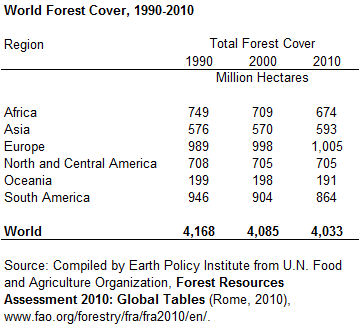
Forests cover 31 percent of the world’s land surface, just over 4 billion hectares. (One hectare = 2.47 acres.) This is down from the pre-industrial area of 5.9 billion hectares. According to data from the U.N. Food and Agriculture Organization, deforestation was at its highest rate in the 1990s, when each year the world lost on average 16 million hectares of forest—roughly the size of the state of Michigan. At the same time, forest area expanded in some places, either through planting or natural processes, bringing the global net loss of forest to 8.3 million hectares per year. In the first decade of this century, the rate of deforestation was slightly lower, but still, a disturbingly high 13 million hectares were destroyed annually. As forest expansion remained stable, the global net forest loss between 2000 and 2010 was 5.2 million hectares per year.

Global rates of deforestation do not capture the full damage done to the world’s forests. Forest degradation from selective logging, road construction, climate change, and other means compromises the health of remaining forests. Each year the world has less forested area, and the forests that remain are of lower quality. For example, replacing natural old-growth forests with a monoculture of an exotic species greatly reduces biodiversity.

The spread of planted forests has been accelerating, rising from an expansion of 3.7 million hectares annually in the 1990s to 4.9 million hectares annually the following decade. Planted forests now cover some 264 million hectares, comprising nearly 7 percent of total forest area. Plantations now have the potential to produce an estimated 1.2 billion cubic meters of industrial wood each year, about two thirds of current global wood production. Where forests have already been cleared, plantations can alleviate the pressure on standing forests.

Forests are primarily threatened by land clearing for agriculture and pasture and by harvesting wood for fuel or industrial uses. In Brazil—which has lost 55 million hectares since 1990, an area three fourths the size of Texas—land clearing for farms and ranches is the big driver. Home to the Amazon rainforest, Brazil contains 13 percent of the world’s forested area, second only to Russia’s 20 percent. Between 2000 and 2010, Brazil lost 2.6 million hectares of forest each year, more than any other country. Brazil is trying to reduce deforestation rates 80 percent from the 1996–2005 average by 2020 and has in fact seen a large drop in deforestation in recent years. But rising beef, corn, and soybean prices are likely to pressure the government to weaken its forest protection, further threatening the world’s largest rainforest. More