Showing posts with label earth. Show all posts

Thursday, December 27, 2012

Rhamis Kent Permaculturist, on Islam & Earth Repair

In our first podcast, Krystina sits down with Rhamis Kent, a Permaculture consultant who travels all over the Middle East and North Africa advising governments and organizations on how they can engage in ecosystem restoration in order to increase biodiversity and sustain plant, animal, and human life.

In this interview, they discuss his recent article entitled “Restoring the Amanah Through Earth Repair: Islam, Permaculture, and Ecosystem Restoration Work.” Download the podcast here.


Krystina Friedlander: I want to start by asking you about Ibn Khaldun, a Tunisian historiographer who lived in the 14th century. You wrote that he warned people about the “pleasures of civilization.” What might he say about what we’re seeing now in terms of environmental degradation and industrialization?

Rhamis Kent: Well, I think it’s a proof to what he’s pointing to in his work. The Muqaddimah is a book where he’s examining the causes for the rise and fall of civilizations. As far as what he means by the “pleasures of civilization,” I think the easier things become, the more convenient our day-to-day living becomes, the more distanced we are from really understanding what it is that we need in order to sustain our lives, the more distance we have between ourselves and the natural world. There’s this artificial separation, a misunderstanding of exactly where we are oriented within that order. It creates a type of lethargy where you become very disoriented, and you don’t realize the impact your actions are having on the things you actually need in order to survive. Ibn Khaldun, he called it very accurately, and we’re seeing the advanced stages of some of the types of decline that he’d spoken of in his work. More



Thursday, September 20, 2012

Irreplaceable Real Estate: What is Plan B?

Climate change is the most serious peril that has faced humanity in its long history. However, we are faced with more than climate change, there is peak oil and an out of control population, as well as concerns for water and food security in the years to come.


As I keep repeating “failing to plan is planning to fail”.

Humanity is today, to use an American term, playing in the major leagues. We are in a sink or swim situation. If we can keep the planet habitable by mitigating and adapting to the changing climate, switching to alternative sources of energy such as solar, wind, geothermal, wave, ocean thermal and nuclear, sequester CO2 and provide the population with adequate supplies of water and food and bring the population under control, humanity may survive .

Warfare and conflict will also need to become a thing of the past as climate change and energy may well exacerbate conflict situations. With a 9.5 billion global population by 2050 ensuring that everyone has adequate food and water could be problematic.

There is however, no ‘Plan B’ if we fail to resolve all the problems facing us.

When playing in this major leagues club there is no time out, there is no one that is going to offer help, let alone rescue us. Look around, the neighbourhood is somewhat sparsely populated and there are no other worlds on which humanity can survive. Even if there were other habitable worlds nearby they would in all probability belong to someone else.

There are, in all likelihood, other intelligent races out there somewhere, however in the major leagues one survives on ones own. As a young civilisation it is up to us to solve all our problems, to make peace among ourselves, to bring the population under control, to implement the Millennium Development Goals (MDG), to bring equality to all peoples. We must solve our own problems. As a young race we are as children, and as such we may not be able to solve our own problems. But solve them we must.

If we are able to solve the situation facing us and make it to adulthood, in the galactic meaning of the world, we may then be introduced to the neighbours.

If we do not make it to adulthood we will be just another minor statistic, a failure, a insignificant footnote in the universal history book. Nick Robson, Editor. © 2011


This video may contain copyrighted material & is the property of the respective authors, artists and labels. This video was compiled by sebastiansz


Thursday, July 26, 2012

A comfortable home: To be honest, our only home!

This is a non-commercial attempt from www.sanctuaryasia.com to highlight the fact that world leaders, irresponsible corporates and mindless 'consumers' are combining to destroy life on earth. It is dedicated to all who died fighting for the planet and those whose lives are on the line today. The cut was put together by Vivek Chauhan, a young film maker, together with naturalists working with the Sanctuary Asia network (www.sanctuaryasia.com Content credit: The principal source for the footage was Yann Arthus-Bertrand's incredible film HOME www.homethemovie.org The music was by Armand Amar. Thank you too Greenpeace and timescapes.org

Saturday, July 14, 2012

Global fight for natural resources 'has only just begun'

Academics and business figures gave a grim warning at the Resource 2012 conference, but defended the Rio+20 outcomes

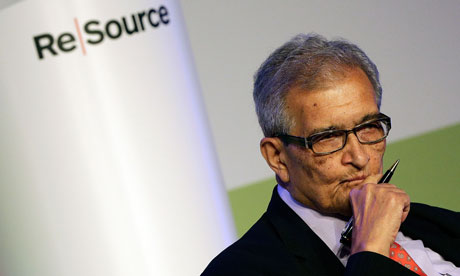
Nobel prize-winning economist Amartya Sen


The global battle for natural resources – from food and water to energyand precious metals – is only beginning, and will intensify to proportions that could mean enormous upheavals for every country, leading academics and business figures told a conference in Oxford on Thursday.

Sir David King, former chief scientific adviser to the UK government, who convened the two-day Resource 2012 conference, told the Guardian: "We are nowhere near realising the full impact of this yet. We have seen the first indications – rising food prices, pressure on water supplies, a land grab by some countries for mining rights and fertile agricultural land, and rising prices for energy and for key resources [such as] metals. But we need to do far more to deal with these problems before they become even more acute, and we are not doing enough yet."

Countries that are not prepared for this rapid change will soon – perhaps irrevocably – lose out, with serious damage to their economies and way of life, the conference was told.

Amartya Sen, a Nobel prize-winning economist, said that the free market would not necessarily provide the best solution to sharing out the world's resources. Governments would need to step in, he said, to ensure that people had access to the basics of life, and that the interests of businesses and the financial markets did not win out over more fundamental human needs.

Sen has played a key role as an academic in showing how the way resources are distributed can impact famine and surplus more than the actual amount of resources, that are available, particularly food.

David Nabarro, special representative for food security and nutrition at the United Nations Special, defended the outcomes of last month's Rio+20 conference – a global summit that was intended to address resource issues and other environmental problems, including pollution, climate change and the loss of biodiversity, all of which are likely to have knock-on effects that will exacerbate resource shortages. More