HRH the Prince of Wales addresses a session of the IUCN World Conservation Congress on the urgent need of bringing agriculture and conservation back together. "There is much to learn if we let nature be our guide", says Charles, Prince of Wales.
Showing posts with label ecosystems. Show all posts
Showing posts with label ecosystems. Show all posts
Wednesday, August 29, 2012
Tuesday, July 31, 2012
We Can Reforest the Earth
Protecting the 10 billion acres of remaining forests on earth and replanting many of those already lost are both essential for restoring the earth’s health. Since 2000, the earth’s forest cover has shrunk by 13 million acres each year, with annual losses of 32 million acres far exceeding the regrowth of 19 million acres. Restoring the earth’s tree and grass cover protects soil from erosion, reduces flooding, and sequesters carbon.
 Global deforestation is concentrated in the developing world. Tropical deforestation in Asia is driven primarily by the fast-growing demand for timber and increasingly by the expansion of oil palm plantations for fuel. In Latin America, the fast-growing markets for soybeans and beef are together squeezing the Amazon. In Africa, the culprit is mostly fuelwood gathering and land clearing for agriculture.
In recent years, the shrinkage of forests in tropical regions has released 2.2 billion tons of carbon into the atmosphere annually. Meanwhile, expanding forests in the temperate regions are absorbing close to 700 million tons of carbon. On balance, therefore, some 1.5 billion tons of carbon are released into the atmosphere each year from forest loss, roughly one fourth as much as from fossil fuel burning.
Fortunately, there is a vast unrealized potential in all countries to lessen the various demands that are shrinking the earth’s forest cover. In industrial nations, the greatest opportunity lies in reducing the amount of wood used to make paper. The goal is first to reduce paper use and then to recycle as much as possible. The rates of paper recycling in the top 10 paper-producing countries range widely, but South Korea, which recycles an impressive 91 percent, stands out. If every country recycled as much of its paper as South Korea does, the amount of wood pulp used to produce paper worldwide would drop by more than one third.
In developing countries, the focus needs to be on reducing fuelwood use. Indeed, fuelwood accounts for just over half of all wood removed from the world’s forests. Some international aid agencies, including the U.S. Agency for International Development and the United Nations Foundation, are sponsoring projects to increase fuelwood efficiency through the use of more efficient cookstoves. Over the longer term, pressure on forests can be reduced by replacing firewood with solar thermal cookers or even with electric hotplates powered with renewable energy. More

In recent years, the shrinkage of forests in tropical regions has released 2.2 billion tons of carbon into the atmosphere annually. Meanwhile, expanding forests in the temperate regions are absorbing close to 700 million tons of carbon. On balance, therefore, some 1.5 billion tons of carbon are released into the atmosphere each year from forest loss, roughly one fourth as much as from fossil fuel burning.
Fortunately, there is a vast unrealized potential in all countries to lessen the various demands that are shrinking the earth’s forest cover. In industrial nations, the greatest opportunity lies in reducing the amount of wood used to make paper. The goal is first to reduce paper use and then to recycle as much as possible. The rates of paper recycling in the top 10 paper-producing countries range widely, but South Korea, which recycles an impressive 91 percent, stands out. If every country recycled as much of its paper as South Korea does, the amount of wood pulp used to produce paper worldwide would drop by more than one third.
In developing countries, the focus needs to be on reducing fuelwood use. Indeed, fuelwood accounts for just over half of all wood removed from the world’s forests. Some international aid agencies, including the U.S. Agency for International Development and the United Nations Foundation, are sponsoring projects to increase fuelwood efficiency through the use of more efficient cookstoves. Over the longer term, pressure on forests can be reduced by replacing firewood with solar thermal cookers or even with electric hotplates powered with renewable energy. More

Friday, July 27, 2012
GDP Cannot Capture the Economics of Climate Change
The newest GDP release shows an increase of 1.5 percent in the second quarter of 2012, down from a 1.9 percent growth in the first quarter and three percent growth in 2011. But, as Dēmos continually asks in our Beyond GDPwork: What exactly is GDP measuring?
 GDP doesn't measure things that are good for our economy and society, like home production and volunteer work, and doesn't count things that are bad, like inequality and pollution. More pressingly, GDP cannot reflect the importance of ecosystem services and without valuing them, preserving them becomes only a cost and not a benefit. As we see more and more impacts from climate change, ecosystems play a vital role in adaptation and mitigation practices, not just as carbon sinks, but also by reducing erosion, providing shade and providing fresh air and water. Yet, their importance does not show up in GDP calculations.
The main difficulty with valuing ecosystems has always been pricing- how do you put a price on forests that act as carbon sinks? There are efforts to start to capture these values, including the System for Environment and Economic Accounts, which provides methods for countries to account for natural resources like minerals, timber and fisheries. There is also the Inclusive Wealth Index, which includes natural capital, in addition to manufactured and human capital, as part of a nation's overall capital assets. Currently, at least 24 countries use some form of natural capital accounting.
While not widely used yet, capturing the value that ecosystems currently provide seems tangible. The more challenging accounting question is how do we capture future costs? The recent heat waves are causing damage not just to natural environments, but also to our built environments. Airplanes are getting stuck in asphalt that has softened from heat, subway trains are derailing after tracks become warped, and highways are shrinking, leading to cracking, because the soil under them is getting too dry. So, how do we capture the role that healthy ecosystems play in preventing these future impacts and costs? More

The main difficulty with valuing ecosystems has always been pricing- how do you put a price on forests that act as carbon sinks? There are efforts to start to capture these values, including the System for Environment and Economic Accounts, which provides methods for countries to account for natural resources like minerals, timber and fisheries. There is also the Inclusive Wealth Index, which includes natural capital, in addition to manufactured and human capital, as part of a nation's overall capital assets. Currently, at least 24 countries use some form of natural capital accounting.
While not widely used yet, capturing the value that ecosystems currently provide seems tangible. The more challenging accounting question is how do we capture future costs? The recent heat waves are causing damage not just to natural environments, but also to our built environments. Airplanes are getting stuck in asphalt that has softened from heat, subway trains are derailing after tracks become warped, and highways are shrinking, leading to cracking, because the soil under them is getting too dry. So, how do we capture the role that healthy ecosystems play in preventing these future impacts and costs? More
Thursday, July 26, 2012
A comfortable home: To be honest, our only home!
This is a non-commercial attempt from www.sanctuaryasia.com to highlight the fact that world leaders, irresponsible corporates and mindless 'consumers' are combining to destroy life on earth. It is dedicated to all who died fighting for the planet and those whose lives are on the line today. The cut was put together by Vivek Chauhan, a young film maker, together with naturalists working with the Sanctuary Asia network (www.sanctuaryasia.com Content credit: The principal source for the footage was Yann Arthus-Bertrand's incredible film HOME www.homethemovie.org The music was by Armand Amar. Thank you too Greenpeace and timescapes.org
Friday, July 6, 2012
Regeneration for real on the Ground and in Your Mind
Film of the Bristol Green Week Schumacher Lecture 2012: Regeneration for real on the Ground and in Your Mind (more info below). The other green week films can be found here: www.permanentculturenow.com More on Schumacher here: www.schumacher.org.uk More on Bristol green week: biggreenweek.com Regeneration for Real: on the Ground and in Your Mind. Speakers: Kevin McCloud (Channel 4's Grand Designs), Rob Hopkins (Transition Towns Co-founder) & Tim Smit (Founder of the Eden Project). Tonight's speakers personify regeneration -- bringing new life. Through Kevin's work we experience a continuous flow of innovation in design; Rob has brought us the model of the resilient community, and Tim has created one of the most inspiring projects in the country. More info on the speakers: Kevin McCloud Founder of Hab Housing, Author, Broadcaster and Designer. Kevin is best known for the BAFTA-nominated Grand Designs and the Stirling Prize. In 2009 he won a Prix Italia for his Grand Tour. He has made series about architecture, design and urban planning and is currently filming a series about a shed. In 2006 Kevin formed the development company Hab Housing. In partnership, the company is now building sustainable housing schemes across the West of England and last year completed their first scheme, The Triangle in Swindon, which was televised as a three-part series Kevin's Grand Design on Channel 4 in December. www.habhousing.co.uk Rob Hopkins Rob Hopkins is the co-founder of the Transition <b>...</b>
Saturday, June 23, 2012
The Earth Cannot Be Saved by Hope and Billionaires
Rio 2012: it's a make-or-break summit. Just like they told us at Rio 1992
 World leaders at Earth summits seem more interested in protecting the interests of plutocratic elites than our environment
Worn down by hope. That's the predicament of those who have sought to defend the earth's living systems. Every time governments meet to discuss the environmental crisis, we are told that this is the "make or break summit", on which the future of the world depends. The talks might have failed before, but this time the light of reason will descend upon the world.
This week's earth summit in Rio de Janeiro is a ghost of the glad, confident meeting 20 years ago. By now, the leaders who gathered in the same city in 1992 told us, the world's environmental problems were to have been solved. But all they have generated is more meetings, which will continue until the delegates, surrounded by rising waters, have eaten the last rare dove, exquisitely presented with an olive leaf roulade. The biosphere that world leaders promised to protect is in a far worse state than it was 20 years ago. Is it not time to recognise that they have failed?
If world governments do not have the vision, the foresight and the compassion to do the right thing, then it is up to us, the People, to bring about change, and if change means a change of government, so be it. This is about a planetary emergency, about a decent life for our children, about our childrens survival. Editor
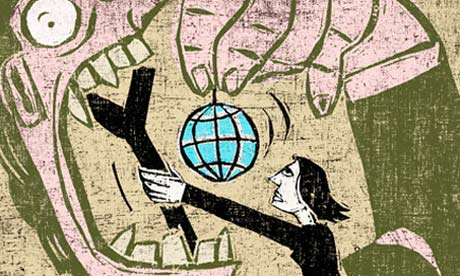
Worn down by hope. That's the predicament of those who have sought to defend the earth's living systems. Every time governments meet to discuss the environmental crisis, we are told that this is the "make or break summit", on which the future of the world depends. The talks might have failed before, but this time the light of reason will descend upon the world.
We know it's rubbish, but we allow our hopes to be raised, only to witness 190 nations arguing through the night over the use of the subjunctive in paragraph 286. We know that at the end of this process the UN secretary general, whose job obliges him to talk nonsense in an impressive number of languages, will explain that the unresolved issues (namely all of them) will be settled at next year's summit. Yet still we hope for something better.'To see Obama backtracking on the commitments made by Bush the elder 20 years ago is to see the extent to which a tiny group of plutocrats has asserted its grip on policy.' Illustration above by Daniel Pudles
This week's earth summit in Rio de Janeiro is a ghost of the glad, confident meeting 20 years ago. By now, the leaders who gathered in the same city in 1992 told us, the world's environmental problems were to have been solved. But all they have generated is more meetings, which will continue until the delegates, surrounded by rising waters, have eaten the last rare dove, exquisitely presented with an olive leaf roulade. The biosphere that world leaders promised to protect is in a far worse state than it was 20 years ago. Is it not time to recognise that they have failed?
If world governments do not have the vision, the foresight and the compassion to do the right thing, then it is up to us, the People, to bring about change, and if change means a change of government, so be it. This is about a planetary emergency, about a decent life for our children, about our childrens survival. Editor
Tuesday, May 29, 2012
John Lius's Green Gold Documentary
John Lius, a photographer, discovered almost by accident, how to rehabilitate damaged ecosystems.
Subscribe to:
Posts (Atom)