Showing posts with label human rights. Show all posts

Wednesday, November 19, 2014

Secrets: shining a light on hidden power

The truth can be a slippery thing. We each have a version but it slips and slides about in our minds as we deal with the constant flood of information coming at us from all sides, not to mention trying to balance this expert view against that, between what we know, what we think we know, and what we suspect.

We are all at the mercy of cognitive biases and layers of assumptions and associations built up over our lifetimes. And so we need reference points to help mark the key geographical features of our worldview. And, sometimes, we need some of those reference points visible in our world, amongst our tribes of friends, colleagues, allies and families. It’s very difficult for most of us to make our way in the world and act with the determination we often crave without some acknowledgement that we’re not the only ones seeing the world as we do. The bigger the thought, the less pleasant it is to assimilate, and the further out from the mainstream it lives, the more important that acknowledgment can be.

The 1%-99% Occupy meme was one of those markers. The reason it travelled so far and fast wasn’t because it told people something altogether new, but rather that it capped off and gave voice to thoughts they already had. It didn’t teach as much as it validated and articulated.

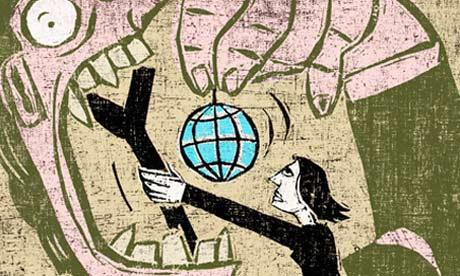
At /The Rules, we think its time for a new marker; one that grows very much from the 1%-99% meme, and, hopefully, adds something important. And it’s that we now all live on a One Party Planet.

This is a provocative claim, pregnant with meaning and implication. If it’s true in the way we believe it to be, it means there is an identifiable form of totalitarianism casting a shadow over the entire human race. It means that there is a force so broad, so enmeshed within the logic of modern global power, that the solutions we all work toward in the specific struggles we care most about – be that rampant inequalities in income and opportunity, widespread poverty, or climate change - are all facing it. Not a force that lives in any single person, organization or structure, but that is ephemeral in the way that all ideology is ephemeral. It transcends and thereby unites the leadership of the vast majority of political parties, governments and corporations that have any proximity to global power. But for all this, it is also specific, definable, and visible through the right lenses. Which means it can be challenged.

It’s got many names but we call it Neoliberalism, because that fits it well enough and is very common, recognizable currency. It’s not primarily an economic agenda; it’s a moral philosophy. As Margaret Thatcher, one of its seminal champions herself said, “economics are the method, the object is to change the heart and soul”.

It is defined by a circular and hermetically sealed logic, in three parts. Firstly, that survival of the fittest through eternal competition between self-interested parties is, practically speaking, the only law upon which human society can realistically be ordered; secondly, that, in the moral hierarchy, financial wealth equates with life success which equates with virtue; and thirdly that man [sic] is, if not an island, then, at most, a part of an archipelago of islands of shared interests, answerable only to himself, his peers and, possibly, his God, in that order. To see only the familiar economics – i.e. belief in small government, low taxes, the sanctity of private property and private industries, and 'free' markets, particularly in labor, all of which feed, above all else, the double-headed hydra of profit and economic growth – and not connect it back to the moral philosophy is to miss the point.

To back up this provocative claim, we have released a pamphlet today called, The One Party Planet. We start it by looking inwards, at our cognitive capacities. The world we see around us today is a reflection of human consciousness; we long since passed the point where we could say, "it wasn't us." So whatever challenges we face—climate change, rampant inequality, endless violent conflict or vast impoverishment—are challenges, first and foremost, of and for the human mind. It helps, therefore, to spend a small amount of time reflecting on what we know about its character in a section called, How True is True?

Then we turn to what might be more familiar territory: power theories, processes and players. This breaks into six parts; The Neoliberal Heart and Soul, Fashions in Global Power, Financial Might, Concentration of Corporate Power, Active Political Projects, and In their Own Words. And finally, a few thoughts on the system's internal logic; that alignment of forces that mean none of this was really planned and no one is actually to blame. We conclude with the most human considerations in Facing Ourselves, and Where Hope Lies.

We have written it as a political pamphlet to honor all those that were written against the wishes of the ruling elite in the past, and that played some part in monumental change, from the English Civil War to the Abolition of Slavery. We’d like help spreading it around, translating it, and building on it. If it’s wrong in important ways, we want to know how. If there more that should be said, we want to help people say it. You can comment on our facebook page, or write to pamphlets@therules.org. More


Wednesday, April 9, 2014

'This Is Not Over': Gulf Life Still Reeling From Toxic BP Spill

Report on four year anniversary of worst oil disaster in US history details fourteen ailing species, and raises the question of

"What should be the legal liability for polluting the Global Commons'?


Nearly four years after BP's Deepwater Horizon oil catastrophe, plants, animals, and fish in the Gulf of Mexico are still reeling from the toxic spill, according to a report released Tuesday by the National Wildlife Federation.

The report, which arrives just ahead of the disaster's anniversary, examined 14 species of wildlife in the Gulf and found ongoing impacts of the disaster that could last for decades.

"Four years later, wildlife in the Gulf are still feeling the impacts of the spill," said Doug Inkley, senior scientist for the National Wildlife Federation. "Bottlenose dolphins in oiled areas are still sick and dying and the evidence is stronger than ever that these deaths are connected to the Deepwater Horizon. The science is telling us that this is not over."

According to the findings, in 2013 dolphins were dying at three times normal rates, with many suffering from "unusual lung damage" and immune system problems.

In addition to the ongoing plight of dolphins in Gulf waters, the researchers found that every year for the past three years roughly five hundred dead sea turtles are found near the spill, "a dramatic increase over normal rates." These sea turtles only recently recovered from near extinction—a recovery that has now been drastically threatened by the spill.

"The Kemp’s ridley sea turtle has long been the poster child for the possibilities of restoration in the Gulf," said Pamela Plotkin, associate research professor of oceanography at Texas A&M University and director of Texas Sea Grant. "Once close to extinction, it has rebounded dramatically over the past thirty years. But four years ago, the numbers of Kemp’s ridley appear to have flat-lined. We need to monitor this species carefully, as the next few years will be critical."

According to the report, sperm whales in the area are showing higher levels of "DNA-damaging metals" than others in other parts of the world—"metals that were present in oil from BP’s well."

In addition, deep sea coral colonies, which "provide a foundation for a diverse assortment of marine life," within seven miles from the site of the spill, were still "heavily impacted."

Other findings, as stated by the group, include:

  • Oyster reproduction remained low over large areas of the northern Gulf at least through the fall of 2012.
  • A chemical in oil from the Deepwater Horizon spill has been shown to cause irregular heartbeats in bluefin and yellowfin tuna that can lead to heart attacks, or even death.
  • Loons that winter on the Louisiana coast have increasing concentrations of toxic oil compounds in their blood.

"Despite what BP would have you believe, the impacts of the disaster are ongoing," said Sara Gonzalez-Rothi, the National Wildlife Federation’s senior policy specialist for Gulf and coastal restoration. "Last year, nearly five million pounds of oiled material from the disaster were removed from Louisiana’s coast. And that’s just what we’ve seen. An unknown amount of oil remains deep in the Gulf."

The Gulf oil disaster—which is the worst in U.S. history—"will likely unfold for years or even decades," NWF writes. "It is essential that careful monitoring of the Gulf ecosystem continue and that mitigation of damages and restoration of degraded and weakened ecosystems begin as soon as possible."

Despite the ongoing travesty the Environmental Protection Agency announced last month that it removed its ban on BP contracts in the U.S. and new drilling leases, including in the Gulf of Mexico.

Shortly after, the oil giant won bids to start new drilling operations in two dozen separate locations, a total pricetag of $54 million.

______________________

Given that the oceans are one continous body of water that encircle the globe, and furthermore that ocean currents will eventually spread the pollutants mentioned above around the world, affecting all inhabitants of the planet, I would argue that all States / countries would be justified in suing BP. Until we can implement Ecocide as the Fifth Crime Against Peace under the Treaty of Rome this may be the only way to stop the destruction of the ecosystem that all living things on Earth are dependant of for their survival. Editor


Wednesday, November 6, 2013

The REAL truth about Palestine in response to Danny Ayalon

The REAL truth about Palestine in response to Danny Ayalon


Intersstingly enough 22,000 pictures on Palestine have just surfaced in the US Library of Congress. This collection depict the country that the Zionists say did not exist! See http://www.loc.gov/pictures/search/?q=Nazareth&sp=1&co=matpc&st=gallery


Saturday, November 2, 2013

Our Invisible Revolution

“Did you ever ask yourself how it happens that government and capitalism continue to exist in spite of all the evil and trouble they are causing in the world?” the anarchist Alexander Berkman wrote in his essay “The Idea Is the Thing.” “If you did, then your answer must have been that it is because the people support those institutions, and that they support them because they believe in them.”

Berkman was right. As long as most citizens believe in the ideas that justify global capitalism, the private and state institutions that serve our corporate masters are unassailable. When these ideas are shattered, the institutions that buttress the ruling class deflate and collapse. The battle of ideas is percolating below the surface. It is a battle the corporate state is steadily losing. An increasing number of Americans are getting it. They know that we have been stripped of political power. They recognize that we have been shorn of our most basic and cherished civil liberties, and live under the gaze of the most intrusive security and surveillance apparatus in human history. Half the country lives in poverty. Many of the rest of us, if the corporate state is not overthrown, will join them. These truths are no longer hidden.

It appears that political ferment is dormant in the United States. This is incorrect. The ideas that sustain the corporate state are swiftly losing their efficacy across the political spectrum. The ideas that are rising to take their place, however, are inchoate. The right has retreated into Christian fascism and a celebration of the gun culture. The left, knocked off balance by decades of fierce state repression in the name of anti-communism, is struggling to rebuild and define itself. Popular revulsion for the ruling elite, however, is nearly universal. It is a question of which ideas will capture the public’s imagination.

Revolution usually erupts over events that would, in normal circumstances, be considered meaningless or minor acts of injustice by the state. But once the tinder of revolt has piled up, as it has in the United States, an insignificant spark easily ignites popular rebellion. No person or movement can ignite this tinder. No one knows where or when the eruption will take place. No one knows the form it will take. But it is certain now that a popular revolt is coming. The refusal by the corporate state to address even the minimal grievances of the citizenry, along with the abject failure to remedy the mounting state repression, the chronic unemployment and underemployment, the massive debt peonage that is crippling more than half of Americans, and the loss of hope and widespread despair, means that blowback is inevitable.

“Because revolution is evolution at its boiling point you cannot ‘make’ a real revolution any more than you can hasten the boiling of a tea kettle,” Berkman wrote. “It is the fire underneath that makes it boil: how quickly it will come to the boiling point will depend on how strong the fire is.”

Revolutions, when they erupt, appear to the elites and the establishment to be sudden and unexpected. This is because the real work of revolutionary ferment and consciousness is unseen by the mainstream society, noticed only after it has largely been completed. Throughout history, those who have sought radical change have always had to first discredit the ideas used to prop up ruling elites and construct alternative ideas for society, ideas often embodied in a utopian revolutionary myth. The articulation of a viable socialism as an alternative to corporate tyranny—as attempted by the book “Imagine: Living in a Socialist USA” and the website Popular Resistance—is, for me, paramount. Once ideas shift for a large portion of a population, once the vision of a new society grips the popular imagination, the old regime is finished.

An uprising that is devoid of ideas and vision is never a threat to ruling elites. Social upheaval without clear definition and direction, without ideas behind it, descends into nihilism, random violence and chaos. It consumes itself. This, at its core, is why I disagree with some elements of the Black Bloc anarchists. I believe in strategy. And so did many anarchists, including Berkman, Emma Goldman, Pyotr Kropotkin and Mikhail Bakunin.

By the time ruling elites are openly defied, there has already been a nearly total loss of faith in the ideas—in our case free market capitalism and globalization—that sustain the structures of the ruling elites. And once enough people get it, a process that can take years, “the slow, quiet, and peaceful social evolution becomes quick, militant, and violent,” as Berkman wrote. “Evolution becomes revolution.”

This is where we are headed. I do not say this because I am a supporter of revolution. I am not. I prefer the piecemeal and incremental reforms of a functioning democracy. I prefer a system in which our social institutions permit the citizenry to nonviolently dismiss those in authority. I prefer a system in which institutions are independent and not captive to corporate power. But we do not live in such a system. Revolt is the only option left. Ruling elites, once the ideas that justify their existence are dead, resort to force. It is their final clutch at power. If a nonviolent popular movement is able to ideologically disarm the bureaucrats, civil servants and police—to get them, in essence, to defect—nonviolent revolution is possible. But if the state can organize effective and prolonged violence against dissent, it spawns reactive revolutionary violence, or what the state calls terrorism. Violent revolutions usually give rise to revolutionaries as ruthless as their adversaries. “Whoever fights monsters should see to it that in the process he does not become a monster,” Friedrich Nietzsche wrote. “And if you gaze long enough into an abyss, the abyss will gaze back into you.”

Violent revolutions are always tragic. I, and many other activists, seek to keep our uprising nonviolent. We seek to spare the country the savagery of domestic violence by both the state and its opponents. There is no guarantee that we will succeed, especially with the corporate state controlling a vast internal security apparatus and militarized police forces. But we must try.

Corporations, freed from all laws, government regulations and internal constraints, are stealing as much as they can, as fast as they can, on the way down. The managers of corporations no longer care about the effects of their pillage. Many expect the systems they are looting to fall apart. They are blinded by personal greed and hubris. They believe their obscene wealth can buy them security and protection. They should have spent a little less time studying management in business school and a little more time studying human nature and human history. They are digging their own graves. More


Thursday, September 12, 2013

Angola: Head of State appoints Ecocide Convention Work Team

The Angolan head of State José Eduardo dos Santos Wednesday in Luanda ordered the setting up of a Work Team to study and draft proposals for incorporation in the country’s legal system of the Ecocide Convention, Angop learned from an official source.

Angolan head of State José Eduardo dos Santos

Ecocide is defined as the destruction or degradation of various ecosystems in a certain territory, through human action or others, putting at stake the full development of the resources by the population.

The United Nations has decided to discuss, approve and promote among the member states an International Convention against the Ecocide, aiming to protect the earth and its living species against the evil and hold legally accountable the institutions, organisms, organisations and their leaders found responsible for the phenomenon.

Internally, the Executive is required to set up national mechanisms of combat against the ecocide, promotion of the enforcement of the law and regulation of the cooperation with the international organisms and organisations involved in the protection of the environment, its technical assistance and exchange of information.

The just appointed Work Team is coordinated by the minister of Environment and includes representatives of the ministries of Energy and Water, Interior, Oil and National Defence.

According to the source, The Work Team is expected to conduct a deep study on the Ecocide Convention draft, by analysing the impact the phenomenon might have on the country’s legal system.

It is also the Work Team’s duty to create a legal framework for the country’s economic development, promote and facilitate international cooperation and provide technical assistance to prevent the ecocide, the source said.

The body is also tasked with arranging and promoting inter-sectoral programmes of information, publicity and social awareness, through environmental education campaigns and identifying and protecting the communities based in threatened areas. More


Monday, August 19, 2013

Where are the environmental movement’s leaders?

The history we grow up with shapes our sense of reality — it’s hard to shake. If you were young during the fight against Nazism, war seems a different, more virtuous animal than if you came of age during Vietnam.

I was born in 1960, and so the first great political character of my life was Martin Luther King, Jr. I had a shadowy, child’s sense of him when he was still alive, and then a mythic one as his legend grew; after all, he had a national holiday. As a result, I think, I imagined that he set the template for how great movements worked. They had a leader, capital L.

As time went on, I learned enough about the civil rights movement to know it was much more than Dr. King. There were other great figures, from Ella Baker and Medgar Evers to Bob Moses, Fannie Lou Hamer, and Malcolm X, and there were tens of thousands more whom history doesn’t remember but who deserve great credit. And yet one’s early sense is hard to dislodge: the civil rights movement had his face on it; Gandhi carried the fight against empire; Susan B. Anthony, the battle for suffrage.

Which is why it’s a little disconcerting to look around and realize that most of the movements of the moment — even highly successful ones like the fight for gay marriage or immigrant’s rights — don’t really have easily discernible leaders. I know that there are highly capable people who have worked overtime for decades to make these movements succeed, and that they are well known to those within the struggle, but there aren’t particular people that the public at large identifies as the face of the fight. The world has changed in this way, and for the better.

It’s true, too, in the battle where I’ve spent most of my life: the fight to slow climate change and hence give the planet some margin for survival. We actually had a charismatic leader in Al Gore, but he was almost the exception that proved the rule. For one thing, a politician makes a problematic leader for a grassroots movement because boldness is hard when you still envision higher office; for another, even as he won the Nobel Prize for his remarkable work in spreading climate science, the other side used every trick and every dollar at their disposal to bring him down. He remains a vital figure in the rest of the world (partly because there he is perceived less as a politician than as a prophet), but at home his power to shape the fight has been diminished.

That doesn’t mean, however, that the movement is diminished. In fact, it’s never been stronger. In the last few years, it has blocked the construction of dozens of coal-fired power plants, fought the oil industry to a draw on the Keystone pipeline, convinced a wide swath of American institutions to divest themselves of their fossil fuel stocks, and challenged practices like mountaintop-removal coal mining and fracking for natural gas. It may not be winning the way gay marriage has won, but the movement itself continues to grow quickly, and it’s starting to claim some victories.

That’s not despite its lack of clearly identifiable leaders, I think. It’s because of it.

A Movement for a New Planet

We live in a different world from that of the civil rights movement. Save perhaps for the spectacle of presidential elections, there’s no way for individual human beings to draw the same kind of focused and sustained attention they did back then. At the moment, you could make the three evening newscasts and the cover of Time (not Newsweek, alas) and still not connect with most people. Our focus is fragmented and segmented, which may be a boon or a problem, but mostly it’s just a fact. Our attention is dispersed.

When we started 350.org five years ago, we dimly recognized this new planetary architecture. Instead of trying to draw everyone to a central place — the Mall in Washington, D.C. — for a protest, we staged 24 hours of rallies around the planet: 5,200 demonstrations in 181 countries, what CNN called “the most widespread of day of political action in the planet’s history.” And we’ve gone on to do more of the same — about 20,000 demonstrations in every country but North Korea.

Part of me, though, continued to imagine that a real movement looked like the ones I’d grown up watching — or maybe some part of me wanted the glory of being a leader. In any event, I’ve spent the last few years in constant motion around the country and the Earth. I’d come to think of myself as a “leader,” and indeed my forthcoming book, Oil and Honey: The Education of an Unlikely Activist, reflects on that growing sense of identity.

What I do sense, however, is that it’s our job to rally a movement in the coming years big enough to stand up to all that money, to profits of a sort never before seen on this planet. Such a movement will need to stretch from California to Ecuador — to, in fact, every place with a thermometer; it will need to engage not just Chevron but every other fossil fuel company; it will need to prevent pipelines from being built and encourage windmills to be built in their place; it needs to remake the world in record time.

However, in recent months — and it’s the curse of an author that sometimes you change your mind after your book is in type — I’ve come to like the idea of capital L leaders less and less. It seems to me to miss the particular promise of this moment: that we could conceive of, and pursue, movements in new ways.

For environmentalists, we have a useful analogy close at hand. We’re struggling to replace a brittle, top-heavy energy system, where a few huge power plants provide our electricity, with a dispersed and lightweight grid, where 10 million solar arrays on 10 million rooftops are linked together. The engineers call this “distributed generation,” and it comes with a myriad of benefits. It’s not as prone to catastrophic failure, for one. And it can make use of dispersed energy, instead of relying on a few pools of concentrated fuel. The same principle, it seems to me, applies to movements.

In the last few weeks, for instance, 350.org helped support a nationwide series of rallies called Summerheat. We didn’t organize them ourselves. We knew great environmental justice groups all over the country, and we knew we could highlight their work, while making links between, say, standing up to a toxic Chevron refinery in Richmond, California, and standing up to the challenge of climate change.

From the shores of Lake Huron and Lake Michigan, where a tar-sands pipeline is proposed, to the Columbia River at Vancouver, Washington, where a big oil port is planned, from Utah’s Colorado Plateau, where the first U.S. tar-sands mine has been proposed, to the coal-fired power plant at Brayton Point on the Massachusetts coast and the fracking wells of rural Ohio — Summerheat demonstrated the local depth and global reach of this emerging fossil fuel resistance. I’ve had the pleasure of going to talk at all these places and more besides, but I wasn’t crucial to any of them. I was, at best, a pollinator, not a queen bee.

Or consider a slightly older fight. In 2012, the Boston Globe magazine put a picture of me on its cover under the headline: “The Man Who Crushed the Keystone Pipeline.” I’ve got an all-too-healthy ego, but even I knew that it was over the top. I’d played a role in the fight, writing the letter that asked people to come to Washington to resist the pipeline, but it was effective because I’d gotten a dozen friends to sign it with me. And I’d been one of 1,253 people who went to jail in what was the largest civil disobedience action in this country in years. It was their combined witness that got the ball rolling. And once it was rolling, the Keystone campaign became the exact model for the sort of loosely-linked well-distributed power system I’ve been describing.

The big environmental groups played key roles, supplying lots of data and information, while keeping track of straying members of Congress. Among them were the National Resources Defense Council, Friends of the Earth, the League of Conservation Voters, and the National Wildlife Federation, none spending time looking for credit, all pitching in. The Sierra Club played a crucial role in pulling together the biggest climate rally yet, last February’s convergence on the Mall in Washington.

Organizations and individuals on the ground were no less crucial: the indigenous groups in Alberta and elsewhere that started the fight against the pipeline which was to bring Canadian tar sands to the U.S. Gulf Coast graciously welcomed the rest of us, without complaining about how late we were. Then there were the ranchers and farmers of Nebraska, who roused a whole stadium of football fans at a Cornhuskers game to boo a pipeline commercial; the scientists who wrote letters, the religious leaders who conducted prayer vigils. And don’t forget the bloggers who helped make sense of it all for us. One upstart website even won a Pulitzer Prize for its coverage of the struggle.

Non-experts quickly educated themselves on the subject, becoming specialists in the corruption of the State Department process that was to okay the building of that pipeline or in the chemical composition of the bitumen that would flow through it. CREDO (half an activist organization, half a cell phone company), as well as Rainforest Action Network and The Other 98%, signed up 75,000 people pledged to civil disobedience if the pipeline were to get presidential approval.

And then there was the Hip Hop Caucus, whose head Lennox Yearwood has roused one big crowd after another, and the labor unions — nurses and transit workers, for instance — who have had the courage to stand up to the pipeline workers’ union which would benefit from the small number of jobs to be created if Keystone were built. Then there are groups of Kids Against KXL, and even a recent grandparents’ march from Camp David to the White House. Some of the most effective resistance has come from groups like Rising Tide and the Tarsands Blockade in Texas, which have organized epic tree-sitting protests to slow construction of the southern portion of the pipeline. More


Friday, May 24, 2013

The Biggest Criminal Enterprise in History

Terracide and the Terrarists - Destroying the Planet for Record Profits

We have a word for the conscious slaughter of a racial or ethnic group: genocide. And one for the conscious destruction of aspects of the environment: ecocide. But we don’t have a word for the conscious act of destroying the planet we live on, the world as humanity had known it until, historically speaking, late last night. A possibility might be “terracide” from the Latin word for earth. It has the right ring, given its similarity to the commonplace danger word of our era: terrorist.

http://eradicatingecocide.com/

The truth is, whatever we call them, it’s time to talk bluntly about the terrarists of our world. Yes, I know, 9/11 was horrific. Almost 3,000 dead, massive towers down, apocalyptic scenes. And yes, when it comes to terror attacks, the Boston Marathon bombings weren’t pretty either. But in both cases, those who committed the acts paid for or will pay for their crimes.

In the case of the terrarists -- and here I’m referring in particular to the men who run what may be the most profitable corporations on the planet, giant energy companies like ExxonMobil, Chevron, ConocoPhillips, BP, and Shell -- you’re the one who’s going to pay, especially your children and grandchildren. You can take one thing for granted: not a single terrarist will ever go to jail, and yet they certainly knew what they were doing.

It wasn’t that complicated. In recent years, the companies they run have been extracting fossil fuels from the Earth in ever more frenetic and ingenious ways. The burning of those fossil fuels, in turn, has put record amounts of carbon dioxide (CO2) into the atmosphere. Only this month, the CO2 level reached 400 parts per million for the first time in human history. A consensus of scientists has long concluded that the process was warming the world and that, if the average planetary temperature rose more than two degrees Celsius, all sorts of dangers could ensue, including seas rising high enough to inundate coastal cities, increasingly intense heat waves, droughts, floods, ever more extreme storm systems, and so on.

How to Make Staggering Amounts of Money and Do In the Planet

None of this was exactly a mystery. It’s in the scientific literature. NASA scientist James Hansen first publicized the reality of global warming to Congress in 1988. It took a while -- thanks in part to the terrarists -- but the news of what was happening increasingly made it into the mainstream. Anybody could learn about it.

Those who run the giant energy corporations knew perfectly well what was going on and could, of course, have read about it in the papers like the rest of us. And what did they do? They put their money into funding think tanks, politicians, foundations, and activists intent on emphasizing “doubts” about the science (since it couldn’t actually be refuted); they and their allies energetically promoted what came to be known as climate denialism. Then they sent their agents and lobbyists and money into the political system to ensure that their plundering ways would not be interfered with. And in the meantime, they redoubled their efforts to get ever tougher and sometimes “dirtier” energy out of the ground in ever tougher and dirtier ways.

The peak oil people hadn’t been wrong when they suggested years ago that we would soon hit a limit in oil production from which decline would follow. The problem was that they were focused on traditional or “conventional” liquid oil reserves obtained from large reservoirs in easy-to-reach locations on land or near to shore. Since then, the big energy companies have invested a remarkable amount of time, money, and (if I can use that word) energy in the development of techniques that would allow them to recover previously unrecoverable reserves (sometimes by processes that themselves burn striking amounts of fossil fuels): fracking, deep-water drilling, and tar-sands production, among others.

They also began to go after huge deposits of what energy expert Michael Klare calls “extreme” or “tough” energy -- oil and natural gas that can only be acquired through the application of extreme force or that requires extensive chemical treatment to be usable as a fuel. In many cases, moreover, the supplies being acquired like heavy oil and tar sands are more carbon-rich than other fuels and emit more greenhouse gases when consumed. These companies have even begun using climate change itself -- in the form of a melting Arctic -- to exploit enormous and previously unreachable energy supplies. With the imprimatur of the Obama administration, Royal Dutch Shell, for example, has been preparing to test out possible drilling techniques in the treacherous waters off Alaska.

Call it irony, if you will, or call it a nightmare, but Big Oil evidently has no qualms about making its next set of profits directly off melting the planet. Its top executives continue to plan their futures (and so ours), knowing that their extremely profitable acts are destroying the very habitat, the very temperature range that for so long made life comfortable for humanity.

Their prior knowledge of the damage they are doing is what should make this a criminal activity. And there are corporate precedents for this, even if on a smaller scale. The lead industry, the asbestos industry, and the tobacco companies all knew the dangers of their products, made efforts to suppress the information or instill doubt about it even as they promoted the glories of what they made, and went right on producing and selling while others suffered and died.

And here’s another similarity: with all three industries, the negative results conveniently arrived years, sometimes decades, after exposure and so were hard to connect to it. Each of these industries knew that the relationship existed. Each used that time-disconnect as protection. One difference: if you were a tobacco, lead, or asbestos exec, you might be able to ensure that your children and grandchildren weren’t exposed to your product. In the long run, that’s not a choice when it comes to fossil fuels and CO2, as we all live on the same planet (though it's also true that the well-off in the temperate zones are unlikely to be the first to suffer).

If Osama bin Laden’s 9/11 plane hijackings or the Tsarnaev brothers’ homemade bombs constitute terror attacks, why shouldn’t what the energy companies are doing fall into a similar category (even if on a scale that leaves those events in the dust)? And if so, then where is the national security state when we really need it? Shouldn’t its job be to safeguard us from terrarists and terracide as well as terrorists and their destructive plots?

The Alternatives That Weren’t

It didn’t have to be this way.

On July 15, 1979, at a time when gas lines, sometimes blocks long, were a disturbing fixture of American life, President Jimmy Carter spoke directly to the American people on television for 32 minutes, calling for a concerted effort to end the country’s oil dependence on the Middle East. “To give us energy security,” he announced,

“I am asking for the most massive peacetime commitment of funds and resources in our nation's history to develop America's own alternative sources of fuel -- from coal, from oil shale, from plant products for gasohol, from unconventional gas, from the sun... Just as a similar synthetic rubber corporation helped us win World War II, so will we mobilize American determination and ability to win the energy war. Moreover, I will soon submit legislation to Congress calling for the creation of this nation's first solar bank, which will help us achieve the crucial goal of 20% of our energy coming from solar power by the year 2000.”

It’s true that, at a time when the science of climate change was in its infancy, Carter wouldn’t have known about the possibility of an overheating world, and his vision of “alternative energy” wasn’t exactly a fossil-fuel-free one. Even then, shades of today or possibly tomorrow, he was talking about having “more oil in our shale alone than several Saudi Arabias.” Still, it was a remarkably forward-looking speech. More

Eradicating Ecocide


Monday, March 4, 2013

Opposition crops up to GMO foods in Hawaii

Lihue, Hawaii - Famous the world over as a tropical vacation spot, the Hawaiian Islands are less well-known as ground zero in the debate over genetically modified organisms (GMO), the open-air testing of pesticide-resistant crops and the ethics of patenting genetically engineered (GE) plant life.

Hawaii is home to one of the world’s greatest concentrations of GMO research fields by five of the largest biotechnology and chemical companies: Monsanto, Dow AgroSciences, Syngenta, DuPont Pioneer and BASF.

These transnational corporations prefer Hawaii for growing and testing GE crops because of its abundant sunshine, rainfall and year-round growing climate. GMO opponents say the companies also enjoy Hawaii’s isolation, largely removed from the public eye.

Yet these companies, which have been in Hawaii for decades, are now facing increasing opposition from residents concerned about GMOs, the health and environmental impacts of pesticides and what they see as a lack of oversight and transparency.

When the Hawaii state legislature convened this January, on its schedule were a dozen bills seeking to regulate, limit or ban the sale and import of GMOs. This month, two of the bills were approved by committee, an important step towards becoming law.

Labelling dispute

Hawaii's House Bill 174 calls for labelling imported genetically engineered fresh produce. If passed, Hawaii would be the first US state to require labelling of GMO foods.

Unlike Japan, China, Russia, the European Union and dozens of other countries, the US does not require GMO foods to be labelled. Opponents of labelling include Alicia Maluafiti, executive director of the Hawaii Crop Improvement Association, a trade association representing biotech companies. She says the burden of labelling should be on foods that do not include GMOs.

Scott McFarland, government and public affairs leader with Dow AgroSciences in Hawaii, says his company "actually has no position on food labelling”. He characterises Dow’s work in Hawaii as “parent seed expansion”, developing commercial seeds to be exported outside the US.

Shiva's visit

Hawaii's fight over GMO foods has garnered worldwide attention. Last month internationally renowned environmentalist and philosopher Dr Vandana Shiva travelled from New Delhi to Hawaii to speak to anti-GMO activists, community groups and lawmakers who are increasingly concerned about the role of GMOs in the US' 50th state. "I think your island is truth-speaking to the world that GMOs are an extension of pesticides, not a substitute or alternative to it,” she told an audience on the island of Kauai.

Shiva is best known for her opposition to GMO crops, globalisation, the privatisation of land and water and what she describes as a "war against the earth.”

The 1993 recipient of the Right Livelihood Award (also known as the "Alternative Nobel Prize") and founder of Navdanya, a programme dedicated to protecting traditional crops through seed banking, Shiva was invited to the islands by Hawaii SEED, a coalition of grassroots groups promoting alternatives to GE farming.

"[Hawaii] has become like a nerve centre for the expansion of destruction,” Shiva said. "GMOs are not a safe alternative to poisons, they are pushed by a poison industry to increase the sale of both the poisons and simultaneously monopolise the seed."

Evoking the 1984 Bhopal, India disaster when a chemical leak from a Union Carbide plant (now a subsidiary of Dow Chemical) killed and injured tens of thousands, Shiva - who was trained as a physicist - embarked on a connect-the-dots tour of how she says yesterday's war chemicals manufacturers reinvented themselves as the agrochemical industry, before mutating into the biotech industry.

"War and agriculture came together when the chemicals that were produced for warfare lost their market - and the industry organised itself to sell those chemicals as agrochemicals,” Shiva said. As gene splicing techniques advanced, she said corporations saw GE crops as a means to claim creative and inventive rights, patent seeds and collect royalties.

Joining Shiva were community activist Walter Ritte and public interest lawyer Andrew Kimbrell, executive director of the Center for Food Safety in Washington.

In the 1970s Ritte was at the centre of direct action against the US military which, at the time, was using the Hawaiian island of Kahoolawe as a bombing range. Eventually the movement was successful in ending weapons testing on the island. Today Ritte focuses his activism on stopping GMO farming.

Kimbrell told the audience that genetic engineering at its essence violates nature's most fundamental codes. "They're treating animals and seed as though they're machines and using machine value on the life forms. That's why we call it genetic engineering.”

Citing a Union of Concerned Scientists 2009 report entitled Failure to Yield, Kimbrell spoke of what he called "GMO myths” and said that, at a minimum, GMOs should be labelled. More


Wednesday, August 15, 2012

Extreme Weather

The weekend forecast for Nashville, Tennessee, called for two to four inches of rain. But by the afternoon of Saturday, May 1, 2010, parts of the city had seen more than six inches, and the rain was still coming down in sheets.

Mayor Karl Dean was in the city’s Emergency Communications Center monitoring the first reports of flash flooding when something on a TV screen caught his eye. It was a live shot of cars and trucks on Interstate 24 being swamped by a tributary of the Cumberland River southeast of the city. Floating past them in the slow lane was a 40-foot-long portable building from the Lighthouse Christian School.

“We’ve got a building running into cars,” the TV anchorman was saying.

Dean had been in the “war room” for hours. But when he saw the building floating down the highway, he says, “it became very clear to me what an extreme situation we had on our hands.” Soon 911 calls were coming in from every part of the city. Police, fire, and rescue teams were dispatched in boats. One crew in a skiff headed out to I-24 to pluck the driver of an 18-wheeler from the chest-high water. Other teams pulled families off rooftops and workers from flooded warehouses. Still, 11 people died in the city that weekend.

This was a new kind of storm for Nashville. “It came down harder than I’ve ever seen it rain here,” says Brad Paisley, the country singer, who owns a farm outside town. “You know how when you’re in a mall and it’s coming down in sheets, and you think, I’ll give it five minutes, and when it lets up I’ll run to my car? Well, imagine that it didn’t let up until the next day.”

Over at NewsChannel 5, the local CBS station, meteorologist Charlie Neese could see where the weather was coming from. The jet stream had gotten stuck over the city, and one thunderstorm after another was sucking up warm, humid air from the Gulf of Mexico, rumbling hundreds of miles northeast, and dumping the water on Nashville. While Neese and his colleagues were broadcasting from a second-floor studio, the first-floor newsroom was being swamped by backed-up sewers. “Water was shooting up through the toilets,” Neese says.

The Cumberland River, which winds through the heart of Nashville, started rising Saturday morning. At Ingram Barge Company, David Edgin, a former towboat captain, had more than seven boats and 70 barges out on the waterway. As the rain continued to pound down, he called the U.S. Army Corps of Engineers to get its forecast of how high the river would rise. “It’s blowing up our models,” the duty officer said. “We’ve never seen anything like this.” Edgin ordered all of Ingram’s boats to tie up at safe locations along the riverbank. It turned out to be a smart move.

By Saturday night the Cumberland had risen at least 15 feet, to 35 feet, and the corps was predicting it would crest at 42. But the rain didn’t stop Sunday, and the river didn’t crest until Monday—at 52 feet, 12 feet above flood stage. Spilling into downtown streets, the flood caused some two billion dollars in damage. More

When one starts to look at the bigger picture of extreme weather around the world you quickly realize that something is ot right. Climate change anyone? Editor


Saturday, June 23, 2012

The Earth Cannot Be Saved by Hope and Billionaires

Rio 2012: it's a make-or-break summit. Just like they told us at Rio 1992

World leaders at Earth summits seem more interested in protecting the interests of plutocratic elites than our environment


Worn down by hope. That's the predicament of those who have sought to defend the earth's living systems. Every time governments meet to discuss the environmental crisis, we are told that this is the "make or break summit", on which the future of the world depends. The talks might have failed before, but this time the light of reason will descend upon the world.


'To see Obama backtracking on the commitments made by Bush the elder 20 years ago is to see the extent to which a tiny group of plutocrats has asserted its grip on policy.' Illustration above by Daniel Pudles

We know it's rubbish, but we allow our hopes to be raised, only to witness 190 nations arguing through the night over the use of the subjunctive in paragraph 286. We know that at the end of this process the UN secretary general, whose job obliges him to talk nonsense in an impressive number of languages, will explain that the unresolved issues (namely all of them) will be settled at next year's summit. Yet still we hope for something better.

This week's earth summit in Rio de Janeiro is a ghost of the glad, confident meeting 20 years ago. By now, the leaders who gathered in the same city in 1992 told us, the world's environmental problems were to have been solved. But all they have generated is more meetings, which will continue until the delegates, surrounded by rising waters, have eaten the last rare dove, exquisitely presented with an olive leaf roulade. The biosphere that world leaders promised to protect is in a far worse state than it was 20 years ago. Is it not time to recognise that they have failed?

If world governments do not have the vision, the foresight and the compassion to do the right thing, then it is up to us, the People, to bring about change, and if change means a change of government, so be it. This is about a planetary emergency, about a decent life for our children, about our childrens survival. Editor

Tuesday, June 5, 2012

An Introduction to Green Governance

Ecological Survival, Human Rights, and the Law of the Commons

Commons scholar David Bollier and law school professor Burns H. Weston persuasively argue that protecting the commons depends upon “bold modifications of our legal structures and political culture.” This article, first published in the current issue of Kosmos Journal, is drawn from their forthcoming book Green Governance: Ecological Survival, Human Rights, and the Law of the Commons to be published by Cambridge University Press next year. Bollier and Weston are founders of the Commons Law Project, which envisions “a new architecture of law and public policy that can effectively address climate change and other urgent ecological problems while advancing human rights and social empowerment.” — Jay Walljasper

At least since Rachel Carson’s Silent Spring, we have known about humankind’s squandering of nonrenewable resources, its careless disregard of precious life species, and its overall contamination and degradation of delicate ecosystems. In recent decades, these defilements have assumed a systemic dimension. Lately we have come to realize the shocking extent to which our atmospheric emission of carbon dioxide and other greenhouse gases threatens Planet Earth.

If the human species is going to overcome the many interconnected ecological catastrophes now confronting us, this moment in history requires that we entertain some bold modifications of our legal structures and political culture. We must find the means to introduce new ideas for effective and just environmental protection—locally, nationally, regionally, globally and points in between. More


Wednesday, May 16, 2012

Ecocide: A Crime Against Peace

Today large scale habitat destruction, massive soil depletion, extensive deforestation lead to worldwide disruption of natural cycles and the irreversibility of extinction. Today instances of mass extinction occur with greater frequency, greater rapidity and greater impact than at any other time. Each day 100 living species become extinct, 1000 acres of peat bogs are excavated and 150000 acres of tropical rainforest are destroyed. Each day, 2 million tons of toxic waste is dumped in to our rivers and seas, 22 million tons of oil are extracted and 100 million tons of greenhouse gases are released. http://www.thisisecocide.com/


Saturday, May 12, 2012

Manal al-Sharif - Oslo Freedom Forum 2012

Manal al-Sharif makes history by speaking out so openly and so boldly about the reality of women in Saudi Arabia.

"The struggle is not about driving a car, the struggle is about being in the driver's seat of our destiny."
www.OsloFreedomForum.com

Tuesday, May 1, 2012

Drone Warfare: Killing by Remote Control


Medea Benjamin

Medea Benjamin is cofounder of the women-led peace group CODEPINK and the human rights/fair trade group Global Exchange.


Counterterrorism adviser John Brennan spoke at the Woodrow Wilson International Center in Washington DC on April 30 to mark the one-year anniversary of the killing of Osama bin Laden. It was the first time a high level member of the Obama Administration spoke at length about the U.S. drone strikes that the CIA and the Joint Special Operations Command have been carrying out in Pakistan, Yemen and Somalia.

“President Obama has instructed us to be more open with the American people about these efforts,” Brennan explained.

I had just co-organized a Drone Summit over the weekend, where Pakistani lawyer Shahzad Akbar told us heart-wrenching stories about the hundreds of innocent victims of our drone attacks. We saw horrific photos of people whose bodies were blown apart by Hellfire missiles, with only a hand or a slab of flesh remaining. We saw poor children on the receiving end of our attacks—maimed for life, with no legs, no eyes, no future. And for all these innocents, there was no apology, no compensation, not even an acknowledgement of their losses. Nothing.

The U.S. government refuses to disclose who has been killed, for what reason, and with what collateral consequences. It deems the entire world a war zone, where it can operate at will, beyond the confines of international law.

So there I was at the Wilson Center, listening to Brennan describe our policies as ethical, “wise,” and in compliance with international law. He spoke as if the only people we kill with our drone strikes are militants bent on killing Americans. “It is unfortunate that to save innocent lives we are sometimes obliged to take lives – the lives of terrorists who seek to murder our fellow citizens.” The only mention of taking innocent lives referred to Al Qaeda. “Al Qaeda’s killing of innocent civilians, mostly Muslim men, women and children, has badly tarnished its image and appeal in the eyes of Muslims around the world.” This is true, but the same must be said of U.S. policies that fuel anti-American sentiments in the eyes of Muslims around the world.

So I stood up and in a calm voice, spoke out.

“Excuse me, Mr. Brennan, will you speak out about the innocents killed by the United States in our drone strikes? What about the hundreds of innocent people we are killing with drone strikes in the Philippines, in Yemen, in Somalia? I speak out on behalf of those innocent victims. They deserve an apology from you, Mr. Brennan. How many people are you willing to sacrifice? Why are you lying to the American people and not saying how many innocents have been killed?” More