Showing posts with label aquifers. Show all posts

Friday, April 11, 2014

The Ohio State University presents Jeffrey Sachs


On April 4, 2014, Jeffrey Sachs spoke at Ohio State University on "The Age of Sustainable Development." Professor Sachs's lecture was both the Keynote Address for the COMPAS Program's Spring Conference and the inaugural Provost's Discovery Themes Lecture. Introductory comments are presented by Michael Neblo ofOSU's Political Science Department, Executive Dean and Vice Provost, David Manderscheid, and Executive Vice President and Provost, Joseph Steinmetz. After his lecture, Professor Sachs was joined on stage by Professors Elena Irwin and lan Sheldon, both of Ohio State's Agricultural, Environmental, and Development Economics Department for a discussion that was moderated by Michael Neblo.


Links:

OSU COMPAS Program: http://compas.osu.edu

OSU Discovery Themes Initiative: http://discovery.osu.edu

Water Crisis: 2020 Statement by Mikhail Gorbachev on 20th Anniversary of Green Cross

Water crisis – clear and present danger

We live in urgent times. The sum of the concurrent crises that have been engulfing everything from climate to energy, to the economy, is creating a spiral of need for change. But the water crisis sticks out of this list in terms of being an explicitly clear and present danger with deadly implications.

Mikhail Gorbachev

The mounting water crisis and its geography make it clear that without resolute counteraction, it will overstretch many societies’ adaptive capacities within the coming decades. This could result in massive migration, severe socio-economic stress, destabilization and violence, jeopardizing national and international security to a new degree.

By 2025, a predicted 1.8 billion people will live in regions suffering from absolute water scarcity. Two-thirds of the world population could be under hydric stress conditions. Demand for water will rise: water withdrawals in developing countries will increase by 50%, and 18% in developed countries by 2025.

Despite these demands, what state is the world’s water in? Despite the fact that we use slightly more than half the world’s (54%) accessible water, more than 50% of the 3.5 billion people living in urban circumstances around the world already do not have access to adequate water and sanitation.

But the really bad news is that the water use is growing even faster than the population: the 20th century water consumption grew twice as fast as the world population. As a result, a third of the world's population lives in water-stressed countries now. By 2025, this is expected to rise to two-thirds.

In addition to unsustainable water use we are polluting our lakes, rivers and streams to death. Most wastewater (about 80%) from residential and industrial sources enters the environment untreated.

The growing human need for water, to sustain life and wellbeing, plus the pressures on the resource itself, from mismanagement, pollution and a general lack of foresight, make for the most telling case for improved global water conservation and consumption.

But too little is being done on these fronts. We have been waiting since 1997 for just 35 countries to sign the UN Watercourses Convention, to promote the management and sharing of the world’s 276 cross-border rivers and connected underground water sources, and we are still a handful short.

The lack of a global framework to manage water sources that cross national borders endangers the world in many ways, not least of all in terms of the risk of conflict between countries over who controls the same river that runs through their respective frontiers.

Then there is the Right to Water and Sanitation, which Green Cross was a loud advocate of before it finally came into being in 2010. While this recognition itself, that access to safe drinking water and sanitation are basic human rights, is a success, what must be happening at breakneck speed now is the realization of this right. This means creation of national legislation enshrining the right (alongside education, health and others) and investing in the infrastructure needed to make safe water and sanitation services available to all.

Despite UN adoption of this vital principle, the deficit of fresh water is becoming increasingly severe and large-scale – whereas, unlike other resources, there is no substitute for water.

While the Millennium Development Goal for access to drinking water and sanitation was announced met in 2012, almost 800 million people still have no access to safe water today, and three times that number lack adequate sanitation. Thousands of children die daily in the developing world due to related waterborne diseases.

The scale and global nature of the water crisis demand stronger statesmanship, vision and international action. To master the water crisis, we must address its effects and causes. The economic, social, water and environmental aspects must be properly coordinated in any response.

A comprehensive “water goal” must be injected into the post-2015 development agenda, linking development and environment in analyses and in governance policies. Such a goal would address the three interdependent dimensions of water: water, sanitation and hygiene; water management; and wastewater management and water quality.

This goal must be based on principles of equity, solidarity, recognition of limits of planet and rights approach, coupled with effective means to check and demand the accountability of all stakeholders.

We live in volatile and transformative times, faced with the awe-inspiring global challenge of climate change, the devastation of civil wars, and the hope-crushing scourge of extreme poverty. But one thing is constant: our need for water. Whole regions are languishing in poverty and conflict, effectively held hostage by their hydrology: we must break this cycle and give people a chance for their future. Benjamin Franklin said that "when the well's dry, we know the worth of water." The alarm clock has been ringing on deaf ears for far too long, it is time to wake-up before it is too late, before the wells of the world have run dry. More


Wednesday, April 17, 2013

Capitalism Is Great, But It Assigns No Value To Your Grandchildren, GRANTHAM

It started [in the mid-1990s] with a visit to the Amazon and to Borneo with the kids. And without thinking about it you start talking about the logs along the side of the river and the lack of mature forests in Borneo.

Jeremy Grantham

We were on family trips and happened to do a couple of tropical forests back to back. I'm sure that played a role, but we didn't treat it as an epiphany. I would argue that one of our children got there first. While we were environmentalists, but low key, one of my sons happened to get a job which saw him end up in a dry tropical forest in Paraguay for five years and then off into the forestry business. Shortly behind that, we [his investment company GMO] began to follow that interest in forestry. We started our own forestry operation 15 years ago [at GMO] because our interest in forestry and of our realisation that land is so important. Forests were mispriced and were an attractive investment. My interest in forestry at that point was entirely commercial and then it began to morph into a decent investment, plus, "look how important these forests are to maintain fresh water, carbon sequestration, etc"…

I picked up none of that [James Hansen's 1988 testimony before Congress on climate change and the 1992 Rio Earth Summit]. No. Absolutely not. I was following along afterwards [once the foundation launched in 1997] asking the big NGOs where was the leverage for the birds flying through Costa Rica and Panama. Let's put our money there. Where were the hotspots? The climate question wasn't there for me at that time. Now it is at least half of the focus for the foundation. And in the other half it brushes up against climate all the time. We are late arrivals to all this and I have nothing but admirations to those who beat me to the punch by a few decades.

On why his environmental interests moved beyond habitat conservation:

I was a moderate environmentalist 10-15 years ago. But then I started to get embroiled in resources and that [the rise in price of] oil was the first paradigm shift that we'd ever come across in an important asset class, and nothing is more important than oil. I realised that the price of oil had changed forever and is not going back to the old $15 a barrel. There had been a majorly important shift. That led us to asking the question, why only oil? Why not every finite resource? And so we ended up about four years ago saying, "watch out, we seem to be running out of things". Two years ago, we did a very detailed paper which took on a life of its own and helped to put these issues onto institutional agenda items, I think. That led me to the realisation, by looking at the data, that between population growth and China gobbling up the world that the world had changed – and dangerously so – and hidden under that that oil and food were the two most dangerous components and within that [the availability of] phosphorous was perhaps the most dangerous long-term issue of all. Digging into the phosphate problem, you realised that it can be handled, but only if the great majority of the world is fed via sustainable farming which means nurturing the soil and having it once again full of micro-organisms. If you kill them every year with herbicides and pesticides then you're dealing basically with sand. You've got to restore and renew the ability to grow by re-applying all the nutrients in very big, expensive doses every year. This is in contrast to well-nurtured soil. There's a 30-year patch in Pennsylvania at the Rodale Institute where they've never put on any phosphorous at all and they are getting productivity equal to regular farming up the road.

We arrived at all this just by looking at the numbers and the more I did the more I became concerned that we were already deep into a food crisis. Arab Spring countries were already getting throttled a bit by rising price of energy and food. They don't spend 8-10% of their budget on these, they spend 40%. So when that starts to double on you, you can see how quickly why people take to the streets. And that's where we are. The rich countries are really not that concerned and their casual behaviour is only serving to push up the price which is not that big a deal to them, certainly not the movers and shakers who make all the money. But it's a terrible deal for the poor half of the world and a disaster for the poorest 10% or so. That's the world we're in and it could lead to country after country being destabilised.
It has forced me to go back and read all the classics. On my iPad I think I have 40 or so books now. I recommend a book by a scholar who summarises all these works back to Gibbon's Decline and Fall of the Roman Empire. It's calledImmoderate Greatness: Why Civilisations Fail by William Ophuls. And then there's perhaps my favourite book of a more detailed type which is called Dirt: The Erosion of Civilisation [by David R Montgomery]. That's a really good read. Then there's Collapse by Jared Diamond, which seems to have done quite well and is reasonable. A lot of details are queried by the experts in the field, but I thought it was fine. Then there are books on peak oil and shortages of raw materials. Books on the whole package of long-term growth on a finite planet, going back to the Limits to Growth and a book by one of the co-authors that looks at the next 40 years. That's called 2052 [by Jorgen Randers]. And so on and so forth.

On the strengths and weaknesses of capitalism:

Capitalism does millions of things better than the alternatives. It balances supply and demand in an elegant way that central planning has never come close to. However, it is totally ill-equipped to deal with a small handful of issues. Unfortunately, today, they are the issues that are absolutely central to our long-term wellbeing and even survival. It doesn't think long-term very well because of high discount rate structure. If you're a typical corporation anything lying out 30 years literally doesn't matter. Or, as I like to say: QED, your grandchildren have no value. And they usually act as if that was true, even though I'm sure they are actually very kind to their grandchildren. More


Wednesday, November 7, 2012

Full Planet, Empty Plates: Quick Facts

With falling water tables, eroding soils, and rising temperatures making it difficult to feed growing populations, control of arable land and water resources is moving to center stage in the global struggle for food security. What will the geopolitics of food look like in a new era dominated by scarcity and food nationalism? Here are a few of the many facts from the book to consider:


  • There will be 219,000 people at the dinner table tonight who were not there last night—many of them with empty plates.
  • As a result of chronic hunger, 48 percent of all children in India are undersized, underweight, and likely to have IQs that are on average 10-15 points lower than those of well-nourished children.
  • Food prices are rising dramatically. The U.N. Food Price Index in June 2012 was twice the base level of 2002-04.
  • More than half the world’s people live in countries where water tables are falling as aquifers are being depleted.
  • A startling 80 percent of oceanic fisheries are being fished at or beyond their sustainable yield.
  • Between 2005 and 2011, the amount of grain used to produce fuel for cars in the United States climbed from 41 million to 127 million tons—nearly a third of the U.S. grain harvest.
  • In 2011, China consumed 70 million tons of soybeans, 56 million of which had to be imported. Almost all went into livestock feed.
  • Today, with incomes rising fast in emerging economies, there are at least 3 billion people moving up the food chain, consuming more grain-intensive livestock and poultry products.
  • Data for India indicate that 175 million people are being fed with grain produced by overpumping. For China, there are 130 million in the same boat.
  • In Ethiopia, a prime target for foreign land acquisitions yet also a major food aid recipient, an acre of land can be leased for less than $1 per year.
  • The 464 land acquisitions identified by the World Bank in 2010 totaled some 140 million acres—more than is planted in corn and wheat combined in the United States.
  • It’s not all bad news: 44 countries have reached population stability as a result of gradual fertility decline over the last several generations.
“In this era of tightening world food supplies, the ability to grow food is fast becoming a new form of geopolitical leverage. Food is the new oil. Land is the new gold.” – Lester R. Brown


Full Planet, Empty Plates: The New Geopolitics of Food Scarcity is available for purchase online. Get a sneak peek by checking out Chapter 1: Food the Weak Link or watch the five minute video below and hear from Lester Brown himself about the main issues raised in the book.


Friday, August 31, 2012

World Forest Area Still on the Decline

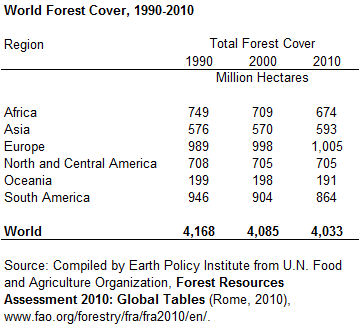
Forests provide many important goods, such as timber and paper. They also supply essential services—for example, they filter water, control water runoff, protect soil, regulate climate, cycle and store nutrients, and provide habitat for countless animal species and space for recreation.

Forests cover 31 percent of the world’s land surface, just over 4 billion hectares. (One hectare = 2.47 acres.) This is down from the pre-industrial area of 5.9 billion hectares. According to data from the U.N. Food and Agriculture Organization, deforestation was at its highest rate in the 1990s, when each year the world lost on average 16 million hectares of forest—roughly the size of the state of Michigan. At the same time, forest area expanded in some places, either through planting or natural processes, bringing the global net loss of forest to 8.3 million hectares per year. In the first decade of this century, the rate of deforestation was slightly lower, but still, a disturbingly high 13 million hectares were destroyed annually. As forest expansion remained stable, the global net forest loss between 2000 and 2010 was 5.2 million hectares per year.

Global rates of deforestation do not capture the full damage done to the world’s forests. Forest degradation from selective logging, road construction, climate change, and other means compromises the health of remaining forests. Each year the world has less forested area, and the forests that remain are of lower quality. For example, replacing natural old-growth forests with a monoculture of an exotic species greatly reduces biodiversity.

The spread of planted forests has been accelerating, rising from an expansion of 3.7 million hectares annually in the 1990s to 4.9 million hectares annually the following decade. Planted forests now cover some 264 million hectares, comprising nearly 7 percent of total forest area. Plantations now have the potential to produce an estimated 1.2 billion cubic meters of industrial wood each year, about two thirds of current global wood production. Where forests have already been cleared, plantations can alleviate the pressure on standing forests.

Forests are primarily threatened by land clearing for agriculture and pasture and by harvesting wood for fuel or industrial uses. In Brazil—which has lost 55 million hectares since 1990, an area three fourths the size of Texas—land clearing for farms and ranches is the big driver. Home to the Amazon rainforest, Brazil contains 13 percent of the world’s forested area, second only to Russia’s 20 percent. Between 2000 and 2010, Brazil lost 2.6 million hectares of forest each year, more than any other country. Brazil is trying to reduce deforestation rates 80 percent from the 1996–2005 average by 2020 and has in fact seen a large drop in deforestation in recent years. But rising beef, corn, and soybean prices are likely to pressure the government to weaken its forest protection, further threatening the world’s largest rainforest. More