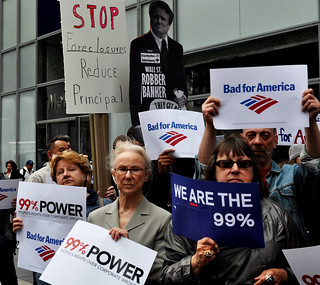
The media's 'bad apple' thesis no longer works. We're seeing systemic corruption in banking – and systemic collusion.
Last fall, I argued that the violent reaction to Occupy and other protests around the world had to do with the 1%ers' fear of the rank and file exposing massive fraud if they ever managed get their hands on the books. At that time, I had no evidence of this motivation beyond the fact that financial system reform and increased transparency were at the top of many protesters' list of demands.
But this week presents a sick-making trove of new data that abundantly fills in this hypothesis and confirms this picture. The notion that the entire global financial system is riddled with systemic fraud – and that key players in the gatekeeper roles, both in finance and in government, including regulatory bodies, know it and choose to quietly sustain this reality – is one that would have only recently seemed like the frenzied hypothesis of tinhat-wearers, but this week's headlines make such a conclusion, sadly, inevitable.
The New York Times business section on 12 July shows multiple exposes of systemic fraud throughout banks: banks colluding with other banks in manipulation of interest rates, regulators aware of systemic fraud, and key government officials (at least one banker who became the most key government official) aware of it and colluding as well. Fraud in banks has been understood conventionally and, I would say, messaged as a glitch. As in London Mayor Boris Johnson's full-throated defense of Barclay's leadership last week, bank fraud is portrayed as a case, when it surfaces, of a few "bad apples" gone astray. More
Sustainability equates to a sustainable global society founded on respect for nature, universal human rights, economic justice, and a culture of peace.
Showing posts with label barclays. Show all posts
Saturday, July 21, 2012
Monday, July 2, 2012
Any entity motivated solely by profit must be heavily regulated
Barclays to review 'flawed' practices as Agius resigns
Barclays has promised a "root and branch review" and announced the resignation of its chairman Marcus Agius following the inter-bank lending rate-fixing scandal.
In a statement, Mr Agius said: "The buck stops with me."
Last week Barclays was fined £290m ($450m) for attempting to manipulate the Libor inter-bank lending rate.
Barclays' chief executive Bob Diamond will appear before MPs on the Treasury Committee on Wednesday.
Mr Agius is due to answer their questions on Thursday.
Mr Agius has also stepped down as chairman of the British Bankers' Association, which is responsible for compiling Libor.
But, Barclays said Mr Agius would remain in his post at the bank until "an orderly succession is assured".
Mr Agius, who also serves on the BBC's executive board, said last week's events were evidence of "unacceptable standards of behaviour within the bank".
He said the findings had "dealt a devastating blow" to Barclays' reputation. More
Barclays has promised a "root and branch review" and announced the resignation of its chairman Marcus Agius following the inter-bank lending rate-fixing scandal.
In a statement, Mr Agius said: "The buck stops with me."
Last week Barclays was fined £290m ($450m) for attempting to manipulate the Libor inter-bank lending rate.
Barclays' chief executive Bob Diamond will appear before MPs on the Treasury Committee on Wednesday.
Mr Agius is due to answer their questions on Thursday.
Mr Agius has also stepped down as chairman of the British Bankers' Association, which is responsible for compiling Libor.
But, Barclays said Mr Agius would remain in his post at the bank until "an orderly succession is assured".
Mr Agius, who also serves on the BBC's executive board, said last week's events were evidence of "unacceptable standards of behaviour within the bank".
He said the findings had "dealt a devastating blow" to Barclays' reputation. More
The statement in the headline applies to not only the financial industry, but also to the nuclear industry (with hindsight into Fukushima), governments which are being unduly influenced by corporate lobbyists and the oil companies. Corporate Social Responsability must become the norm. Editor
Subscribe to:
Posts (Atom)
