Climate change is the most serious peril that has faced humanity in its long history. However, we are faced with more than climate change, there is peak oil and an out of control population, as well as concerns for water and food security in the years to come.
As I keep repeating “failing to plan is planning to fail”.
Humanity is today, to use an American term, playing in the major leagues. We are in a sink or swim situation. If we can keep the planet habitable by mitigating and adapting to the changing climate, switching to alternative sources of energy such as solar, wind, geothermal, wave, ocean thermal and nuclear, sequester CO2 and provide the population with adequate supplies of water and food and bring the population under control, humanity may survive .
Warfare and conflict will also need to become a thing of the past as climate change and energy may well exacerbate conflict situations. With a 9.5 billion global population by 2050 ensuring that everyone has adequate food and water could be problematic.
There is however, no ‘Plan B’ if we fail to resolve all the problems facing us.
When playing in this major leagues club there is no time out, there is no one that is going to offer help, let alone rescue us. Look around, the neighbourhood is somewhat sparsely populated and there are no other worlds on which humanity can survive. Even if there were other habitable worlds nearby they would in all probability belong to someone else.
There are, in all likelihood, other intelligent races out there somewhere, however in the major leagues one survives on ones own. As a young civilisation it is up to us to solve all our problems, to make peace among ourselves, to bring the population under control, to implement the Millennium Development Goals (MDG), to bring equality to all peoples. We must solve our own problems. As a young race we are as children, and as such we may not be able to solve our own problems. But solve them we must.
If we are able to solve the situation facing us and make it to adulthood, in the galactic meaning of the world, we may then be introduced to the neighbours.
If we do not make it to adulthood we will be just another minor statistic, a failure, a insignificant footnote in the universal history book. Nick Robson, Editor. © 2011
This video may contain copyrighted material & is the property of the respective authors, artists and labels. This video was compiled by sebastiansz
Thursday, September 20, 2012
Monday, September 17, 2012
How to give peace a chance with Gross Peaceful Product (GPP)
Research for the NATO Science Programme by blindspotter proposes a simple change to international accounting conventions so that economic competition becomes a powerful 'weapon' for greater security and lower weapons costs.
This is the fourth of a set of Seven Policy Switches for Global Security. Global security (all facets of security everywhere) may be achievable by making all the switches soon enough.

A short web address for this page is http://bit.ly/fourthswitch
Your comments are very welcome below. If you're interested in any of these topics please join my group designing and inspiring fast global change - Fixing systems not symptoms! You can also support my continuing work on whole systems change bydonating.
Thanks!
James Greyson (blindspotter)
Security in the modern world means far more than military security and radical new non-combative solutions are needed to cope with new security challenges. This was highlighted by Professor Sir Brian Heap (2009), former UK Representative on the NATO Science Committee on the occasion of NATO’s 60th anniversary: “security includes non-military threats arising from incompetent governance, corruption, organised crime, insecure borders, ethnic and religious conflict, proliferation of weapons of mass destruction, shortage of natural resources and, of course, terrorism.” Traditional narrow concepts of security are obsolete. The future security of individuals, regions and nations requires a broad ‘global security’ vision that encompasses rapid effective solutions to all major economic, social and ecological challenges.
See more from section 1 which is the intro to Seven Policy Switches for Global Security ... More
This is the fourth of a set of Seven Policy Switches for Global Security. Global security (all facets of security everywhere) may be achievable by making all the switches soon enough.

A short web address for this page is http://bit.ly/fourthswitch
Your comments are very welcome below. If you're interested in any of these topics please join my group designing and inspiring fast global change - Fixing systems not symptoms! You can also support my continuing work on whole systems change bydonating.
Thanks!
James Greyson (blindspotter)
"No matter what political reasons are given for war, the underlying reason is always economic." A. J. P. Taylor
1. Security Means Global Security
1.1. SECURITY INCLUDES NON-MILITARY THREATSSecurity in the modern world means far more than military security and radical new non-combative solutions are needed to cope with new security challenges. This was highlighted by Professor Sir Brian Heap (2009), former UK Representative on the NATO Science Committee on the occasion of NATO’s 60th anniversary: “security includes non-military threats arising from incompetent governance, corruption, organised crime, insecure borders, ethnic and religious conflict, proliferation of weapons of mass destruction, shortage of natural resources and, of course, terrorism.” Traditional narrow concepts of security are obsolete. The future security of individuals, regions and nations requires a broad ‘global security’ vision that encompasses rapid effective solutions to all major economic, social and ecological challenges.
See more from section 1 which is the intro to Seven Policy Switches for Global Security ... More

Arctic expert predicts final collapse of sea ice within four years
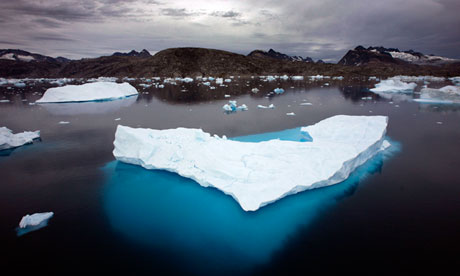
One of the world's leading ice experts has predicted the final collapse of Arctic sea ice in summer months within four years.
 In what he calls a "global disaster" now unfolding in northern latitudes as the sea area that freezes and melts each year shrinks to its lowest extentever recorded, Prof Peter Wadhams of Cambridge University calls for "urgent" consideration of new ideas to reduce global temperatures.
In an email to the Guardian he says: "Climate change is no longer something we can aim to do something about in a few decades' time, and that we must not only urgently reduce CO2 emissions but must urgently examine other ways of slowing global warming, such as the variousgeoengineering ideas that have been put forward."
These include reflecting the sun's rays back into space, making clouds whiter and seeding the ocean with minerals to absorb more CO2.
Wadhams has spent many years collecting ice thickness data from submarines passing below the arctic ocean. He predicted the imminent break-up of sea ice in summer months in 2007, when the previous lowest extent of 4.17 million square kilometres was set. This year, it has unexpectedly plunged a further 500,000 sq km to less than 3.5m sq km. "I have been predicting [the collapse of sea ice in summer months] for many years. The main cause is simply global warming: as the climate has warmed there has been less ice growth during the winter and more ice melt during the summer.
"At first this didn't [get] noticed; the summer ice limits slowly shrank back, at a rate which suggested that the ice would last another 50 years or so. But in the end the summer melt overtook the winter growth such that the entire ice sheet melts or breaks up during the summer months.
"This collapse, I predicted would occur in 2015-16 at which time the summer Arctic (August to September) would become ice-free. The final collapse towards that state is now happening and will probably be complete by those dates".
Wadhams says the implications are "terrible". "The positives are increased possibility of Arctic transport, increased access to Arctic offshore oil and gas resources. The main negative is an acceleration of global warming." More
In an email to the Guardian he says: "Climate change is no longer something we can aim to do something about in a few decades' time, and that we must not only urgently reduce CO2 emissions but must urgently examine other ways of slowing global warming, such as the variousgeoengineering ideas that have been put forward."
These include reflecting the sun's rays back into space, making clouds whiter and seeding the ocean with minerals to absorb more CO2.
Wadhams has spent many years collecting ice thickness data from submarines passing below the arctic ocean. He predicted the imminent break-up of sea ice in summer months in 2007, when the previous lowest extent of 4.17 million square kilometres was set. This year, it has unexpectedly plunged a further 500,000 sq km to less than 3.5m sq km. "I have been predicting [the collapse of sea ice in summer months] for many years. The main cause is simply global warming: as the climate has warmed there has been less ice growth during the winter and more ice melt during the summer.
"At first this didn't [get] noticed; the summer ice limits slowly shrank back, at a rate which suggested that the ice would last another 50 years or so. But in the end the summer melt overtook the winter growth such that the entire ice sheet melts or breaks up during the summer months.
"This collapse, I predicted would occur in 2015-16 at which time the summer Arctic (August to September) would become ice-free. The final collapse towards that state is now happening and will probably be complete by those dates".
Wadhams says the implications are "terrible". "The positives are increased possibility of Arctic transport, increased access to Arctic offshore oil and gas resources. The main negative is an acceleration of global warming." More
Sunday, September 16, 2012
Growth Is the Problem
The ceaseless expansion of economic exploitation, the engine of global capitalism, has come to an end. The futile and myopic effort to resurrect this expansion—a fallacy embraced by most economists—means that we respond to illusion rather than reality. We invest our efforts into bringing back what is gone forever.
 This strange twilight moment, in which our experts and systems managers squander resources in attempting to re-create an expanding economic system that is moribund, will inevitably lead to systems collapse. The steady depletion of natural resources, especially fossil fuels, along with the accelerated pace of climate change, will combine with crippling levels of personal and national debt to thrust us into a global depression that will dwarf any in the history of capitalism. And very few of us are prepared.
“Our solution is our problem,” Richard Heinberg, the author of “The End of Growth: Adapting to Our New Economic Reality,” told me when I reached him by phone in California. “Its name is growth. But growth has become uneconomic. We are worse off because of growth. To achieve growth now means mounting debt, more pollution, an accelerated loss of biodiversity and the continued destabilization of the climate. But we are addicted to growth. If there is no growth there are insufficient tax revenues and jobs. If there is no growth existing debt levels become unsustainable. The elites see the current economic crisis as a temporary impediment. They are desperately trying to fix it. But this crisis signals an irreversible change for civilization itself. We cannot prevent it. We can only decide whether we will adapt to it or not."
Heinberg, a senior fellow at the Post Carbon Institute, argues that we cannot grasp the real state of the global economy by the usual metrics—GDP, unemployment, housing, durable goods, national deficits, personal income and consumer spending—although even these measures point to severe and chronic problems. Rather, he says, we have to examine the structural flaws that sit like time bombs embedded within the economic edifice. U.S. household debt enabled the expansion of consumer spending during the boom years, he says, but consumer debt cannot continue to grow as house prices decline to realistic levels. Toxic assets litter the portfolios of the major banks, presaging another global financial meltdown. The Earth’s natural resources are being exhausted. And climate change, with its extreme weather conditions, is beginning to exact a heavy economic toll on countries, including the United States, through the destruction brought about by droughts, floods, wildfires and loss of crop yields.
Heinberg also highlights what he calls “the highly dysfunctional U.S. political system,” which is paralyzed and hostage to corporate power. It is unable to respond rationally to the crisis or solve “even the most trivial of problems.”
“The government at this point exacerbates nearly every crisis the nation faces,” he said. “Policy decisions do not emerge from deliberations between the public and elected leaders. They arise from unaccountable government agencies and private interest groups. The Republican Party has taken leave of reality. It exists in a hermetically sealed ideasphere where climate change is a hoax and economic problems can be solved by cutting spending and taxes. The Democrats, meanwhile, offer no realistic strategy for coping with the economic unraveling or climate change."
The collision course is set. It is now only a matter of time and our personal response. More
“Our solution is our problem,” Richard Heinberg, the author of “The End of Growth: Adapting to Our New Economic Reality,” told me when I reached him by phone in California. “Its name is growth. But growth has become uneconomic. We are worse off because of growth. To achieve growth now means mounting debt, more pollution, an accelerated loss of biodiversity and the continued destabilization of the climate. But we are addicted to growth. If there is no growth there are insufficient tax revenues and jobs. If there is no growth existing debt levels become unsustainable. The elites see the current economic crisis as a temporary impediment. They are desperately trying to fix it. But this crisis signals an irreversible change for civilization itself. We cannot prevent it. We can only decide whether we will adapt to it or not."
Heinberg, a senior fellow at the Post Carbon Institute, argues that we cannot grasp the real state of the global economy by the usual metrics—GDP, unemployment, housing, durable goods, national deficits, personal income and consumer spending—although even these measures point to severe and chronic problems. Rather, he says, we have to examine the structural flaws that sit like time bombs embedded within the economic edifice. U.S. household debt enabled the expansion of consumer spending during the boom years, he says, but consumer debt cannot continue to grow as house prices decline to realistic levels. Toxic assets litter the portfolios of the major banks, presaging another global financial meltdown. The Earth’s natural resources are being exhausted. And climate change, with its extreme weather conditions, is beginning to exact a heavy economic toll on countries, including the United States, through the destruction brought about by droughts, floods, wildfires and loss of crop yields.
Heinberg also highlights what he calls “the highly dysfunctional U.S. political system,” which is paralyzed and hostage to corporate power. It is unable to respond rationally to the crisis or solve “even the most trivial of problems.”
“The government at this point exacerbates nearly every crisis the nation faces,” he said. “Policy decisions do not emerge from deliberations between the public and elected leaders. They arise from unaccountable government agencies and private interest groups. The Republican Party has taken leave of reality. It exists in a hermetically sealed ideasphere where climate change is a hoax and economic problems can be solved by cutting spending and taxes. The Democrats, meanwhile, offer no realistic strategy for coping with the economic unraveling or climate change."
The collision course is set. It is now only a matter of time and our personal response. More
Saturday, September 15, 2012
Without nuclear, the battle against global warming is as good as lost
A madness is taking hold. In the same week as Arctic ice cover is recorded at its lowest ever extent, two major countries decide to reduce or eliminate their use of the only proven source of low-carbon power that can be deployed at sufficient scale to tackle our climate crisis.
 Japan plans to phase out nuclear entirely by 2030, its prime minister announced today. The French president has just revealed a plan to dramatically reduce the country's reliance on nuclear, which currently gives France some of the cleanest electricity in the world.
Let me be very clear. Without nuclear, the battle against global warming is as good as lost. Even many greens now admit this in private moments. We are already witnessing the first signs of the collapse in the biosphere this entails – with the Arctic in full-scale meltdown, more solar radiation is being captured by the dark ocean surface, and the weather systems of the entire northern hemisphere are being thrown into chaos. With nuclear, there is a chance that global warming this century can be limited to 2C; without nuclear, I would guess we are heading for 4C or above. That will devastate ecosystems and societies worldwide on a scale which is unimaginable.
Given the trauma the Japanese people have suffered since the earthquake and tsunami of 11 March 2011, it is understandable that major questions are asked of domestic politicians. But we must never forget that Fukushima has killed no one. More people in Japan recently died from an E coli outbreak due to eating contaminated pickles. Scientists also agree there will never be an observable cancer increase in the Japanese population attributable to Fukushima.
But in response to the nuclear shutdown, oil and gas imports to Japan have doubled, and carbon dioxide emissions soared by more than 60m tonnes. Any environmentalist who celebrates this outcome is not worthy of the name.
Japan is already backing away from its own climate change targets. As a participant in the UN climate negotiations last year, I watched this happen. Under the 2009 Copenhagen accord, Japan pledged to reduce CO2 emissions by 25% by 2020. The plan was to increase nuclear to half of national electricity in order to facilitate the carbon cuts, supported by an increase in renewables to 20% by 2030. To reach the same targets without nuclear is impossible; wind and solar combined meet barely 1% of electricity production today in Japan, and there is no way they can be deployed at sufficient scale to meet the gap. So the climate targets will be dropped, as Japan re-carbonises its economy.
It is nothing short of insane that politicians around the world, under pressure from populations subjected to decades of anti-nuclear fearmongering by people who call themselves greens, are raising our collective risk of catastrophic climate change in order to eliminate the safest power source ever invented. More

Let me be very clear. Without nuclear, the battle against global warming is as good as lost. Even many greens now admit this in private moments. We are already witnessing the first signs of the collapse in the biosphere this entails – with the Arctic in full-scale meltdown, more solar radiation is being captured by the dark ocean surface, and the weather systems of the entire northern hemisphere are being thrown into chaos. With nuclear, there is a chance that global warming this century can be limited to 2C; without nuclear, I would guess we are heading for 4C or above. That will devastate ecosystems and societies worldwide on a scale which is unimaginable.
Given the trauma the Japanese people have suffered since the earthquake and tsunami of 11 March 2011, it is understandable that major questions are asked of domestic politicians. But we must never forget that Fukushima has killed no one. More people in Japan recently died from an E coli outbreak due to eating contaminated pickles. Scientists also agree there will never be an observable cancer increase in the Japanese population attributable to Fukushima.
But in response to the nuclear shutdown, oil and gas imports to Japan have doubled, and carbon dioxide emissions soared by more than 60m tonnes. Any environmentalist who celebrates this outcome is not worthy of the name.
Japan is already backing away from its own climate change targets. As a participant in the UN climate negotiations last year, I watched this happen. Under the 2009 Copenhagen accord, Japan pledged to reduce CO2 emissions by 25% by 2020. The plan was to increase nuclear to half of national electricity in order to facilitate the carbon cuts, supported by an increase in renewables to 20% by 2030. To reach the same targets without nuclear is impossible; wind and solar combined meet barely 1% of electricity production today in Japan, and there is no way they can be deployed at sufficient scale to meet the gap. So the climate targets will be dropped, as Japan re-carbonises its economy.
It is nothing short of insane that politicians around the world, under pressure from populations subjected to decades of anti-nuclear fearmongering by people who call themselves greens, are raising our collective risk of catastrophic climate change in order to eliminate the safest power source ever invented. More
Wednesday, September 12, 2012
Strengthening the Institutional Framework for Sustainable Development (IFSD)
Strengthening the Institutional Framework for Sustainable Development (IFSD)
UNITAR E-Learning Course
5 November – 14 December 2012
Dear Colleagues,
The United Nations Institute for Training and Research (UNITAR) is pleased to announce the delivery of the e-learning course, “Strengthening the Institutional Framework for Sustainable Development”, which will take place from 5 November – 14 December 2012. Participants will learn about the current institutional architecture concerned with sustainable development, emerging policy issues requiring an effective institutional response, and political challenges to advance reform as reflected in the negotiations leading up to, and during the Rio+20 Conference.
Please feel free to disseminate information about this course through your networks, and do not hesitate to contact us (envgov@unitar.org) should you need any further information.
Sincerely,
The UNITAR Environmental Governance Programme Team
Background
Since the 1972 Stockholm Conference on the Human Environment, the institutional framework to address environment and sustainable development challenges has witnessed a steady growth in the number of institutions and agreements, with more than 500 multilateral environmental agreements currently in existence. Yet the continuing deterioration in the natural resource base and ecosystems, global climate change and persistent poverty raise doubts about the capacity of the institutional framework to address these challenges. The 2012 UN Conference on Sustainable Development (Rio+20) reaffirmed the need to strengthen the institutional framework for sustainable development (IFDS) and initiated specific action to foster more effective and coherent institutional responses.
Target Groups
The course targets groups and individuals that are interested in obtaining a general understanding about the theme of international sustainable development governance and latest developments. They include:
• Civil servants in national Ministries, provincial departments and local authorities
• Diplomats from Permanent Missions and Ministries of Foreign Affairs
• Environmental managers in private sector and civil society organizations
• Faculty, researchers and students
• Interested citizens
Learning Objectives
Participants will learn about the strengths and weaknesses of the current institutional architecture concerned with sustainable development, key emerging policy issues requiring an effective institutional response, and the political challenges to advance reform as reflected in the negotiations leading up to, and during the Rio+20 Conference.
After completing the course, participants will be able to:
• Explain sustainable development challenges demanding effective international institutions
• Outline key milestones of developing and reforming international institutions concerned with sustainable development
• Chart and analyze the current international IFSD
• Recognize linkages between international, national and sub-national sustainable development governance
• Analyze key policy issues relevant for the Rio+20 negotiations and beyond
• Assess options to strengthen the institutional framework for sustainable development
Methodology
The course pedagogy is adapted to professionals in full-time work. Participants are provided with the opportunity to learn through various experiences: absorb (read); do (activity); interact (socialize); and reflect (relate to one’s own reality). The total number of learning hours is 40 over a 6 week period. During weeks 1-5 the reading of an e-book is complemented by a range of learning activities and experiences that include interactive exercises, discussion forums, and an applied case study. Week 6 is reserved for wrap-up and completing course assignments.
Course Fee and Registration
The course participation fee is 600 USD. A small number of full/partial fellowships are available for participants from developing countries working in the public sector, academia or non-profit organizations. Priority for fellowships will be given to applicants from Least Developed Countries (LDCs).
Register at: http://www.unitar.org/event/strengthening-institutional-framework-sustainable-development-ifsd
For details please contact the UNITAR Environmental Governance Programme at: envgov@unitar.org
Registration Deadline: 28 October 2012.
UNITAR E-Learning Course
5 November – 14 December 2012
Dear Colleagues,
The United Nations Institute for Training and Research (UNITAR) is pleased to announce the delivery of the e-learning course, “Strengthening the Institutional Framework for Sustainable Development”, which will take place from 5 November – 14 December 2012. Participants will learn about the current institutional architecture concerned with sustainable development, emerging policy issues requiring an effective institutional response, and political challenges to advance reform as reflected in the negotiations leading up to, and during the Rio+20 Conference.
Please feel free to disseminate information about this course through your networks, and do not hesitate to contact us (envgov@unitar.org) should you need any further information.
Sincerely,
The UNITAR Environmental Governance Programme Team
Background
Since the 1972 Stockholm Conference on the Human Environment, the institutional framework to address environment and sustainable development challenges has witnessed a steady growth in the number of institutions and agreements, with more than 500 multilateral environmental agreements currently in existence. Yet the continuing deterioration in the natural resource base and ecosystems, global climate change and persistent poverty raise doubts about the capacity of the institutional framework to address these challenges. The 2012 UN Conference on Sustainable Development (Rio+20) reaffirmed the need to strengthen the institutional framework for sustainable development (IFDS) and initiated specific action to foster more effective and coherent institutional responses.
Target Groups
The course targets groups and individuals that are interested in obtaining a general understanding about the theme of international sustainable development governance and latest developments. They include:
• Civil servants in national Ministries, provincial departments and local authorities
• Diplomats from Permanent Missions and Ministries of Foreign Affairs
• Environmental managers in private sector and civil society organizations
• Faculty, researchers and students
• Interested citizens
Learning Objectives
Participants will learn about the strengths and weaknesses of the current institutional architecture concerned with sustainable development, key emerging policy issues requiring an effective institutional response, and the political challenges to advance reform as reflected in the negotiations leading up to, and during the Rio+20 Conference.
After completing the course, participants will be able to:
• Explain sustainable development challenges demanding effective international institutions
• Outline key milestones of developing and reforming international institutions concerned with sustainable development
• Chart and analyze the current international IFSD
• Recognize linkages between international, national and sub-national sustainable development governance
• Analyze key policy issues relevant for the Rio+20 negotiations and beyond
• Assess options to strengthen the institutional framework for sustainable development
Methodology
The course pedagogy is adapted to professionals in full-time work. Participants are provided with the opportunity to learn through various experiences: absorb (read); do (activity); interact (socialize); and reflect (relate to one’s own reality). The total number of learning hours is 40 over a 6 week period. During weeks 1-5 the reading of an e-book is complemented by a range of learning activities and experiences that include interactive exercises, discussion forums, and an applied case study. Week 6 is reserved for wrap-up and completing course assignments.
Course Fee and Registration
The course participation fee is 600 USD. A small number of full/partial fellowships are available for participants from developing countries working in the public sector, academia or non-profit organizations. Priority for fellowships will be given to applicants from Least Developed Countries (LDCs).
Register at: http://www.unitar.org/event/strengthening-institutional-framework-sustainable-development-ifsd
For details please contact the UNITAR Environmental Governance Programme at: envgov@unitar.org
Registration Deadline: 28 October 2012.
Tuesday, September 11, 2012
Home: Our Survival Depends On Changing The Way We Live

We are living in exceptional times. Scientists tell us that we have 10 years to change the way we live, avert the depletion of natural resources and the catastrophic evolution of the Earth's climate. The stakes are high for us and our children. Everyone should take part in the effort, and HOME has been conceived to take a message of mobilization out to every human being. For this purpose, HOME needs to be free. A patron, the PPR Group, made this possible. EuropaCorp, the distributor, also pledged not to make any profit because Home is a non-profit film. HOME has been made for you : share it! And act for the planet. Yann Arthus-Bertrand HOME official website www.home-2009.com PPR is proud to support HOME http HOME is a carbon offset movie www.actioncarbone.org More information about the Planet http
Sunday, September 9, 2012
African farmers must do more to beat climate change -study
OSLO, Sept 7 (Reuters) - African farmers are finding new ways to cope with droughts, erosion and other ravages of climate change but need to develop even more techniques to thrive in an increasingly uncertain environment, scientists said on Friday.
 Smallholders have started to plant more drought-resistant and faster-growing crops to keep the harvests coming in, according to a survey of 700 households in Kenya, Ethiopia, Uganda and Tanzania.
"The good news is that a lot of farmers are making changes," said Patti Kristjanson, who heads a programme on climate change, agriculture and food security at the World Agroforestry Centre in Nairobi and led the study.
"So it's not all doom and gloom ... but much more needs to be done," she told Reuters.
Farmers, backed by researchers and international donors, needed to find better ways to store rain water, increase the use of manure and bring in hardier crops like sweet potatoes, she said.
In the past decade, 55 percent of households surveyed said they had taken up faster-growing crop varieties, mainly of maize, and 56 percent had adopted at least one drought-tolerant variety, according to the findings in the journal Food Security.
FIGHTING EROSION
Fifty percent of the households were planting trees on their farms - helping to combat erosion, increase water and soil quality and bring in new crops like nuts.
Half of the farmers had introduced inter-cropping - planting alternate rows of, for instance of beans and maize, in the same field and then swapping the rows next season. Beans fix nitrogen in the soil, helping reduce the need for fertilisers.
But Friday's study found just a quarter of farmers were using manure or compost - avoiding the use of more expensive fertilisers. And only 10 percent were storing water, it added.
The study said that global warming, leading to erosion, less reliable rainfall and changes in the length of growing seasons, was adding to other stresses for farmers worldwide such as price spikes and a rising population. More

"The good news is that a lot of farmers are making changes," said Patti Kristjanson, who heads a programme on climate change, agriculture and food security at the World Agroforestry Centre in Nairobi and led the study.
"So it's not all doom and gloom ... but much more needs to be done," she told Reuters.
Farmers, backed by researchers and international donors, needed to find better ways to store rain water, increase the use of manure and bring in hardier crops like sweet potatoes, she said.
In the past decade, 55 percent of households surveyed said they had taken up faster-growing crop varieties, mainly of maize, and 56 percent had adopted at least one drought-tolerant variety, according to the findings in the journal Food Security.
FIGHTING EROSION
Fifty percent of the households were planting trees on their farms - helping to combat erosion, increase water and soil quality and bring in new crops like nuts.
Half of the farmers had introduced inter-cropping - planting alternate rows of, for instance of beans and maize, in the same field and then swapping the rows next season. Beans fix nitrogen in the soil, helping reduce the need for fertilisers.
But Friday's study found just a quarter of farmers were using manure or compost - avoiding the use of more expensive fertilisers. And only 10 percent were storing water, it added.
The study said that global warming, leading to erosion, less reliable rainfall and changes in the length of growing seasons, was adding to other stresses for farmers worldwide such as price spikes and a rising population. More
Monday, September 3, 2012
Young Greeks Self Reliant Island Society
On the slopes of Mount Telaithrion on the island of Evia, a group of young Greeks have left the busy city and created a self-reliant rural community.
Their goal is to eat only the organic produce they grow themselves, to free themselves from the national electricity grid, and to exchange what they grow or make instead of using money.
The project, whose ultimate goal is to create a school for sustainable living, was the idea of four Athenians who met online back in 2008 and bonded over their dissatisfaction with the daily grind of city life.
In their second year of living permanently on a forested patch of land next to the village of Aghios, 80 percent of the food they eat now comes from their two herb and vegetable gardens and the fruit they pick off the trees.
The group, almost all of whom follow a strict vegetarian diet, sleep communally in yurts - portable, tent-like dwellings made of tarp often seen in Central Asia.
Whatever is left over from their gardens, they exchange in the village for the supplies they cannot produce.
The group actively use social media, and last year over one hundred people from Greece and abroad asked about joining or collaborating in some way.
Dionysis Papanikolaou, for example, gave up a lucrative academic career to be closer to nature and far from the heavy atmosphere of the financial crisis in Greece. [Dionysis Papanikolaou, Group Member]:
"If you keep on reading news, watching TV and the crisis, the crisis, the crisis, even subconsciously you say the crisis! Here, there is no crisis. I mean, it makes no difference."
The group take pride in being self-sufficient.
[Panagiotis Kantas, Co-Founder of 'Free and Real']:
"The reality of life is just outside your door. When you have to warm yourself up you actually have to go out in the wood and gather wood, fire wood, and bring it home to actually warm yourself up."
They currently organize seminars on organic farming and have drawn up the plans for a large school on sustainable living to be constructed later this summer, and for which they raised money on a crowdfunding site on the internet.
[Panagiotis Kantas, Co-Founder of 'Free and Real']:
"I just try to be the change I want to be, instead of waiting for a government to make the change, or instead of voting for someone to make the change. I try to be the change."
For more news and videos visit ☛ http://english.ntdtv.com
Their goal is to eat only the organic produce they grow themselves, to free themselves from the national electricity grid, and to exchange what they grow or make instead of using money.
The project, whose ultimate goal is to create a school for sustainable living, was the idea of four Athenians who met online back in 2008 and bonded over their dissatisfaction with the daily grind of city life.
In their second year of living permanently on a forested patch of land next to the village of Aghios, 80 percent of the food they eat now comes from their two herb and vegetable gardens and the fruit they pick off the trees.
The group, almost all of whom follow a strict vegetarian diet, sleep communally in yurts - portable, tent-like dwellings made of tarp often seen in Central Asia.
Whatever is left over from their gardens, they exchange in the village for the supplies they cannot produce.
"The crisis or the austerity measures doesn't actually affect you because you create your life and your future everyday, it has nothing to do with the outside circle. It may (have) affected us, but only in a good way because more and more people are willing to be self-sufficient and sustainable, so they contact us, and more and more people after the crisis want to get involved."32-year-old co-founder Apostolos Sianos quit a well-paying job as a web site designer in Athens to help start the community, which is called 'Free and Real.' [Apostolos Sianos, Co-Founder of 'Free and Real']:
The group actively use social media, and last year over one hundred people from Greece and abroad asked about joining or collaborating in some way.
Dionysis Papanikolaou, for example, gave up a lucrative academic career to be closer to nature and far from the heavy atmosphere of the financial crisis in Greece. [Dionysis Papanikolaou, Group Member]:
"If you keep on reading news, watching TV and the crisis, the crisis, the crisis, even subconsciously you say the crisis! Here, there is no crisis. I mean, it makes no difference."
The group take pride in being self-sufficient.
[Panagiotis Kantas, Co-Founder of 'Free and Real']:
"The reality of life is just outside your door. When you have to warm yourself up you actually have to go out in the wood and gather wood, fire wood, and bring it home to actually warm yourself up."
They currently organize seminars on organic farming and have drawn up the plans for a large school on sustainable living to be constructed later this summer, and for which they raised money on a crowdfunding site on the internet.
[Panagiotis Kantas, Co-Founder of 'Free and Real']:
"I just try to be the change I want to be, instead of waiting for a government to make the change, or instead of voting for someone to make the change. I try to be the change."
For more news and videos visit ☛ http://english.ntdtv.com
Friday, August 31, 2012
World Forest Area Still on the Decline
Forests provide many important goods, such as timber and paper. They also supply essential services—for example, they filter water, control water runoff, protect soil, regulate climate, cycle and store nutrients, and provide habitat for countless animal species and space for recreation.
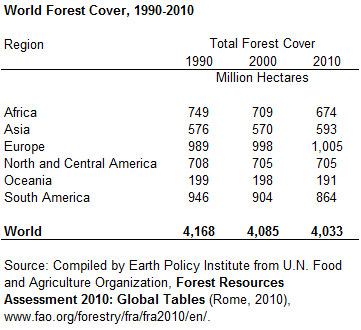
 Forests cover 31 percent of the world’s land surface, just over 4 billion hectares. (One hectare = 2.47 acres.) This is down from the pre-industrial area of 5.9 billion hectares. According to data from the U.N. Food and Agriculture Organization, deforestation was at its highest rate in the 1990s, when each year the world lost on average 16 million hectares of forest—roughly the size of the state of Michigan. At the same time, forest area expanded in some places, either through planting or natural processes, bringing the global net loss of forest to 8.3 million hectares per year. In the first decade of this century, the rate of deforestation was slightly lower, but still, a disturbingly high 13 million hectares were destroyed annually. As forest expansion remained stable, the global net forest loss between 2000 and 2010 was 5.2 million hectares per year.
Global rates of deforestation do not capture the full damage done to the world’s forests. Forest degradation from selective logging, road construction, climate change, and other means compromises the health of remaining forests. Each year the world has less forested area, and the forests that remain are of lower quality. For example, replacing natural old-growth forests with a monoculture of an exotic species greatly reduces biodiversity.
The spread of planted forests has been accelerating, rising from an expansion of 3.7 million hectares annually in the 1990s to 4.9 million hectares annually the following decade. Planted forests now cover some 264 million hectares, comprising nearly 7 percent of total forest area. Plantations now have the potential to produce an estimated 1.2 billion cubic meters of industrial wood each year, about two thirds of current global wood production. Where forests have already been cleared, plantations can alleviate the pressure on standing forests.
Forests are primarily threatened by land clearing for agriculture and pasture and by harvesting wood for fuel or industrial uses. In Brazil—which has lost 55 million hectares since 1990, an area three fourths the size of Texas—land clearing for farms and ranches is the big driver. Home to the Amazon rainforest, Brazil contains 13 percent of the world’s forested area, second only to Russia’s 20 percent. Between 2000 and 2010, Brazil lost 2.6 million hectares of forest each year, more than any other country. Brazil is trying to reduce deforestation rates 80 percent from the 1996–2005 average by 2020 and has in fact seen a large drop in deforestation in recent years. But rising beef, corn, and soybean prices are likely to pressure the government to weaken its forest protection, further threatening the world’s largest rainforest. More
Global rates of deforestation do not capture the full damage done to the world’s forests. Forest degradation from selective logging, road construction, climate change, and other means compromises the health of remaining forests. Each year the world has less forested area, and the forests that remain are of lower quality. For example, replacing natural old-growth forests with a monoculture of an exotic species greatly reduces biodiversity.
The spread of planted forests has been accelerating, rising from an expansion of 3.7 million hectares annually in the 1990s to 4.9 million hectares annually the following decade. Planted forests now cover some 264 million hectares, comprising nearly 7 percent of total forest area. Plantations now have the potential to produce an estimated 1.2 billion cubic meters of industrial wood each year, about two thirds of current global wood production. Where forests have already been cleared, plantations can alleviate the pressure on standing forests.
Forests are primarily threatened by land clearing for agriculture and pasture and by harvesting wood for fuel or industrial uses. In Brazil—which has lost 55 million hectares since 1990, an area three fourths the size of Texas—land clearing for farms and ranches is the big driver. Home to the Amazon rainforest, Brazil contains 13 percent of the world’s forested area, second only to Russia’s 20 percent. Between 2000 and 2010, Brazil lost 2.6 million hectares of forest each year, more than any other country. Brazil is trying to reduce deforestation rates 80 percent from the 1996–2005 average by 2020 and has in fact seen a large drop in deforestation in recent years. But rising beef, corn, and soybean prices are likely to pressure the government to weaken its forest protection, further threatening the world’s largest rainforest. More
Wednesday, August 29, 2012
Karez in Iraqi Kurdistan Parts 1 & 2
Ancient water tunnels called karez in Iraqi Kurdistan are rapidly drying up, a clear sign that the recent regional droughts are hitting the villages hard. Climate change seems to be unfolding at a wider scale and the future for groundwater supply seems bleak. Dale Lightfoot, an american geographer, travels the northern provinces of Kurdistan to document the situation. It urges UNESCO to set up a major initiative to safe the karez tunnels of Kurdistan.
It's in your hands
This film has been shortlisted for The Golden Poo Awards short film competition as part of the Global Handwashing Day and World Toilet Day campaigns. tippytap.org ** It really is in your hands*** *****************************************************
Diarrheal and respiratory infections kill over 3.5 million children under the age of five every year. Hand washing with soap is the most effective and an inexpensive way to prevent these deaths. It can save the lives of 1.2 million children every year. The tippy tap is a low cost, low tech, low water, hands-free device to promote hand washing with soap. **************************************************** **
Help us get the word out! 1. share this video 2. like tippytap.org on FB on.fb.me 3. check out tippytap.org! 3.
Like WMG on FB on.fb.me tippytap.org is a partnership between WMG (www.watershedmg.org) and Grampari (www.gampari.org) Filmed and directed by Andrew Hinton at Pilgrim Films vimeo.com Music by Jamie Perera www.jamieperera.com Produced by Sowmya Somnath and Jared Buono
Diarrheal and respiratory infections kill over 3.5 million children under the age of five every year. Hand washing with soap is the most effective and an inexpensive way to prevent these deaths. It can save the lives of 1.2 million children every year. The tippy tap is a low cost, low tech, low water, hands-free device to promote hand washing with soap. **************************************************** **
Help us get the word out! 1. share this video 2. like tippytap.org on FB on.fb.me 3. check out tippytap.org! 3.
Like WMG on FB on.fb.me tippytap.org is a partnership between WMG (www.watershedmg.org) and Grampari (www.gampari.org) Filmed and directed by Andrew Hinton at Pilgrim Films vimeo.com Music by Jamie Perera www.jamieperera.com Produced by Sowmya Somnath and Jared Buono
Message from Prince Charles to the IUCN World Conservation Congress
HRH the Prince of Wales addresses a session of the IUCN World Conservation Congress on the urgent need of bringing agriculture and conservation back together. "There is much to learn if we let nature be our guide", says Charles, Prince of Wales.
Sunday, August 26, 2012
The Dark Side of the “Green Economy”
Everywhere you look these days, things are turning green. In Chiapas, Mexico, indigenous farmers are being paid to protect the last vast stretch of rainforest in Mesoamerica. In the Brazilian Amazon, peasant families are given a monthly “green basket” of basic food staples to allow them to get by without cutting down trees.
 In Kenya, small farmers who plant climate-hardy trees and protect green zones are promised payment for their part in the fight to reduce global warming. In Mozambique, one of the world’s poorest nations, fully 19 percent of the country’s surface is leased to a British capital firm that pays families to reforest.
These are a few of the keystone projects that make up what is being called “the green economy”: an emerging approach that promises to protect planetary ecology while boosting the economy and fighting poverty.
On its face this may sound like a good thing. Yet, during the recently concluded United Nations Rio+20 Earth Summit in Brazil, tens of thousands of people attending a nearby People’s Summit condemned such approaches to environmental management. Indeed, if social movements gathered in Rio last month had one common platform, it was “No to the green economy.”
Whose Economy? Whose Green?
Just a few years ago, the term “green economy” referred to economies that are locally based, climate friendly, and low-impact. But since the global economic meltdown began in 2007, the green economy has come to mean something more akin to the wholesale privatization of nature. This green economy is about putting a price on natural cycles through a controversial set of policies called “Payments for Ecosystem Services”—an approach to greening capitalism that some liken to a tiger claiming to turn vegetarian.
Rather than reducing pollution and consumption, protecting the territorial rights of land-based peoples, and promoting local initiatives that steward resources for future generations, the approach is doing the opposite: promoting monoculture tree plantations, trade in pollution credits, and the establishment of speculative markets in biodiversity and forests, all of which threaten to displace land-based communities.
A report by Ecosystem Marketplace, the leading purveyor of “Payments for Ecosystem Services,” lays out the green economy argument: “Ecosystems provide trillions of dollars in clean water, flood protection, fertile lands, clean air, pollination, disease control. ... So how do we secure this enormously valuable infrastructure and its services? The same way we would electricity, potable water, or natural gas. We pay for it.”
The United Nations Environment Program (UNEP), among the chief proponents of the green economy, says this approach will result in “improved well-being and social equity while significantly reducing environmental risks and ecological scarcities.” The World Bank, also promoting the green economy, says, “Natural capital accounting would add to our national GDPs the wealth stored in our natural resources: minerals before they are mined, forests before they are felled, water while it is still in the rivers.”
But, for social movements, land-based communities, and indigenous peoples, the question is, who really pays? For what are they paying? And, most poignantly, since when has nature, the source of all life, been reduced to a service-provider?
One concern is that this new green economy is a form of “disaster capitalism”—a global effort to put the “services” of nature into the same hands that caused the global financial meltdown. And that seems like a very, very bad idea.
Increasingly, the evidence on the ground bears this out.
The reforestation plan in Mozambique has peasant farmers planting industrial monocultures of African palm for biofuel production, not native forest. The Kenyan farmers of the Green Belt Movement, while initially receptive to a World Bank-backed scheme that would pay them to protect agricultural soils, became discouraged when they realized the payments would add up to less than 15 cents per acre per year, and that they would have to wait many years for payment. In Brazil, the “green basket” of food staples adds up to 100 Reales per family per month—but cooking gas alone can cost 50 Reales a month, leaving families without access to the forest hungry and dependent on paltry state support. More

These are a few of the keystone projects that make up what is being called “the green economy”: an emerging approach that promises to protect planetary ecology while boosting the economy and fighting poverty.
On its face this may sound like a good thing. Yet, during the recently concluded United Nations Rio+20 Earth Summit in Brazil, tens of thousands of people attending a nearby People’s Summit condemned such approaches to environmental management. Indeed, if social movements gathered in Rio last month had one common platform, it was “No to the green economy.”
Whose Economy? Whose Green?
Just a few years ago, the term “green economy” referred to economies that are locally based, climate friendly, and low-impact. But since the global economic meltdown began in 2007, the green economy has come to mean something more akin to the wholesale privatization of nature. This green economy is about putting a price on natural cycles through a controversial set of policies called “Payments for Ecosystem Services”—an approach to greening capitalism that some liken to a tiger claiming to turn vegetarian.
Rather than reducing pollution and consumption, protecting the territorial rights of land-based peoples, and promoting local initiatives that steward resources for future generations, the approach is doing the opposite: promoting monoculture tree plantations, trade in pollution credits, and the establishment of speculative markets in biodiversity and forests, all of which threaten to displace land-based communities.
A report by Ecosystem Marketplace, the leading purveyor of “Payments for Ecosystem Services,” lays out the green economy argument: “Ecosystems provide trillions of dollars in clean water, flood protection, fertile lands, clean air, pollination, disease control. ... So how do we secure this enormously valuable infrastructure and its services? The same way we would electricity, potable water, or natural gas. We pay for it.”
The United Nations Environment Program (UNEP), among the chief proponents of the green economy, says this approach will result in “improved well-being and social equity while significantly reducing environmental risks and ecological scarcities.” The World Bank, also promoting the green economy, says, “Natural capital accounting would add to our national GDPs the wealth stored in our natural resources: minerals before they are mined, forests before they are felled, water while it is still in the rivers.”
But, for social movements, land-based communities, and indigenous peoples, the question is, who really pays? For what are they paying? And, most poignantly, since when has nature, the source of all life, been reduced to a service-provider?
One concern is that this new green economy is a form of “disaster capitalism”—a global effort to put the “services” of nature into the same hands that caused the global financial meltdown. And that seems like a very, very bad idea.
Increasingly, the evidence on the ground bears this out.
The reforestation plan in Mozambique has peasant farmers planting industrial monocultures of African palm for biofuel production, not native forest. The Kenyan farmers of the Green Belt Movement, while initially receptive to a World Bank-backed scheme that would pay them to protect agricultural soils, became discouraged when they realized the payments would add up to less than 15 cents per acre per year, and that they would have to wait many years for payment. In Brazil, the “green basket” of food staples adds up to 100 Reales per family per month—but cooking gas alone can cost 50 Reales a month, leaving families without access to the forest hungry and dependent on paltry state support. More
Thursday, August 23, 2012
Permaculture in Palestine - A green revolution
It was a brisk, rather harried morning when my husband, photographer Christopher List, and I set off on a trip to delve deeper into the relatively unheard of phenomenon of permaculture.
 It felt like only yesterday when we’d announced to friends and family that were were going to Palestine, to study a 14-day intensive permaculture course. After discovering some of the principles of permaculture on a recent trip to SA, I knew we were in for a gruelling, yet worthwhile experience.
Relatively new to the Middle East, with permaculture projects in Saudi Arabia and in the Jordan River Valley, permaculture simply means working nature to produce a sustainable garden design, and can be used by farmers and gardeners alike.
In fact, permaculture principles can be applied to community gardens, rooftop gardens, small balconies or even just to help your pot plants flourish. Not only applicable to growing things, permaculture includes reusing and recycling as well as renewable energy. It even extends to sustainable housing. In a nutshell, permaculture entails a holistic, sustainable way of life. More

Relatively new to the Middle East, with permaculture projects in Saudi Arabia and in the Jordan River Valley, permaculture simply means working nature to produce a sustainable garden design, and can be used by farmers and gardeners alike.
In fact, permaculture principles can be applied to community gardens, rooftop gardens, small balconies or even just to help your pot plants flourish. Not only applicable to growing things, permaculture includes reusing and recycling as well as renewable energy. It even extends to sustainable housing. In a nutshell, permaculture entails a holistic, sustainable way of life. More
Saturday, August 18, 2012
My Outside Classrooms
If you ask me what I remember of all that I studied at school and, then, in many years at college and university and which came in handy later in life, I don't think I'll have much to narrate. What an awful waste of those precious youthful years! Honestly, little of what I was forced to learn in the classroom proved of any use to me once I stepped out into the 'real world'. Which is why, when Raju, a middle-aged father, came to meet me yesterday for 'advice' as to what to do about his two sons, who go to an expensive medium school but who seem, as he put it, to 'learn nothing at all' there, I was tempted to tell him to pull them out of the school at once.
 If education is a means for us to learn about the world so as to help us prepare to live in it, it was mainly outside the classroom--out in the 'real world'--that my education really took place. My parents made it a point to take us to a new place every year during the winter holidays, and the things I learned in the course of those early travels--about different places, monuments, people, cultures, religions, ways of living and so on--was my first exposure to the 'real world', and an enormously educative experience. But this was for less than a month each year, and then it was back to school, where, carefully insulated from the 'real world', I spent the rest of the year studying about almost nothing at all that inspired or intrigued me.
I know I ought to be grateful for those annual learning trips, but they were nothing remotely like what a girl I heard of the other day is priveleged to enjoy: She's not yet ten, but her parents have sensibly withdrawn her from school for a while and are taking her on a two-year journey around the world. They are really roughing it out, going for treks in the mountains, trips deep into deserts and jungles and across seas, and spending time with NGOs working with people with disabilities. What an amazing learning experience for that lucky little child!
Back in the 1980s, I was in college in Delhi, where I majored in Economics, a subject I had no interest in whatsoever. The subject was taught in such a way that it seemed to have no bearing at all on the harsh realities of the 'real world'. Poverty, for instance, was just a bundle of figures and graphs. We learned about industries and agricultural yields, but were never taken to see a factory or a field out in the 'real world'. And so on. And so, when I heard of an organisation that sponsored college students to spend their holidays in an NGO of their choice working out in the 'field' I enthusiastically signed up, and was sent to spend a month in a little village in tribal-dominated Koraput, in Orissa.
This was a quarter century ago, and Koraput, which is still said to be among the most 'backward' districts in India, was then thought to be really 'back of beyond'. The village I was to live in was set in a narrow valley and surrounded by thickly-forested hills. Most of its inhabitants belonged to the Kondh tribe, most of who were then (and, I suppose, even now are) miserably poor. The Kondhs still followed much of their simple, traditional way of life. More

I know I ought to be grateful for those annual learning trips, but they were nothing remotely like what a girl I heard of the other day is priveleged to enjoy: She's not yet ten, but her parents have sensibly withdrawn her from school for a while and are taking her on a two-year journey around the world. They are really roughing it out, going for treks in the mountains, trips deep into deserts and jungles and across seas, and spending time with NGOs working with people with disabilities. What an amazing learning experience for that lucky little child!
Back in the 1980s, I was in college in Delhi, where I majored in Economics, a subject I had no interest in whatsoever. The subject was taught in such a way that it seemed to have no bearing at all on the harsh realities of the 'real world'. Poverty, for instance, was just a bundle of figures and graphs. We learned about industries and agricultural yields, but were never taken to see a factory or a field out in the 'real world'. And so on. And so, when I heard of an organisation that sponsored college students to spend their holidays in an NGO of their choice working out in the 'field' I enthusiastically signed up, and was sent to spend a month in a little village in tribal-dominated Koraput, in Orissa.
This was a quarter century ago, and Koraput, which is still said to be among the most 'backward' districts in India, was then thought to be really 'back of beyond'. The village I was to live in was set in a narrow valley and surrounded by thickly-forested hills. Most of its inhabitants belonged to the Kondh tribe, most of who were then (and, I suppose, even now are) miserably poor. The Kondhs still followed much of their simple, traditional way of life. More
Wednesday, August 15, 2012
Extreme Weather
The weekend forecast for Nashville, Tennessee, called for two to four inches of rain. But by the afternoon of Saturday, May 1, 2010, parts of the city had seen more than six inches, and the rain was still coming down in sheets.
 Mayor Karl Dean was in the city’s Emergency Communications Center monitoring the first reports of flash flooding when something on a TV screen caught his eye. It was a live shot of cars and trucks on Interstate 24 being swamped by a tributary of the Cumberland River southeast of the city. Floating past them in the slow lane was a 40-foot-long portable building from the Lighthouse Christian School.
“We’ve got a building running into cars,” the TV anchorman was saying.
Dean had been in the “war room” for hours. But when he saw the building floating down the highway, he says, “it became very clear to me what an extreme situation we had on our hands.” Soon 911 calls were coming in from every part of the city. Police, fire, and rescue teams were dispatched in boats. One crew in a skiff headed out to I-24 to pluck the driver of an 18-wheeler from the chest-high water. Other teams pulled families off rooftops and workers from flooded warehouses. Still, 11 people died in the city that weekend.
This was a new kind of storm for Nashville. “It came down harder than I’ve ever seen it rain here,” says Brad Paisley, the country singer, who owns a farm outside town. “You know how when you’re in a mall and it’s coming down in sheets, and you think, I’ll give it five minutes, and when it lets up I’ll run to my car? Well, imagine that it didn’t let up until the next day.”
Over at NewsChannel 5, the local CBS station, meteorologist Charlie Neese could see where the weather was coming from. The jet stream had gotten stuck over the city, and one thunderstorm after another was sucking up warm, humid air from the Gulf of Mexico, rumbling hundreds of miles northeast, and dumping the water on Nashville. While Neese and his colleagues were broadcasting from a second-floor studio, the first-floor newsroom was being swamped by backed-up sewers. “Water was shooting up through the toilets,” Neese says.
The Cumberland River, which winds through the heart of Nashville, started rising Saturday morning. At Ingram Barge Company, David Edgin, a former towboat captain, had more than seven boats and 70 barges out on the waterway. As the rain continued to pound down, he called the U.S. Army Corps of Engineers to get its forecast of how high the river would rise. “It’s blowing up our models,” the duty officer said. “We’ve never seen anything like this.” Edgin ordered all of Ingram’s boats to tie up at safe locations along the riverbank. It turned out to be a smart move.
By Saturday night the Cumberland had risen at least 15 feet, to 35 feet, and the corps was predicting it would crest at 42. But the rain didn’t stop Sunday, and the river didn’t crest until Monday—at 52 feet, 12 feet above flood stage. Spilling into downtown streets, the flood caused some two billion dollars in damage. More
When one starts to look at the bigger picture of extreme weather around the world you quickly realize that something is ot right. Climate change anyone? Editor

“We’ve got a building running into cars,” the TV anchorman was saying.
Dean had been in the “war room” for hours. But when he saw the building floating down the highway, he says, “it became very clear to me what an extreme situation we had on our hands.” Soon 911 calls were coming in from every part of the city. Police, fire, and rescue teams were dispatched in boats. One crew in a skiff headed out to I-24 to pluck the driver of an 18-wheeler from the chest-high water. Other teams pulled families off rooftops and workers from flooded warehouses. Still, 11 people died in the city that weekend.
This was a new kind of storm for Nashville. “It came down harder than I’ve ever seen it rain here,” says Brad Paisley, the country singer, who owns a farm outside town. “You know how when you’re in a mall and it’s coming down in sheets, and you think, I’ll give it five minutes, and when it lets up I’ll run to my car? Well, imagine that it didn’t let up until the next day.”
Over at NewsChannel 5, the local CBS station, meteorologist Charlie Neese could see where the weather was coming from. The jet stream had gotten stuck over the city, and one thunderstorm after another was sucking up warm, humid air from the Gulf of Mexico, rumbling hundreds of miles northeast, and dumping the water on Nashville. While Neese and his colleagues were broadcasting from a second-floor studio, the first-floor newsroom was being swamped by backed-up sewers. “Water was shooting up through the toilets,” Neese says.
The Cumberland River, which winds through the heart of Nashville, started rising Saturday morning. At Ingram Barge Company, David Edgin, a former towboat captain, had more than seven boats and 70 barges out on the waterway. As the rain continued to pound down, he called the U.S. Army Corps of Engineers to get its forecast of how high the river would rise. “It’s blowing up our models,” the duty officer said. “We’ve never seen anything like this.” Edgin ordered all of Ingram’s boats to tie up at safe locations along the riverbank. It turned out to be a smart move.
By Saturday night the Cumberland had risen at least 15 feet, to 35 feet, and the corps was predicting it would crest at 42. But the rain didn’t stop Sunday, and the river didn’t crest until Monday—at 52 feet, 12 feet above flood stage. Spilling into downtown streets, the flood caused some two billion dollars in damage. More
When one starts to look at the bigger picture of extreme weather around the world you quickly realize that something is ot right. Climate change anyone? Editor
Monday, August 13, 2012
Population and Sustainability in an Unequal World
June’s Rio + 20 Conference on Sustainable Development left environmentalists little to cheer about. Kumi Naidoo, executive director of Greenpeace International, called the meeting “a failure of epic proportions.” And Washington Post reporter Juliet Eilperin said the conference “may produce one lasting legacy: convincing people it’s not worth holding global summits.”

For those who care about population and sustainability, the meeting was especially disappointing. Despite advocacy efforts by scientists and NGOs from around the world, including a high-profile lead-up report by the UK’s Royal Society, the outcome document failed to recognize the environmental implications of population dynamics and to connect the dots between demography, reproductive health, and sustainable development.
How did this happen? The reasons are many, but here, I’ll focus on one that is fundamental to the global stalemate on environmental issues in general and to population and environment issues in particular: inequality.
The Gap
Around the world, there is a vast – and widening – gulf between the “haves” and the “have-nots.” A 2008 study by the UN University’s World Institute for Development Economics Research found that the richest one percent of adults now own 40 percent of global assets. The bottom half of humanity, in contrast, owns barely one percent of all wealth.
This appalling gap in wealth is matched by disparities in environmental impact: The relatively affluent citizens of industrialized countries consume a far greater share of the planet’s resources and emit a greater quantity of waste than their counterparts in the developing world. According to the Global Footprint Network, if everyone on Earth lived the lifestyle of an average American, we would need five planets to support everyone.
These disparities, and the injustice they represent, are a major obstacle to global consensus and action on environmental problems. Take climate change; because industrialized countries have historically contributed the lion’s share of heat-trapping carbon dioxide emissions, those countries lack the moral authority to call for reductions elsewhere. And developing countries, which are struggling to lift their people from abject poverty, reasonably fear that emissions limits will stunt their development. More

For those who care about population and sustainability, the meeting was especially disappointing. Despite advocacy efforts by scientists and NGOs from around the world, including a high-profile lead-up report by the UK’s Royal Society, the outcome document failed to recognize the environmental implications of population dynamics and to connect the dots between demography, reproductive health, and sustainable development.
How did this happen? The reasons are many, but here, I’ll focus on one that is fundamental to the global stalemate on environmental issues in general and to population and environment issues in particular: inequality.
The Gap
Around the world, there is a vast – and widening – gulf between the “haves” and the “have-nots.” A 2008 study by the UN University’s World Institute for Development Economics Research found that the richest one percent of adults now own 40 percent of global assets. The bottom half of humanity, in contrast, owns barely one percent of all wealth.
This appalling gap in wealth is matched by disparities in environmental impact: The relatively affluent citizens of industrialized countries consume a far greater share of the planet’s resources and emit a greater quantity of waste than their counterparts in the developing world. According to the Global Footprint Network, if everyone on Earth lived the lifestyle of an average American, we would need five planets to support everyone.
These disparities, and the injustice they represent, are a major obstacle to global consensus and action on environmental problems. Take climate change; because industrialized countries have historically contributed the lion’s share of heat-trapping carbon dioxide emissions, those countries lack the moral authority to call for reductions elsewhere. And developing countries, which are struggling to lift their people from abject poverty, reasonably fear that emissions limits will stunt their development. More
Wednesday, August 8, 2012
Biochar Promises Bevy of Benefits for People and Planet
It’s hard to attend any kind of energy or sustainability conference these days without needing to pop a Xanax, but at the 2012 US Biochar Conference , held this week in Sonoma County, California, excitement trumped angst handily. That’s because biochar is a simple technology with the potential to ameliorate no fewer than five dire global crises –topsoil depletion, nitrogen runoff, solid waste disposal, drought and, drum roll please…climate change.
 Biochar is essentially charcoal that is ground up and incorporated as a soil amendment. It’s made by slowly burning anything from walnut husks to dead tree limbs to poop – just put that feedstock into a simple biochar stove (or bury it underground), light up and presto, you’ve got gas and charcoal, two valuable products for farmers grappling with high energy prices and poor soil fertility.
Long the province of farmers and gardeners, biochar is now attracting the attention of the climate change community for its massive carbon sequestration potential. Of the ten finalists for the Virgin Earth Challenge’s $25 million prize for a proven carbon capture technology, three are biochar companies.
 Climate activists are fans of technologies like renewable energy that are carbon neutral -- that is, they don’t add any more friggin’ CO2 to the atmosphere. But carbon neutrality alone won’t prevent us from reaching the dreaded tipping point climate scientist James Hansen warns of . According to Hansen, even if all fossil fuel emissions cease in 2015, we’ll still be above the safe limit of 350 ppm until the end of the century (we’re currently at 395 ppm, and CO2 has a long shelf life). That means, Hansen and a growing number of climate scientists and activists agree, we need to scale up carbon negative technologies that suck CO2 out of the atmosphere. Enter biochar which, alongside reforestation, grasslands restoration and regenerative agriculture techniques, can turn dust bowls into rich, lush carbon sinks. According to the Climate Trust , biochar has the potential to sequester 12% of the world’s current GHG emissions. More

Long the province of farmers and gardeners, biochar is now attracting the attention of the climate change community for its massive carbon sequestration potential. Of the ten finalists for the Virgin Earth Challenge’s $25 million prize for a proven carbon capture technology, three are biochar companies.

Monday, August 6, 2012
Subscribe to:
Posts (Atom)