Saturday, July 7, 2012
'Who is Charles Grant?' at the British Humanist Conference
Polly Higgins describes her latest campaign 'Who is Charles Grant?' at the British Humanist Conference in Cardiff. The campaign aims to find an influential business leader who will embrace and spread the law of ecocide. Please visit www.WhoIsCharlesGrant.com to nominate your business leader and find out more!

Friday, July 6, 2012
Electricity from Solar Panels Transforms Lives in Rural Bangladesh
In 2002, only 7,000 Bangladeshi households were using solar panels. Today, more than 1.4 million low-income rural households in Bangladesh have electricity—delivered by solar PV panels, most of which are imported from China.
“It’s the fastest expansion of solar energy anywhere in the world,” said Formanul Islam of Bangladesh’s Infrastructure Development Company, which is working with the World Bank to install solar home systems across the
About half of Bangladesh’s 150 million people still don’t have access to reliable electricity, but with the low prices for solar PV panels, among other factors, installations under the Bank-supported project have doubled in the past two years to 40,000 a month.
“It is changing the face of the remote, rural areas of Bangladesh,” said Zubair Sadeque, Energy Finance Specialist in the World Bank’s Dhaka office.
Zubair is the task team leader of the Rural Electrification and Renewable Energy Development project in Bangladesh, for which the World Bank approved a $130 million zero-interest International Development Association (IDA) loan in 2009 and another $172 million loan in 2011. An earlier IDA credit had launched the project in 2002. What has changed is the pace of installations. “It has simply skyrocketed in the last couple of years,” he said.
The combination of competitively-priced solar PV panels and a well-designed financing scheme is now delivering life-changing—and zero-carbon—electricity to bottom-of-the-pyramid families on a scale that was inconceivable only a few years ago.
This drop in price of solar PV panels, combined with high prices for fossil fuels, slow pace of grid connections, along with the scale of cell-phone penetration among the poor, which is driving demand, has created vast new potential for off-grid solar—not just in Bangladesh, but in many other low-income countries. || Vijay Iyer, Director, Sustainable Energy Department, The World Bank
“It is a remarkable alignment of positive factors,” said Vijay Iyer, Director of the Bank’s Sustainable Energy department, who was instrumental in launching the project almost a decade ago. “This drop in price of solar PV panels, combined with high prices for fossil fuels, slow pace of grid connections, along with the scale of cell-phone penetration among the poor, which is driving demand, has created vast new potential for off-grid solar—not just in Bangladesh, but in many other low-income countries.”
Off-grid solar power, while not considered an option among high-intensity electricity consuming rich-country households, does meet the immediate needs of low-income households and small businesses in developing countries. A 40-to-120-watt solar panel is enough for a couple of lights and to charge a cellphone, which can transform lives in rural areas of Bangladesh.
As leaders prepare for the June 20-22 Rio+20 Summit on Sustainable Development, clean energy solutions like this one that deliver electricity to the world’s poor while also opening market opportunities should attract interest not only among donors, but private investors as well. The Bangladesh solar experience may provide a model to help achieve the goals of the Sustainable Energy for All initiative, namely universal access to electricity, double the share of renewable energy in the global mix, and double the rate of improvement of energy efficiency.
The project is implemented by a partnership between the Bangladesh Infrastructure Development Company (IDCOL) and about 40 non-governmental organizations, including private sector companies and microcredit agencies. More
Regeneration for real on the Ground and in Your Mind
Film of the Bristol Green Week Schumacher Lecture 2012: Regeneration for real on the Ground and in Your Mind (more info below). The other green week films can be found here: www.permanentculturenow.com More on Schumacher here: www.schumacher.org.uk More on Bristol green week: biggreenweek.com Regeneration for Real: on the Ground and in Your Mind. Speakers: Kevin McCloud (Channel 4's Grand Designs), Rob Hopkins (Transition Towns Co-founder) & Tim Smit (Founder of the Eden Project). Tonight's speakers personify regeneration -- bringing new life. Through Kevin's work we experience a continuous flow of innovation in design; Rob has brought us the model of the resilient community, and Tim has created one of the most inspiring projects in the country. More info on the speakers: Kevin McCloud Founder of Hab Housing, Author, Broadcaster and Designer. Kevin is best known for the BAFTA-nominated Grand Designs and the Stirling Prize. In 2009 he won a Prix Italia for his Grand Tour. He has made series about architecture, design and urban planning and is currently filming a series about a shed. In 2006 Kevin formed the development company Hab Housing. In partnership, the company is now building sustainable housing schemes across the West of England and last year completed their first scheme, The Triangle in Swindon, which was televised as a three-part series Kevin's Grand Design on Channel 4 in December. www.habhousing.co.uk Rob Hopkins Rob Hopkins is the co-founder of the Transition <b>...</b>
Tuesday, July 3, 2012
Pakistan's National Mammal Makes Comeback
The Wildlife Conservation Society (WCS) announced July 3 that the markhor -- a majestic wild goat species -- is making a remarkable comeback in Pakistan due to conservation efforts.
 WCS-led community surveys have revealed that markhor populations in northern Pakistan's Kargah region in Gilgit-Baltistan have increased from a low of approximately 40-50 individuals in 1991 to roughly 300 this year. These community surveys suggest that the total markhor population where WCS works in Gilgit-Baltistan may now be as high as 1,500 animals, a dramatic increase since the last government estimate of less than 1,000 in 1999.
Pakistan's national mammal, markhor are known for their spectacular, corkscrew horns that can reach nearly five feet in length. They are an important prey species for large carnivores such as wolves and snow leopards. Markhor have been listed as Endangered by IUCN since 1994, with a 2008 global population estimate of less than 2,500 animals across five countries: Pakistan, Afghanistan, Tajikistan, Uzbekistan, and India. They are threatened by illegal hunting, habitat destruction, and competition from domestic goats and sheep.
"We are thrilled that markhor conservation efforts in Pakistan are paying off," said Peter Zahler, WCS Deputy Director of Asia programs. "Markhor are part of Pakistan's natural heritage, and we are proud to be assisting the communities of Gilgit-Baltistan and the Government of Pakistan to safeguard this iconic species." More
Monday, July 2, 2012
Any entity motivated solely by profit must be heavily regulated
Barclays to review 'flawed' practices as Agius resigns
 Barclays has promised a "root and branch review" and announced the resignation of its chairman Marcus Agius following the inter-bank lending rate-fixing scandal.
In a statement, Mr Agius said: "The buck stops with me."
Last week Barclays was fined £290m ($450m) for attempting to manipulate the Libor inter-bank lending rate.
Barclays' chief executive Bob Diamond will appear before MPs on the Treasury Committee on Wednesday.
Mr Agius is due to answer their questions on Thursday.
Mr Agius has also stepped down as chairman of the British Bankers' Association, which is responsible for compiling Libor.
But, Barclays said Mr Agius would remain in his post at the bank until "an orderly succession is assured".
Mr Agius, who also serves on the BBC's executive board, said last week's events were evidence of "unacceptable standards of behaviour within the bank".
He said the findings had "dealt a devastating blow" to Barclays' reputation. More
The statement in the headline applies to not only the financial industry, but also to the nuclear industry (with hindsight into Fukushima), governments which are being unduly influenced by corporate lobbyists and the oil companies. Corporate Social Responsability must become the norm. Editor
Friday, June 29, 2012
Can Lawyers Save the Planet?
Consider two scenarios:
Scenario one involves a corporation that wants to extract oil from a territory where an indigenous population lives. When they refuse to leave their homeland, a government minister orders in the army, giving express orders to kill those who remain. The army kills 1000 people. The oil is extracted.
Scenario two involves the same corporation, the same oil, and the same people. Instead of ordering in the army, the minister simply approves the project. The oil leaks into the river system poisoning the fish and the people who drink the water. The same number of people die.
Only one scenario involves an international crime. How can this be?
The group Eradicating Ecocide has proposed amending the 1998 Rome Statute to include a fifth crime against peace -- the crime of ecocide.
Eradicating Ecocide's legal adviser Louise Kulbicki recently attended the World Congress on Justice, Governance and Law for Environmental Sustainability in Brazil, which brought together chief justices and attorneys general from around the world.
"Everybody recognized that there is a need to develop international environmental crimes," Kulbicki reports.
Ecocide, roughly defined, is "extensive damage to and loss of ecosystems of a given territory, whether by human agency or by other cause, to such an extent that peaceful enjoyment by the inhabitants of that territory has been severely diminished." More
 |
| Polly Higgins |
Scenario two involves the same corporation, the same oil, and the same people. Instead of ordering in the army, the minister simply approves the project. The oil leaks into the river system poisoning the fish and the people who drink the water. The same number of people die.
Only one scenario involves an international crime. How can this be?
The group Eradicating Ecocide has proposed amending the 1998 Rome Statute to include a fifth crime against peace -- the crime of ecocide.
Eradicating Ecocide's legal adviser Louise Kulbicki recently attended the World Congress on Justice, Governance and Law for Environmental Sustainability in Brazil, which brought together chief justices and attorneys general from around the world.
"Everybody recognized that there is a need to develop international environmental crimes," Kulbicki reports.
Ecocide, roughly defined, is "extensive damage to and loss of ecosystems of a given territory, whether by human agency or by other cause, to such an extent that peaceful enjoyment by the inhabitants of that territory has been severely diminished." More
Wednesday, June 27, 2012
Two Views of Our Future
No previous civilization has survived the ongoing destruction of its natural supports. Nor will ours. Yet economists look at the future through a different lens.
Relying heavily on economic data to measure progress, they see the near 10-fold growth in the world economy since 1950 and the associated gains in living standards as the crowning achievement of our modern civilization. During this period, income per person worldwide climbed nearly fourfold, boosting living standards to previously unimaginable levels. A century ago, annual growth in the world economy was measured in the billions of dollars. Today, it is measured in the trillions. In the eyes of mainstream economists, our present economic system has not only an illustrious past but also a promising future.
Mainstream economists see the 2008–09 global economic recession and near-collapse of the international financial system as a bump in the road, albeit an unusually big one, before a return to growth as usual. Projections of economic growth, whether by the World Bank, Goldman Sachs, or Deutsche Bank, typically show the global economy expanding by roughly 3 percent a year. At this rate the 2010 economy would easily double in size by 2035. With these projections, economic growth in the decades ahead is more or less an extrapolation of the growth of recent decades.
 But natural scientists see that as the world economy expanded some 20-fold over the last century, it has revealed a flaw—a flaw so serious that if it is not corrected it will spell the end of civilization as we know it. At some point, what had been excessive local demands on environmental systems when the economy was small became global in scope.
A study by a team of scientists led by Mathis Wackernagel aggregates the use of the earth’s natural assets, including carbon dioxide overload in the atmosphere, into a single indicator—the ecological footprint. The authors concluded that humanity’s collective demands first surpassed the earth’s regenerative capacity around 1980. By 2007, global demands on the earth’s natural systems exceeded sustainable yields by 50 percent. Stated otherwise, it would take 1.5 Earths to sustain our current consumption. If we use environmental indicators to evaluate our situation, then the global decline of the economy’s natural support systems—the environmental decline that will lead to economic decline and social collapse—is well under way. More
Relying heavily on economic data to measure progress, they see the near 10-fold growth in the world economy since 1950 and the associated gains in living standards as the crowning achievement of our modern civilization. During this period, income per person worldwide climbed nearly fourfold, boosting living standards to previously unimaginable levels. A century ago, annual growth in the world economy was measured in the billions of dollars. Today, it is measured in the trillions. In the eyes of mainstream economists, our present economic system has not only an illustrious past but also a promising future.
Mainstream economists see the 2008–09 global economic recession and near-collapse of the international financial system as a bump in the road, albeit an unusually big one, before a return to growth as usual. Projections of economic growth, whether by the World Bank, Goldman Sachs, or Deutsche Bank, typically show the global economy expanding by roughly 3 percent a year. At this rate the 2010 economy would easily double in size by 2035. With these projections, economic growth in the decades ahead is more or less an extrapolation of the growth of recent decades.

A study by a team of scientists led by Mathis Wackernagel aggregates the use of the earth’s natural assets, including carbon dioxide overload in the atmosphere, into a single indicator—the ecological footprint. The authors concluded that humanity’s collective demands first surpassed the earth’s regenerative capacity around 1980. By 2007, global demands on the earth’s natural systems exceeded sustainable yields by 50 percent. Stated otherwise, it would take 1.5 Earths to sustain our current consumption. If we use environmental indicators to evaluate our situation, then the global decline of the economy’s natural support systems—the environmental decline that will lead to economic decline and social collapse—is well under way. More
Sunday, June 24, 2012
Biodiversity and the Environment: Silent Spring For Us? by Dr. Paul Craig Roberts
With her 1962 book, Silent Spring, Rachel Carson got DDT and other synthetic pesticides banned and saved bird life. Today it is humans who are directly threatened by technologies designed to extract the maximum profit at the lowest private cost and the maximum social cost from natural resources.
 Once abundant clean water has become a scarce resource. Yet, in the US ground water and surface water are being polluted and made unusable by mountain top removal mining, fracking and other such “new technologies.” Ranchers in eastern Montana, for example, are being forced out of ranching by polluted water.
Offshore oil drilling and chemical farming run-off have destroyed fisheries in the Gulf of Mexico. In other parts of the world, explosives used to maximize short-run fish catches have destroyed coral reefs that sustained fish life. http://aquatek-california.com/coral-reef-destruction/ Deforestation for short-run agricultural production results in replacing bio-diverse rain forests with barren land. The “now generation” is leaving a resource scarce planet to future generations.
Nuclear power plants are thoughtlessly built in earthquake and tsunami zones. Spent fuel rods are stored within the plants, a practice that adds their destructive potential to a catastrophic accident or act of nature.
The newest threat comes from genetically modified seeds that produce crops resistant to herbicides. The active ingredient in Monsanto’s Roundup herbicide is glyphosate, a toxic element that now contaminates groundwater in Spain and according to the US Geological Survey is now “commonly found in rain and streams in the Mississippi River Basin.” More
A message from Pandora: In the Amazon
Take action now to join the battle: http://bit.ly/AWatch
"A Message from Pandora" is a special feature produced by James Cameron about the battle to stop the Belo Monte Dam on the Xingu, one of the great tributaries of the Amazon River.
"A Message from Pandora" is a special feature produced by James Cameron about the battle to stop the Belo Monte Dam on the Xingu, one of the great tributaries of the Amazon River.
Saturday, June 23, 2012
The Earth Cannot Be Saved by Hope and Billionaires
Rio 2012: it's a make-or-break summit. Just like they told us at Rio 1992
 World leaders at Earth summits seem more interested in protecting the interests of plutocratic elites than our environment
Worn down by hope. That's the predicament of those who have sought to defend the earth's living systems. Every time governments meet to discuss the environmental crisis, we are told that this is the "make or break summit", on which the future of the world depends. The talks might have failed before, but this time the light of reason will descend upon the world.
This week's earth summit in Rio de Janeiro is a ghost of the glad, confident meeting 20 years ago. By now, the leaders who gathered in the same city in 1992 told us, the world's environmental problems were to have been solved. But all they have generated is more meetings, which will continue until the delegates, surrounded by rising waters, have eaten the last rare dove, exquisitely presented with an olive leaf roulade. The biosphere that world leaders promised to protect is in a far worse state than it was 20 years ago. Is it not time to recognise that they have failed?
If world governments do not have the vision, the foresight and the compassion to do the right thing, then it is up to us, the People, to bring about change, and if change means a change of government, so be it. This is about a planetary emergency, about a decent life for our children, about our childrens survival. Editor
Worn down by hope. That's the predicament of those who have sought to defend the earth's living systems. Every time governments meet to discuss the environmental crisis, we are told that this is the "make or break summit", on which the future of the world depends. The talks might have failed before, but this time the light of reason will descend upon the world.
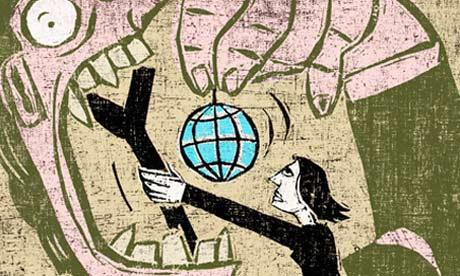
We know it's rubbish, but we allow our hopes to be raised, only to witness 190 nations arguing through the night over the use of the subjunctive in paragraph 286. We know that at the end of this process the UN secretary general, whose job obliges him to talk nonsense in an impressive number of languages, will explain that the unresolved issues (namely all of them) will be settled at next year's summit. Yet still we hope for something better.'To see Obama backtracking on the commitments made by Bush the elder 20 years ago is to see the extent to which a tiny group of plutocrats has asserted its grip on policy.' Illustration above by Daniel Pudles
This week's earth summit in Rio de Janeiro is a ghost of the glad, confident meeting 20 years ago. By now, the leaders who gathered in the same city in 1992 told us, the world's environmental problems were to have been solved. But all they have generated is more meetings, which will continue until the delegates, surrounded by rising waters, have eaten the last rare dove, exquisitely presented with an olive leaf roulade. The biosphere that world leaders promised to protect is in a far worse state than it was 20 years ago. Is it not time to recognise that they have failed?
If world governments do not have the vision, the foresight and the compassion to do the right thing, then it is up to us, the People, to bring about change, and if change means a change of government, so be it. This is about a planetary emergency, about a decent life for our children, about our childrens survival. Editor
Thursday, June 14, 2012
Monday, June 11, 2012
Ta'Kaiya Blaney, ten year old environmentalist appeals to Canadian government
March 24, 2011 Open Letter to Canadian politicians, My name is Ta'Kaiya Blaney. I am 10-years-old. I live in North Vancouver and am from the Sliammon Nation. My name means "special water." I am writing to you because the Enbridge Corporation is planning to build a pipeline from the tar sands of Alberta to Kitimat, BC. I thought it would be very risky for our coast so I wrote a song, called "Shallow Waters" about an oil spill happening in the shallow waters. You will be debating Bill C-606 soon, if an election is not triggered, which would ban oil tankers from our northwest coast. I am sharing my song's music video and a personal message to encourage you to vote in favour of the bill. Today is the anniversary of the Exxon Valdez oil spill in Alaska. Even today, 22 years later, oil still remains a few inches under the surface of the water. With this song, I hope to encourage government officials, people of British Columbia, and people across the world will realize the dangers of oil pollution, replace jobs that destroy the environment with jobs that help the environment. I ask government and corporate officials such as yourselves change your plans stop oil tanker traffic on BC's coast and in waters around the world. Please feel free to share my letter and video with others. All my relations, Ta'Kaiya Blaney For more information, please read Stephanie Goodwin's blog: www.greenpeace.org Shallow Waters was a semi-finalist in the 2010 David Suzuki Songwriting Contest, Playlist <b>...</b>
How We Got Here and the Pathway to Sustainability
John D. Liu presents the 20th Richard Jones Memorial Lecture (2011) on "How We Got Here and the Pathway to Sustainability".
Visit www.rjml.org.au for further information.
Visit www.rjml.org.au for further information.
Saturday, June 9, 2012
Chomsky on America We’re really regressing back to the dark ages.
Chomsky: Do We Have the Makings of a Real Revolution?
Unless the spirit of the last year continues to grow and becomes a major force in the social and political world, the chances for a decent future are not very high. The Occupy movement has been an extremely exciting development. Unprecedented, in fact. There’s never been anything like it that I can think of. If the bonds and associations it has established can be sustained through a long, dark period ahead -- because victory won’t come quickly -- it could prove a significant moment in American history.
 The fact that the Occupy movement is unprecedented is quite appropriate. After all, it’s an unprecedented era and has been so since the 1970s, which marked a major turning point in American history. For centuries, since the country began, it had been a developing society, and not always in very pretty ways. That’s another story, but the general progress was toward wealth, industrialization, development, and hope. There was a pretty constant expectation that it was going to go on like this. That was true even in very dark times.
I’m just old enough to remember the Great Depression. After the first few years, by the mid-1930s -- although the situation was objectively much harsher than it is today -- nevertheless, the spirit was quite different. There was a sense that “we’re gonna get out of it,” even among unemployed people, including a lot of my relatives, a sense that “it will get better.”
There was militant labor union organizing going on, especially from the CIO (Congress of Industrial Organizations). It was getting to the point of sit-down strikes, which are frightening to the business world -- you could see it in the business press at the time -- because a sit-down strike is just a step before taking over the factory and running it yourself. The idea of worker takeovers is something which is, incidentally, very much on the agenda today, and we should keep it in mind. Also New Deal legislation was beginning to come in as a result of popular pressure. Despite the hard times, there was a sense that, somehow, “we’re gonna get out of it.”
It’s quite different now. For many people in the United States, there’s a pervasive sense of hopelessness, sometimes despair. I think it’s quite new in American history. And it has an objective basis. More
Unless the spirit of the last year continues to grow and becomes a major force in the social and political world, the chances for a decent future are not very high. The Occupy movement has been an extremely exciting development. Unprecedented, in fact. There’s never been anything like it that I can think of. If the bonds and associations it has established can be sustained through a long, dark period ahead -- because victory won’t come quickly -- it could prove a significant moment in American history.
I’m just old enough to remember the Great Depression. After the first few years, by the mid-1930s -- although the situation was objectively much harsher than it is today -- nevertheless, the spirit was quite different. There was a sense that “we’re gonna get out of it,” even among unemployed people, including a lot of my relatives, a sense that “it will get better.”
There was militant labor union organizing going on, especially from the CIO (Congress of Industrial Organizations). It was getting to the point of sit-down strikes, which are frightening to the business world -- you could see it in the business press at the time -- because a sit-down strike is just a step before taking over the factory and running it yourself. The idea of worker takeovers is something which is, incidentally, very much on the agenda today, and we should keep it in mind. Also New Deal legislation was beginning to come in as a result of popular pressure. Despite the hard times, there was a sense that, somehow, “we’re gonna get out of it.”
It’s quite different now. For many people in the United States, there’s a pervasive sense of hopelessness, sometimes despair. I think it’s quite new in American history. And it has an objective basis. More
A Global Call: Eco Warriors, Arise!
Ahead of the Rio+20 Earth Summit, a call for a paradigm shift By Vandana Shiva
 In June 2012, movements and leaders will meet in Rio for Rio+20, two decades after the Earth Summit was organised in 1992 to address urgent ecological challenges such as species extinction, biodiversity erosion and climate change. The Earth Summit gave us two very significant international environmental laws: the United Nations Convention on Biological Diversity and the United Nations framework Convention on Climate Change. It also gave us the Rio principles, including the Precautionary Principle and the Polluter Pays Principle.
The world has changed radically since 1992, and sadly, not for the better. Ecological sustainability has been systematically sacrificed for a particular model of the economy, which is itself in crisis. 1995 created a tectonic shift in what values guide our decisions, and who makes the decisions. Rio was based on values of ecological sustainability, social justice and economic equity - across countries and within countries. It was shaped by ecological movements, ecological science and sovereign governments. The establishment of WTO, and the paradigm of global corporate rule, inaccurately called "free trade" (more accurately described as corporate globalisation) changed the values and the structures of governance and decision making.
Conservation of the Earth's resources, and equitable sharing was replaced by greed and the grabbing and privatisation of resources. Sustainable economies and societies were replaced by non-sustainable production systems, and a relentless drive to spread the virus of consumerism. Decision making moved into the hands of global corporations, both directly and indirectly. It is therefore not surprising that when we meet at Rio+ 20, the ecological crisis is deeper than what it was at the time of the Earth Summit, and the will and capacity of governments is weaker. More
Friday, June 8, 2012
This is Ecocide - Youth Blast Rio Summit 2012
This video is being presented at Youth Blast at the Rio Earth Summit on behalf of the Eradicating Ecocide campaign. The aim is to inspire and intrigue young people to help make ecocide an international crime. Youth Blast is the official young peoples event for Rio+20 being held in June 2012.
Thursday, June 7, 2012
Top US companies shelling out to block action on climate change
Analysis of 28 companies finds cases of support for thinktanks that misrepresent climate science, including Heartland Institute
 Some of America's top companies are spending heavily to block action on climate change or discredit climate science, despite public commitments to sustainable and green values, a new report has found.
An analysis of 28 Standard & Poor 500 publicly traded companies by researchers from the Union of Concerned Scientists exposed a sharp disconnect in some cases between PR message and less visible activities, with companies quietly lobbying against climate policy or funding groups which work to discredit climate science.
The findings are in line with the recent expose of the Heartland Institute. Over the years, the ultra-conservative organisation devoted to discrediting climate science received funds from a long list of companies which had public commitments to sustainability.
The disconnect in this instance was especially stark in the researchers' analysis of oil giants ConocoPhillips and ExxonMobil, and the electricity company DTE energy.
But even General Electric Company, which ranks climate change as a pillar of its corporate policy on its website, had supported trade groups and thinktanks that misrepresent climate science, the researchers found.
Caterpillar Inc, despite its public commitment to sustainability, also worked behind the scenes to block action on climate change. The company spent more than $16m (£10.3m) on lobbying during the study, with nearly five times as much of that spent lobbying to block climate action than on pro-environmental policies.
Other big corporate players were fairly consistent with their public image. Nike and NRG Energy Inc lobbied in support of climate change policy and supported conservation groups. More
Scientists Fear Global Ecological Collapse Once 50% of the Natural Landscape is Gone
I love me some solid, science-backed doom and gloom—and good thing! It's in such ample supply. A new study from 22 respected biologists and ecologists says that the world may be about to undergo a "state shift" that will trigger huge environmental transformations, mass extinctions, and ecological collapse. Oh, it will probably be an existential threat to humanity too.
 So, New York Times, riddle me this:
Guess which option humanity is leaning towards? (Hint: not deflate gently.) It's yet another mostly incomprehensible tipping point to look out for on the horizon—since we're likely to keep developing the natural landscape at roughly the same rate (if not faster) well into the future, we should hit that 50 percent mark pronto. Then I guess we just do what we seem to do best these days: cross our fingers and hope that the scientists are wrong. More

Humans have already converted about 43 percent of the ice-free land surface of the planet to uses like raising crops and livestock and building cities, the scientists said. Studies on a smaller scale have suggested that when more than 50 percent of a natural landscape is lost, the ecological web can collapse. The new paper essentially asks, what are the chances that will prove true for the planet as a whole?And the answer is ... scientists don't really know for sure, but they're scared shitless.James H. Brown, a macroecologist at the University of New Mexico, said in an interview that this “scares the hell out of me. We’ve created this enormous bubble of population and economy. If you try to get the good data and do the arithmetic, it’s just unsustainable. It’s either got to be deflated gently, or it’s going to burst.”
Guess which option humanity is leaning towards? (Hint: not deflate gently.) It's yet another mostly incomprehensible tipping point to look out for on the horizon—since we're likely to keep developing the natural landscape at roughly the same rate (if not faster) well into the future, we should hit that 50 percent mark pronto. Then I guess we just do what we seem to do best these days: cross our fingers and hope that the scientists are wrong. More
Tuesday, June 5, 2012
An Introduction to Green Governance
Ecological Survival, Human Rights, and the Law of the Commons
 Commons scholar David Bollier and law school professor Burns H. Weston persuasively argue that protecting the commons depends upon “bold modifications of our legal structures and political culture.” This article, first published in the current issue of Kosmos Journal, is drawn from their forthcoming book Green Governance: Ecological Survival, Human Rights, and the Law of the Commons to be published by Cambridge University Press next year. Bollier and Weston are founders of the Commons Law Project, which envisions “a new architecture of law and public policy that can effectively address climate change and other urgent ecological problems while advancing human rights and social empowerment.” — Jay Walljasper
At least since Rachel Carson’s Silent Spring, we have known about humankind’s squandering of nonrenewable resources, its careless disregard of precious life species, and its overall contamination and degradation of delicate ecosystems. In recent decades, these defilements have assumed a systemic dimension. Lately we have come to realize the shocking extent to which our atmospheric emission of carbon dioxide and other greenhouse gases threatens Planet Earth.
If the human species is going to overcome the many interconnected ecological catastrophes now confronting us, this moment in history requires that we entertain some bold modifications of our legal structures and political culture. We must find the means to introduce new ideas for effective and just environmental protection—locally, nationally, regionally, globally and points in between. More
Subscribe to:
Posts (Atom)