Tuesday, November 20, 2012

The bailout of the 99% by the 99%

Why should the 1% get all the bailouts? Now, an Occupy Wall Street offshoot has launched an exciting project called Rolling Jubilee that lets you turn a little cash into a helping hand for folks who deserve it a lot more than Bank of America does.

Here's the deal. Jubilee is an ancient biblical tradition in which, periodically, debts were forgiven, slaves were freed and slates were wiped clean. It was a time for starting afresh, of renewal. Now, Rolling Jubilee takes that concept to a new level. According to their website, it works like this:

Banks sell debt for pennies on the dollar on a shadowy speculative market of debt buyers who then turn around and try to collect the full amount from debtors. The Rolling Jubilee intervenes by buying debt, keeping it out of the hands of collectors, and then abolishing it. We’re going into this market not to make a profit but to help each other out and highlight how the predatory debt system affects our families and communities. Think of it as a bailout of the 99% by the 99%.

Millions of working people are still haunted by the debt they ran up while trying to stay afloat during the Great Recession. And while the government doled out hundreds of billions of dollars to big corporations and too-big-to-fail banks, normal folks have been pretty much left to fend for themselves.

By wiping out this debt, Rolling Jubilee spares thousands of hard-pressed people the agonies of getting pursued by aggressive collection agencies, many of whom use abusive, illegal practices to try and extract money from people who might be struggling to get back on their feet after losing a job, falling ill or other personal disasters.

So far, Rolling Jubilee says it's collected nearly $300,000 in donations, enough to extinguish more than $5m in debt. The group hopes to grow a broad debt resistance movement – and help build a non-exploitative economy that works for everybody.

Learn more: This trailer for the documentary film Maxed Out features professor (now, newly elected US senator) Elizabeth Warren explaining the predatory practices of banks and credit card companies. Then, if that doesn't make you angry enough, check out this ABC News expose of outrageous practices in the collections industry. More


Monday, November 19, 2012

Taking Stock: World Fish Catch Falls to 90 Million Tons in 2012

The U.N. Food and Agriculture Organization (FAO) projects that the world’s wild fish harvest will fall to 90 million tons in 2012, down 2 percent from 2011. This is close to 4 percent below the all-time peak haul of nearly 94 million tons in 1996.

The wild fish catch per person has dropped even more dramatically, from 17 kilograms (37.5 pounds) per person at its height in 1988 to 13 kilograms in 2012—a 37-year low. While wild fish harvests have flattened out during this time, the output from fish farming has soared from 24 million tons in the mid-1990s to a projected 67 million tons in 2012.

Over the last several decades, as demand for fish and shellfish for food, feed, and other products rose dramatically, fishing operations have used increasingly sophisticated technologies—such as on-vessel refrigeration and processing facilities, spotter planes, and GPS satellites. Industrial fishing fleets initially targeted the northern hemisphere’s coastal fish stocks, then as stocks were depleted they expanded progressively southward on average close to one degree of latitude annually since 1950. The fastest expansion was during the 1980s and early 1990s. Thereafter, the only frontiers remaining were the high seas, the hard-to-reach waters near Antarctica and in the Arctic, and the depths of the oceans.

The escalating pursuit of fish—now with gross revenue exceeding $80 billion per year—has had heavy ecological consequences, including the alteration of marine food webs via a massive reduction in the populations of larger, longer-lived predatory fish such as tunas, cods, and marlins. Unselective fishing gear, including longlines and bottom-scraping trawls, kill large numbers of non-target animals like sea turtles, sharks, and corals.

As of 2009, some 57 percent of the oceanic fish stocks evaluated by FAO are “fully exploited,” with harvest levels at or near what fisheries scientists call maximum sustainable yield (MSY). If we think of a fish stock as a savings account, fishing at MSY is theoretically similar to withdrawing only the accrued interest, avoiding dipping into the principal.

Some 30 percent of stocks are “overexploited”—they have been fished beyond MSY and require strong management intervention in order to rebuild. The share of stocks in this category has tripled since the mid-1970s. A well-known example of this is the Newfoundland cod fishery that collapsed in the early 1990s and has yet to recover.

This leaves just 13 percent of oceanic fish stocks in the “non-fully exploited” category, down from 40 percent in 1974. Unfortunately, these remaining stocks tend to have very limited potential for safely increasing the catch.

These FAO figures describe 395 fisheries that account for some 70 percent of the global catch. Included are the small minority that have undergone the time-consuming and expensive process of formal scientific stock assessment, with the remainder being "unassessed" fisheries. There are thousands more unassessed fisheries, however, that are absent from the FAO analysis. In a 2012 Science article, Christopher Costello and colleagues published the first attempt to characterize all of the world’s unassessed fisheries. The authors report that 64 percent of them were overexploited as of 2009.

The top 10 fished species represent roughly one quarter of the world catch. Nearly all of the stocks of these species are considered fully exploited (most of these fish have more than one geographically distinct stock), including both of the major stocks of Peruvian anchovy, the world's leading wild-caught fish. Stocks that are overexploited and in need of rebuilding include largehead hairtail—a ribbon-like predator caught mainly by Chinese ships—in its main fishing grounds in the Northwest Pacific. (See data.)

Despite the unsustainable nature of current harvest levels, countries continue to subsidize fishing fleets in ways that encourage even higher catches. Governments around the world spend an estimated $16 billion annually on increasing fleet size and fish-catching ability, including $4 billion for fuel subsidies. Industrial countries spend some $10 billion of that total. More than $2 billion is spent by China, whose 15-million-ton catch is nearly triple that of the next closest country, Indonesia. More


Sunday, November 11, 2012

Wire Frame Rocket Stove

The 'Thab' style rocket stove is a template that utilizes unwanted wire hangers [or any stiff wire] from North America to assist in improving the portable dung stove used by Tibetan nomads.

A rocket stove is an efficient cooking stove using small diameter wood fuel which is burned in a simple high-temperature combustion chamber containing an insulated vertical chimneywhich ensures complete combustion prior to the flames reaching the cooking surface. The principles were described by Dr. Larry Winiarski from Aprovecho in 1982 and stoves based on this design won Ashden Awards in both 2005 and 2006. Interest in rocket stoves has led to the development of rocket mass heaters and other innovations.


A rocket stove is an efficient cooking stove using small diameter wood fuel which is burned in a simple high-temperature combustion chamber containing an insulated vertical chimneywhich ensures complete combustion prior to the flames reaching the cooking surface. The principles were described by Dr. Larry Winiarski from Aprovecho in 1982 and stoves based on this design won Ashden Awards in both 2005 and 2006. Interest in rocket stoves has led to the development of rocket mass heaters and other innovations.

The rocket stove operates roughly twice as efficiently, and substantially more cleanly, than the open fire cooking methods still used in many areas of the world. Furthermore, the design of the stove requires small diameter lengths of wood, which can generally be satisfied with small branches. As such, sufficient fuel for cooking tasks can be gathered in less time, without the benefit of tools, and ideally without the destruction of forested areas.


Because these qualities improve local air quality, and discourage deforestation, the rocket stove has attracted the attention of a number of Appropriate Technologyconcerns, which have deployed it in numerous third-world locales (notably, the Rwandan refugee camps). This attention has resulted in a number of adaptations intended to improve convenience and safety, and thus the size of the target audience. The Justa Stove, for example, is a cousin of the rocket stove adapted for indoor use and family cooking needs. More


Wednesday, November 7, 2012

UN Reports That Up To 90% Of Deforestation Is Due To Organized Crime

GREEN CARBON - BLACK TRADE

ILLEGAL LOGGING,TAX FRAUD ANDLAUNDERING IN THE WORLD’STROPICAL FORESTS

Environmental crime and the illegal grabbing of natural resources is becoming an evermore sophisticated activity requiring national authorities and law enforcement agencies to develop responses commensurate with the scale and the complexity of the challengeto keep one step ahead.


This report – Green Carbon, Black Trade – by UNEP and INTER-POL focuses on illegal logging and its impacts on the lives andlivelihoods of often some of the poorest people in the world setaside the environmental damage. It underlines how criminalsare combining old fashioned methods such as bribes with hightech methods such as computer hacking of government websites to obtain transportation and other permits. The reportspotlights the increasingly sophisticated tactics being deployedto launder illegal logs through a web of palm oil plantations,road networks and saw mills.

Indeed it clearly spells out that illegal logging is not on the decline, rather it is becoming more advanced as cartels becomebetter organized including shifting their illegal activities inorder to avoid national or local police efforts. By some estimates,15 per cent to 30 per cent of the volume of wood traded globallyhas been obtained illegally. Unless addressed, the criminal ac-tions of the few may endanger not only the development pros-pects for the many but also some of the creative and catalyticinitiatives being introduced to recompense countries and com-munities for the ecosystem services generated by forests.

One of the principal vehicles for catalyzing positive environ-mental change and sustainable development is the ReducedEmissions from Deforestation and Forest Degradation initia-tive (REDD or REDD+). If REDD+ is to be sustainable over thelong term, it requests and requires all partners to fine tune theoperations, and to ensure that they meet the highest standardsof rigour and that efforts to reduce deforestation in one locationare not offset by an increase elsewhere.


If REDD+ is to succeed, payments to communities for theirconservation efforts need to be higher than the returns from ac-tivities that lead to environmental degradation. Illegal loggingthreatens this payment system if the unlawful monies chang-ing hands are bigger than from REDD+ payments.

The World’s forests represent one of the most important pil-lars in countering climate change and delivering sustainabledevelopment. Deforestation, largely of tropical rainforests, isresponsible for an estimated 17 per cent of all man-made emis-sions, and 50 per cent more than that from ships, aviation andland transport combined. Today only one-tenth of primary for-est cover remains on the globe.

Forests also generate water supplies, biodiversity, pharma-ceuticals, recycled nutrients for agriculture and flood pre-vention, and are central to the transition towards a GreenEconomy in the context of sustainable development and pov-erty eradication.

Strengthened international collaboration on environmentallaws and their enforcement is therefore not an option. It is in-deed the only response to combat an organized internationalthreat to natural resources, environmental sustainability andefforts to lift millions of people out of penury. Download Report


Achim Steiner UN Under-Secretary General and UNEP Executive Director

Ronald K. Noble INTERPOL Secretary General


Full Planet, Empty Plates: Quick Facts

With falling water tables, eroding soils, and rising temperatures making it difficult to feed growing populations, control of arable land and water resources is moving to center stage in the global struggle for food security. What will the geopolitics of food look like in a new era dominated by scarcity and food nationalism? Here are a few of the many facts from the book to consider:


  • There will be 219,000 people at the dinner table tonight who were not there last night—many of them with empty plates.
  • As a result of chronic hunger, 48 percent of all children in India are undersized, underweight, and likely to have IQs that are on average 10-15 points lower than those of well-nourished children.
  • Food prices are rising dramatically. The U.N. Food Price Index in June 2012 was twice the base level of 2002-04.
  • More than half the world’s people live in countries where water tables are falling as aquifers are being depleted.
  • A startling 80 percent of oceanic fisheries are being fished at or beyond their sustainable yield.
  • Between 2005 and 2011, the amount of grain used to produce fuel for cars in the United States climbed from 41 million to 127 million tons—nearly a third of the U.S. grain harvest.
  • In 2011, China consumed 70 million tons of soybeans, 56 million of which had to be imported. Almost all went into livestock feed.
  • Today, with incomes rising fast in emerging economies, there are at least 3 billion people moving up the food chain, consuming more grain-intensive livestock and poultry products.
  • Data for India indicate that 175 million people are being fed with grain produced by overpumping. For China, there are 130 million in the same boat.
  • In Ethiopia, a prime target for foreign land acquisitions yet also a major food aid recipient, an acre of land can be leased for less than $1 per year.
  • The 464 land acquisitions identified by the World Bank in 2010 totaled some 140 million acres—more than is planted in corn and wheat combined in the United States.
  • It’s not all bad news: 44 countries have reached population stability as a result of gradual fertility decline over the last several generations.
“In this era of tightening world food supplies, the ability to grow food is fast becoming a new form of geopolitical leverage. Food is the new oil. Land is the new gold.” – Lester R. Brown


Full Planet, Empty Plates: The New Geopolitics of Food Scarcity is available for purchase online. Get a sneak peek by checking out Chapter 1: Food the Weak Link or watch the five minute video below and hear from Lester Brown himself about the main issues raised in the book.


Saturday, November 3, 2012

Hope for Self-Sufficiency! Could Permaculture Influence Future Sustainable Development Policy?

Wales leads planning revolution as new Practice Guidance document is released to simplify the process of gaining planning permission on 'open countryside'.


A new advisory document has been released which will aid people in making planning applications for sustainable development on open countryside in Wales, but which could potentially also lead to change in the uk and abroad.

These developments, referred to as One Planet Developments must:

  • commit to provide for the income, food and energy needs of all the inhabitants, and manage their own waste
  • have either a positive or neutral effect on the environment, demonstrated through a footprint calculation each year, known as the Ecological Footprint Analysis (EFA)
Lammas in Pembrokeshire was one of the first One Planet Developments, where construction began in 2009. It is hoped that such examples, along with the new guidance, will help demystify the difficult process of gaining planning permission on undeveloped land in the countryside.

What the New Guidance Covers

It is usually almost impossible to gain planning permission for undeveloped land. Building your own One Planet Development offers a viable and satisfying way to live on open countryside, in harmony with the environment. This doesn't mean that you won't still be very closely monitored by planning officials, and there are some very important criteria that you must meet. The new advisory document explains in plain terms how to get started, laying out:

  • the practical requirements to complete a successful planning application for a One Planet Development
  • how to prepare a Management Plan (explained in more detail below)
  • the requirements of the Ecological Footprint Analysis (EFA) which is used to monitor the success of the development

A Place for Permaculture Design

Importantly, the advisory document specifically names permaculture as a sound option for achieving the objectives of One Planet Development – "as permaculture is intrinsically site-based and focused on low environmental impacts, it is so often linked to One Planet Development... Permaculture has a long association with development likely to meet the necessary requirements due to its intrinsically holistic nature." More


A Grim Warming From Science

One of the things that makes Sandy different from Katrina is that it’s a relatively clean story. The lessons of Katrina were numerous and painful—they had to do with race, with class, with the willful incompetence of a government that had put a professional Arabian horse fancier in charge of its rescue efforts.

Sandy, by contrast, has been pretty straightforward. It’s hit rich, poor, and middle class Americans with nearly equal power, though of course the affluent always have it easier in the aftermath of tragedy. Government officials prepared forthrightly for its arrival, and have refrained from paralysis and bickering in its wake. Which allows us to concentrate on the only really useful message it might deliver: that we live in a changed world, where we need both to adapt to the changes, and to prevent further changes so great that adaptation will be impossible.

Science and its practical consort Engineering mostly come out of this week with enhanced reputations. For some years now, various researchers have been predicting that such a trauma was not just possible but almost certain, as we raised the temperature and with it the level of the sea—just this past summer, for instance, scientists demonstrated that seas were rising faster near the northeast United States (for reasons having to do with alterations to the Gulf Stream) than almost anyplace on the planet. They had described, in the long run, the loaded gun, right down to a set of documents describing the precise risk to the New York subway system.

The same researchers who predicted events like this week’s horror have warned that unless we cease burning coal and gas and oil the planet’s temperature—already elevated by a degree—will climb another four or five. At which point “civilization” will be another word for “ongoing emergency response.”

As nature pulled the trigger in mid-October, when a tropical wave left Africa and moved into the Atlantic and began to spin, scientists were able to do the short-term work of hurricane forecasting with almost eerie precision. Days before Sandy came ashore we not only knew approximately where it would go, but that its barometric pressure would drop below previous records and hence that its gushing surge would set new marks. The computer models dealt with the weird hybrid nature of the storm—a tropical cyclone hitting a blocking front—with real aplomb; it was a bravura performance.

In so doing, it should shame at least a little those people who argue against the computer modeling of climate change on the grounds that “they can’t even tell the weather three days ahead of time—how can they predict the climate?” But in fact “they” can tell the weather, and in the process they saved thousands upon thousands of lives. They can tell the future too. No serious climate scientist believes that the sea will rise less than a meter this century, unless we get off fossil fuel with great speed; many anticipate it will rise far more. Think about what that means—as one researcher put it this week, it means that any average storm will become an insidious threat. More


Tuesday, October 30, 2012

Greetings from 2020

Greetings from 2020

I write to you from 2020, a world where there is no more Ecocide; a law of Eococide has now been passed after 5 years of transition where all companies have been given subsidies to prioritise a green economy; governments have been re-writing their policies and laws to bring them in line with the 5th Crime Against Peace and banks have new investment rules that categorise investment into dangerous indistrial activity as unsupportable. Innovation in the green sector has flourished and economies are stabilising; long-term investment signals into green-tech have brought a flood of job opportunities to millions of people across the globe and Green Crime has become a thing of the past.


My wish is not only possible, it almost became a reality 14 years ago. Back then the Rome Statute was put in place - however earlier drafts had included a law of Ecocide. Can you imagine where we would be if it had been enacted? We would be in a place just as I envision for 2020. You can read more about the history of a law of Ecocide in the report called Ecocide is the Missing 5th Crime Against Peace.

This time round we can put in place the missing 5th Crime Against Peace by bringing the people of the world together - and that is why we are calling on you and every one you know to support ourWish20. Our leaders need a public mandate to step forward and say yes to making Ecocide a crime. This time round we can make sure it does not get overlooked. Please help us make it happen. Sign our Global Citizens Initiative here and help us create a world map of support for a law of Ecocide. More


Tuesday, October 9, 2012

Ambassador Anwarul Chowdhury To Deliver “Peace And Equality”

(Long Island, NY) Ambassador of Bangladesh Anwarul Chowdhury, an expert on current critical issues including peace, sustainable development, and human rights, will speak at Adelphi University as part of the International Leadership Coordinating Committee Ambassador Series on “Peace and Equality—Absolutely Essential for a Better World” on Tuesday, November 13, 2012 in the Ruth S. Harley University Center Ballroom. This event is free and open to the public.

For the past two decades, Chowhurdy has been recognized as a leader in the movement for global peace. Ambassador Chowdhury currently holds the titles of Career Diplomat; Permanent Representative to the United Nations; President of the UN Security Council; and, President of the UNICEF board. From 2002 to 2007, he served as the UN Under-Secretary-General. Chowdhury has also served as the Secretary-General of the two major global conferences convened by the United Nations General Assembly: The Almaty International Conference on Global Transit Transport Cooperation in 2003 and the Mauritius International Meeting on Small Island Developing States in 2005.

Since October 2007, he has held the role as the Honorary Chair of the International Day of Peace NGO Committee. Chowdhury is a member of the Wisdom Council of the Summer of Peace 2012, a world-wide participatory initiative to advance the Culture of Peace, as well as a Board of Trustee of the New York City Peace Museum.

In 2007, he completed his term as the Under-Secretary-General and high representative for the most vulnerable countries of the world. From 1996 to 2001, Ambassador Chowdhury was Permanent Representative of Bangladesh, his native country, to the United Nations in New York. In addition, he served as Bangladesh’s Ambassador to Chile, Nicaragua, Peru, and Venezuela as well as Bangladesh’ High Commissioner to the Bahamas and Guyana.

One of his major accomplishments as the president of the Security Council included an initiative that brought about the adoption of the groundbreaking UN Security Council Resolution 1325, which recognized for the first time the role and contribution of women in the area of peace and security.

Due to his contributions, in 1999 the United Nations General Assembly adopted the landmark “Programme of Action on a Culture of Peace.” He also initiated the declaration by the United Nations General Assembly of the “International Decade for Culture of Peace and Nonviolence for the Children of the World (2001-2010).”

Ambassador Chowdhury is the first recipient of the Institute for Global Leadership Lifetime Service Award which he received at the conference on New Leadership Models for Worcester, United States and the World held in Worcester, Massachusetts in May 2007. In October 2007, the United Nations NGO Committee on Spirituality, Values, and Global Concerns presented its first “SPIRIT OF THE UNITED NATIONS” Award to Chowdhury. Also in 2007, he received the highest honor of The Government of Burkina Faso in West Africa, “L’Ordre Nacionale,” in Ouagadougou for his championship of the cause of the most vulnerable countries. Chowdhury has earned a number of honorary degrees for his global peace efforts from Soka University, in Tokyo, Japan and Saint Peter’s College, in Jersey City, NJ, among others. More


Friday, October 5, 2012

Jacque Fresco - Global Sustainability: The Venus Project-Resource Based Economy


The Venus Project-Resource Based Economy - Jacque Fresco - Global Sustainability

The term and meaning of a Resource-Based Economy was originated by Jacque Fresco. It is a holistic social and economic system in which all goods and services are available without the use of money, credits, barter or any other system of debt or servitude. All resources become the common heritage of all of the inhabitants, not just a select few. The premise upon which this system is based is that the Earth is abundant with plentiful resource; our practice of rationing resources through monetary methods is irrelevant and counter productive to our survival.

Modern society has access to highly advanced technology and can make available food, clothing, housing and medical care; update our educational system; and develop a limitless supply of renewable, non-contaminating energy. By supplying an efficiently designed economy, everyone can enjoy a very high standard of living with all of the amenities of a high technological society.

A resource-based economy would utilize existing resources from the land and sea, physical equipment, industrial plants, etc. to enhance the lives of the total population. In an economy based on resources rather than money, we could easily produce all of the necessities of life and provide a high standard of living for all.


Journey into Ecological Resurgence: John Liu at TEDxWageningen

Journey into Ecological Resurgence: John Liu at TEDxWageningen

Published onAug 14, 2012byTEDxTalks

952 views


16 likes, 0 dislikes
For 15 years, in the 1980's and early 1990's, John worked as a television journalist in China for CBS News, Radiotelevisione Italiana (RAI), and Zweites Deutsches Fernsehen (ZDF German Television). Over the years he had to do virtually every job in remote television production and gained some skills that were in demand.
As John grew in his work he was also observing China as it emerged from isolation and poverty. It was exhilarating to see China stand up but terrifying to consider the pollution and environmental implications of its rise. John would go to his office and think, "someone should really do something about the environment", but what he meant was "someone else". After some time he began to feel that his own attitude was part of the problem. If John was unwilling to change his life, why would anyone else? At this point he decided to found the "Environmental Education Media Project for China (EEMPC)" and to devote his energies to understanding and communicating about the environment and ecology. Since the mid-1990's, the EEMPC has distributed hundreds of existing films in China and John have made dozens of environmental and ecological films in China and around the world.

In the spirit of ideas worth spreading, TEDx is a program of local, self-organized events that bring people together to share a TED-like experience. At a TEDx event, TEDTalks video and live speakers combine to spark deep discussion and connection in a small group. These local, self-organized events are branded TEDx, where x = independently organized TED event. The TED Conference provides general guidance for the TEDx program, but individual TEDx events are self-organized.* (*Subject to certain rules and regulations)

Wednesday, October 3, 2012

The Great Barrier Reef has lost half of its coral in the last 27 years

Can we save the Reef by controlling crown of thorns starfish?


The Great Barrier Reef has lost half its coral cover in the last 27 years. The loss was due to storm damage (48%), crown of thorns starfish (42%), and bleaching (10%) according to a new study published in the Proceedings of the National Academy of Sciences today by researchers from the Australian Institute of Marine Science (AIMS) in Townsville and the University of Wollongong.

"We can't stop the storms but, perhaps we can stop the starfish. If we can, then the Reef will have more opportunity to adapt to the challenges of rising sea temperatures and ocean acidification", says John Gunn, CEO of AIMS.

"This finding is based on the most comprehensive reef monitoring program in the world. The program started broadscale surveillance of more than 100 reefs in 1985 and from 1993 it has incorporated more detailed annual surveys of 47 reefs," says one of the program's original creators, Dr Peter Doherty, Research Fellow at AIMS.

"Our researchers have spent more than 2,700 days at sea and we've invested in the order of $50 million in this monitoring program," he says.

"The study shows the Reef has lost more than half its coral cover in 27 years. If the trend continued coral cover could halve again by 2022. Interestingly, the pattern of decline varies among regions. In the northern Great Barrier Reef coral cover has remained relatively stable, whereas in the southern regions we see the most dramatic loss of coral, particularly over the last decade when storms have devastated many reefs. " says Peter Doherty.

The study clearly shows that three factors are overwhelmingly responsible for this loss of coral cover. Intense tropical cyclones have caused massive damage, primarily to reefs in the central and southern parts of the Reef, while population explosions of the coral-consuming Crown-of-thorns starfish have affected coral populations along the length of the Reef. Two severe coral bleaching events have also had major detrimental impacts in northern and central parts of the GBR.

"Our data show that the reefs can regain their coral cover after such disturbances, but recovery takes 10-20 years. At present, the intervals between the disturbances are generally too short for full recovery and that's causing the long-term losses," says Dr Hugh Sweatman, one of the study's authors.

"We can't stop the storms, and ocean warming (the primary cause of coral bleaching) is one of the critical impacts of the global climate change," says AIMS CEO, John Gunn. "However, we can act to reduce the impact of crown of thorns," he says. "The study shows that in the absence of crown of thorns, coral cover would increase at 0.89% per year, so even with losses due to cyclones and bleaching there should be slow recovery. More


Thursday, September 20, 2012

Irreplaceable Real Estate: What is Plan B?

Climate change is the most serious peril that has faced humanity in its long history. However, we are faced with more than climate change, there is peak oil and an out of control population, as well as concerns for water and food security in the years to come.


As I keep repeating “failing to plan is planning to fail”.

Humanity is today, to use an American term, playing in the major leagues. We are in a sink or swim situation. If we can keep the planet habitable by mitigating and adapting to the changing climate, switching to alternative sources of energy such as solar, wind, geothermal, wave, ocean thermal and nuclear, sequester CO2 and provide the population with adequate supplies of water and food and bring the population under control, humanity may survive .

Warfare and conflict will also need to become a thing of the past as climate change and energy may well exacerbate conflict situations. With a 9.5 billion global population by 2050 ensuring that everyone has adequate food and water could be problematic.

There is however, no ‘Plan B’ if we fail to resolve all the problems facing us.

When playing in this major leagues club there is no time out, there is no one that is going to offer help, let alone rescue us. Look around, the neighbourhood is somewhat sparsely populated and there are no other worlds on which humanity can survive. Even if there were other habitable worlds nearby they would in all probability belong to someone else.

There are, in all likelihood, other intelligent races out there somewhere, however in the major leagues one survives on ones own. As a young civilisation it is up to us to solve all our problems, to make peace among ourselves, to bring the population under control, to implement the Millennium Development Goals (MDG), to bring equality to all peoples. We must solve our own problems. As a young race we are as children, and as such we may not be able to solve our own problems. But solve them we must.

If we are able to solve the situation facing us and make it to adulthood, in the galactic meaning of the world, we may then be introduced to the neighbours.

If we do not make it to adulthood we will be just another minor statistic, a failure, a insignificant footnote in the universal history book. Nick Robson, Editor. © 2011


This video may contain copyrighted material & is the property of the respective authors, artists and labels. This video was compiled by sebastiansz


Monday, September 17, 2012

How to give peace a chance with Gross Peaceful Product (GPP)

Research for the NATO Science Programme by blindspotter proposes a simple change to international accounting conventions so that economic competition becomes a powerful 'weapon' for greater security and lower weapons costs.


This is the fourth of a set of Seven Policy Switches for Global Security. Global security (all facets of security everywhere) may be achievable by making all the switches soon enough.


A short web address for this page is http://bit.ly/fourthswitch


Your comments are very welcome below. If you're interested in any of these topics please join my group designing and inspiring fast global change - Fixing systems not symptoms! You can also support my continuing work on whole systems change bydonating.

Thanks!

James Greyson (blindspotter)


"No matter what political reasons are given for war, the underlying reason is always economic." A. J. P. Taylor

1. Security Means Global Security

1.1. SECURITY INCLUDES NON-MILITARY THREATS

Security in the modern world means far more than military security and radical new non-combative solutions are needed to cope with new security challenges. This was highlighted by Professor Sir Brian Heap (2009), former UK Representative on the NATO Science Committee on the occasion of NATO’s 60th anniversary: “security includes non-military threats arising from incompetent governance, corruption, organised crime, insecure borders, ethnic and religious conflict, proliferation of weapons of mass destruction, shortage of natural resources and, of course, terrorism.” Traditional narrow concepts of security are obsolete. The future security of individuals, regions and nations requires a broad ‘global security’ vision that encompasses rapid effective solutions to all major economic, social and ecological challenges.


See more from section 1 which is the intro to Seven Policy Switches for Global Security ... More


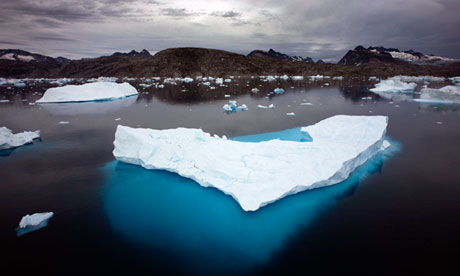
Arctic expert predicts final collapse of sea ice within four years

One of the world's leading ice experts has predicted the final collapse of Arctic sea ice in summer months within four years.

In what he calls a "global disaster" now unfolding in northern latitudes as the sea area that freezes and melts each year shrinks to its lowest extentever recorded, Prof Peter Wadhams of Cambridge University calls for "urgent" consideration of new ideas to reduce global temperatures.

In an email to the Guardian he says: "Climate change is no longer something we can aim to do something about in a few decades' time, and that we must not only urgently reduce CO2 emissions but must urgently examine other ways of slowing global warming, such as the variousgeoengineering ideas that have been put forward."

These include reflecting the sun's rays back into space, making clouds whiter and seeding the ocean with minerals to absorb more CO2.

Wadhams has spent many years collecting ice thickness data from submarines passing below the arctic ocean. He predicted the imminent break-up of sea ice in summer months in 2007, when the previous lowest extent of 4.17 million square kilometres was set. This year, it has unexpectedly plunged a further 500,000 sq km to less than 3.5m sq km. "I have been predicting [the collapse of sea ice in summer months] for many years. The main cause is simply global warming: as the climate has warmed there has been less ice growth during the winter and more ice melt during the summer.

"At first this didn't [get] noticed; the summer ice limits slowly shrank back, at a rate which suggested that the ice would last another 50 years or so. But in the end the summer melt overtook the winter growth such that the entire ice sheet melts or breaks up during the summer months.

"This collapse, I predicted would occur in 2015-16 at which time the summer Arctic (August to September) would become ice-free. The final collapse towards that state is now happening and will probably be complete by those dates".

Wadhams says the implications are "terrible". "The positives are increased possibility of Arctic transport, increased access to Arctic offshore oil and gas resources. The main negative is an acceleration of global warming." More


Sunday, September 16, 2012

Growth Is the Problem

The ceaseless expansion of economic exploitation, the engine of global capitalism, has come to an end. The futile and myopic effort to resurrect this expansion—a fallacy embraced by most economists—means that we respond to illusion rather than reality. We invest our efforts into bringing back what is gone forever.

This strange twilight moment, in which our experts and systems managers squander resources in attempting to re-create an expanding economic system that is moribund, will inevitably lead to systems collapse. The steady depletion of natural resources, especially fossil fuels, along with the accelerated pace of climate change, will combine with crippling levels of personal and national debt to thrust us into a global depression that will dwarf any in the history of capitalism. And very few of us are prepared.


“Our solution is our problem,” Richard Heinberg, the author of “The End of Growth: Adapting to Our New Economic Reality,” told me when I reached him by phone in California. “Its name is growth. But growth has become uneconomic. We are worse off because of growth. To achieve growth now means mounting debt, more pollution, an accelerated loss of biodiversity and the continued destabilization of the climate. But we are addicted to growth. If there is no growth there are insufficient tax revenues and jobs. If there is no growth existing debt levels become unsustainable. The elites see the current economic crisis as a temporary impediment. They are desperately trying to fix it. But this crisis signals an irreversible change for civilization itself. We cannot prevent it. We can only decide whether we will adapt to it or not."


Heinberg, a senior fellow at the Post Carbon Institute, argues that we cannot grasp the real state of the global economy by the usual metrics—GDP, unemployment, housing, durable goods, national deficits, personal income and consumer spending—although even these measures point to severe and chronic problems. Rather, he says, we have to examine the structural flaws that sit like time bombs embedded within the economic edifice. U.S. household debt enabled the expansion of consumer spending during the boom years, he says, but consumer debt cannot continue to grow as house prices decline to realistic levels. Toxic assets litter the portfolios of the major banks, presaging another global financial meltdown. The Earth’s natural resources are being exhausted. And climate change, with its extreme weather conditions, is beginning to exact a heavy economic toll on countries, including the United States, through the destruction brought about by droughts, floods, wildfires and loss of crop yields.

Heinberg also highlights what he calls “the highly dysfunctional U.S. political system,” which is paralyzed and hostage to corporate power. It is unable to respond rationally to the crisis or solve “even the most trivial of problems.”

“The government at this point exacerbates nearly every crisis the nation faces,” he said. “Policy decisions do not emerge from deliberations between the public and elected leaders. They arise from unaccountable government agencies and private interest groups. The Republican Party has taken leave of reality. It exists in a hermetically sealed ideasphere where climate change is a hoax and economic problems can be solved by cutting spending and taxes. The Democrats, meanwhile, offer no realistic strategy for coping with the economic unraveling or climate change."

The collision course is set. It is now only a matter of time and our personal response. More


Saturday, September 15, 2012

Without nuclear, the battle against global warming is as good as lost

A madness is taking hold. In the same week as Arctic ice cover is recorded at its lowest ever extent, two major countries decide to reduce or eliminate their use of the only proven source of low-carbon power that can be deployed at sufficient scale to tackle our climate crisis.

Japan plans to phase out nuclear entirely by 2030, its prime minister announced today. The French president has just revealed a plan to dramatically reduce the country's reliance on nuclear, which currently gives France some of the cleanest electricity in the world.

Let me be very clear. Without nuclear, the battle against global warming is as good as lost. Even many greens now admit this in private moments. We are already witnessing the first signs of the collapse in the biosphere this entails – with the Arctic in full-scale meltdown, more solar radiation is being captured by the dark ocean surface, and the weather systems of the entire northern hemisphere are being thrown into chaos. With nuclear, there is a chance that global warming this century can be limited to 2C; without nuclear, I would guess we are heading for 4C or above. That will devastate ecosystems and societies worldwide on a scale which is unimaginable.

Given the trauma the Japanese people have suffered since the earthquake and tsunami of 11 March 2011, it is understandable that major questions are asked of domestic politicians. But we must never forget that Fukushima has killed no one. More people in Japan recently died from an E coli outbreak due to eating contaminated pickles. Scientists also agree there will never be an observable cancer increase in the Japanese population attributable to Fukushima.

But in response to the nuclear shutdown, oil and gas imports to Japan have doubled, and carbon dioxide emissions soared by more than 60m tonnes. Any environmentalist who celebrates this outcome is not worthy of the name.

Japan is already backing away from its own climate change targets. As a participant in the UN climate negotiations last year, I watched this happen. Under the 2009 Copenhagen accord, Japan pledged to reduce CO2 emissions by 25% by 2020. The plan was to increase nuclear to half of national electricity in order to facilitate the carbon cuts, supported by an increase in renewables to 20% by 2030. To reach the same targets without nuclear is impossible; wind and solar combined meet barely 1% of electricity production today in Japan, and there is no way they can be deployed at sufficient scale to meet the gap. So the climate targets will be dropped, as Japan re-carbonises its economy.

It is nothing short of insane that politicians around the world, under pressure from populations subjected to decades of anti-nuclear fearmongering by people who call themselves greens, are raising our collective risk of catastrophic climate change in order to eliminate the safest power source ever invented. More


Wednesday, September 12, 2012

Strengthening the Institutional Framework for Sustainable Development (IFSD)

Strengthening the Institutional Framework for Sustainable Development (IFSD)

UNITAR E-Learning Course

5 November – 14 December 2012


Dear Colleagues,


The United Nations Institute for Training and Research (UNITAR) is pleased to announce the delivery of the e-learning course, “Strengthening the Institutional Framework for Sustainable Development”, which will take place from 5 November – 14 December 2012. Participants will learn about the current institutional architecture concerned with sustainable development, emerging policy issues requiring an effective institutional response, and political challenges to advance reform as reflected in the negotiations leading up to, and during the Rio+20 Conference.


Please feel free to disseminate information about this course through your networks, and do not hesitate to contact us (envgov@unitar.org) should you need any further information.


Sincerely,


The UNITAR Environmental Governance Programme Team


Background

Since the 1972 Stockholm Conference on the Human Environment, the institutional framework to address environment and sustainable development challenges has witnessed a steady growth in the number of institutions and agreements, with more than 500 multilateral environmental agreements currently in existence. Yet the continuing deterioration in the natural resource base and ecosystems, global climate change and persistent poverty raise doubts about the capacity of the institutional framework to address these challenges. The 2012 UN Conference on Sustainable Development (Rio+20) reaffirmed the need to strengthen the institutional framework for sustainable development (IFDS) and initiated specific action to foster more effective and coherent institutional responses.


Target Groups

The course targets groups and individuals that are interested in obtaining a general understanding about the theme of international sustainable development governance and latest developments. They include:

• Civil servants in national Ministries, provincial departments and local authorities

• Diplomats from Permanent Missions and Ministries of Foreign Affairs

• Environmental managers in private sector and civil society organizations

• Faculty, researchers and students

• Interested citizens


Learning Objectives

Participants will learn about the strengths and weaknesses of the current institutional architecture concerned with sustainable development, key emerging policy issues requiring an effective institutional response, and the political challenges to advance reform as reflected in the negotiations leading up to, and during the Rio+20 Conference.


After completing the course, participants will be able to:

• Explain sustainable development challenges demanding effective international institutions

• Outline key milestones of developing and reforming international institutions concerned with sustainable development

• Chart and analyze the current international IFSD

• Recognize linkages between international, national and sub-national sustainable development governance

• Analyze key policy issues relevant for the Rio+20 negotiations and beyond

• Assess options to strengthen the institutional framework for sustainable development


Methodology

The course pedagogy is adapted to professionals in full-time work. Participants are provided with the opportunity to learn through various experiences: absorb (read); do (activity); interact (socialize); and reflect (relate to one’s own reality). The total number of learning hours is 40 over a 6 week period. During weeks 1-5 the reading of an e-book is complemented by a range of learning activities and experiences that include interactive exercises, discussion forums, and an applied case study. Week 6 is reserved for wrap-up and completing course assignments.


Course Fee and Registration

The course participation fee is 600 USD. A small number of full/partial fellowships are available for participants from developing countries working in the public sector, academia or non-profit organizations. Priority for fellowships will be given to applicants from Least Developed Countries (LDCs).


Register at: http://www.unitar.org/event/strengthening-institutional-framework-sustainable-development-ifsd


For details please contact the UNITAR Environmental Governance Programme at: envgov@unitar.org


Registration Deadline: 28 October 2012.


Tuesday, September 11, 2012

Home: Our Survival Depends On Changing The Way We Live


We are living in exceptional times. Scientists tell us that we have 10 years to change the way we live, avert the depletion of natural resources and the catastrophic evolution of the Earth's climate. The stakes are high for us and our children. Everyone should take part in the effort, and HOME has been conceived to take a message of mobilization out to every human being. For this purpose, HOME needs to be free. A patron, the PPR Group, made this possible. EuropaCorp, the distributor, also pledged not to make any profit because Home is a non-profit film. HOME has been made for you : share it! And act for the planet. Yann Arthus-Bertrand HOME official website www.home-2009.com PPR is proud to support HOME http HOME is a carbon offset movie www.actioncarbone.org More information about the Planet http

Sunday, September 9, 2012

African farmers must do more to beat climate change -study

OSLO, Sept 7 (Reuters) - African farmers are finding new ways to cope with droughts, erosion and other ravages of climate change but need to develop even more techniques to thrive in an increasingly uncertain environment, scientists said on Friday.

Smallholders have started to plant more drought-resistant and faster-growing crops to keep the harvests coming in, according to a survey of 700 households in Kenya, Ethiopia, Uganda and Tanzania.

"The good news is that a lot of farmers are making changes," said Patti Kristjanson, who heads a programme on climate change, agriculture and food security at the World Agroforestry Centre in Nairobi and led the study.

"So it's not all doom and gloom ... but much more needs to be done," she told Reuters.

Farmers, backed by researchers and international donors, needed to find better ways to store rain water, increase the use of manure and bring in hardier crops like sweet potatoes, she said.

In the past decade, 55 percent of households surveyed said they had taken up faster-growing crop varieties, mainly of maize, and 56 percent had adopted at least one drought-tolerant variety, according to the findings in the journal Food Security.

FIGHTING EROSION

Fifty percent of the households were planting trees on their farms - helping to combat erosion, increase water and soil quality and bring in new crops like nuts.

Half of the farmers had introduced inter-cropping - planting alternate rows of, for instance of beans and maize, in the same field and then swapping the rows next season. Beans fix nitrogen in the soil, helping reduce the need for fertilisers.

But Friday's study found just a quarter of farmers were using manure or compost - avoiding the use of more expensive fertilisers. And only 10 percent were storing water, it added.

The study said that global warming, leading to erosion, less reliable rainfall and changes in the length of growing seasons, was adding to other stresses for farmers worldwide such as price spikes and a rising population. More